By GM Farhadul Majumder and Md Delwar Hossain (Dhaka Bureau)
A certain quarter is recently engaged in propagating false, anti-military, and anti-state narratives from both inside and outside the country, with the aim of creating a rift between the Bangladesh Army and its citizens. It is learned that the interim government led by Professor Muhammad Yunus and the Bangladesh Army is fully aware of this quarter’s objectives.
A source from Bangladesh’s security apparatus indicated that several groups involved in this anti-state false propaganda have already been identified, and investigations into them have begun. These ‘matchmakers of darkness’ who are criticizing the Bangladesh Army are under surveillance. Furthermore, counter-measures have been implemented to suppress the ‘anti-state propaganda’ concerning the Bangladesh Army circulating on social media and other online platforms.
In this regard, the Ex-Forces Association (EFA), an organization of retired officers of the Bangladesh Armed Forces, has warned that the ‘coordinated false information campaign’ is designed to erode public trust in the military. Simultaneously, the EFA has urged the media to verify information and play a responsible role in maintaining national harmony.
Meanwhile, Lieutenant (Retd.) Saifullah Khan Saif, General Secretary of the EFA, has called upon the concerned government authorities to take action against those propagating false content. He emphasized that ‘no propaganda can isolate patriotic citizens from the nation’s protectors.’
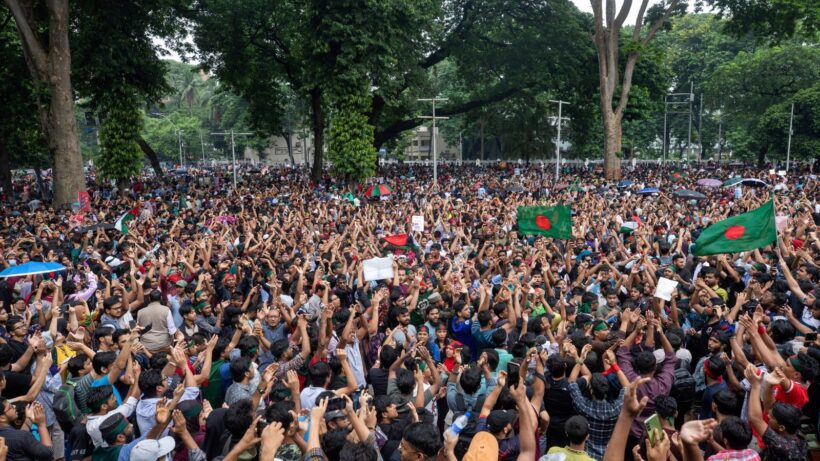
Bangladesh student protest.. Tensions between students and the public on the streets increased as protesting student leaders rejected then Prime Minister Sheikh Hasina’s call for dialogue. The image covers the entire area of the Central Shaheed Minar. Image courtesy of Google.
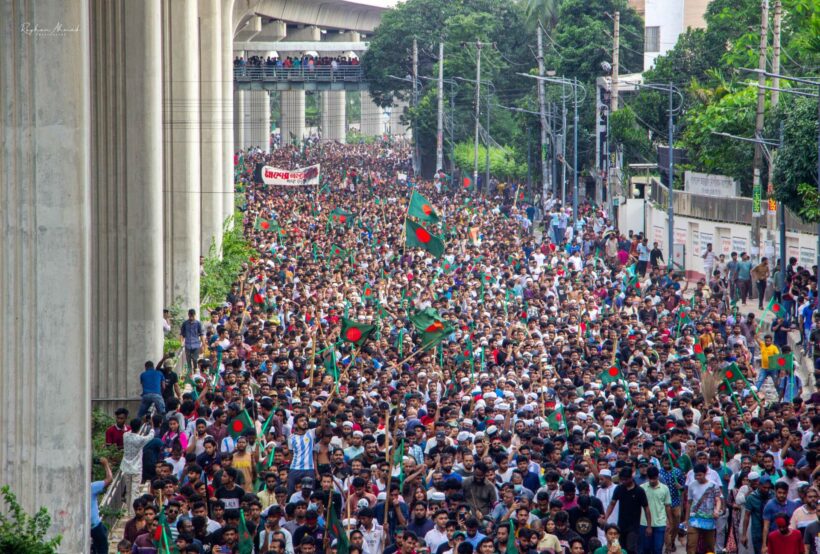
Victory procession after Sheikh Hasina’s resignation at Shahbagh, Dhaka. Image courtesy of Google.
It is noteworthy that following the student-people’s ‘July Revolution’ in Bangladesh last year (July-August), the Bangladesh Army stood by the interim government and the people to maintain overall law and order and stability in the country. On the other hand, some activists are also criticizing the Army, pointing to its perceived critical role.
Meanwhile, the country’s politicians do not agree with the activists’ criticism of the Army. They assert that Bangladesh’s national security force is a symbol of the nation’s dignity. According to experts, a group of online activists, most of whom are expatriate Bangladeshis, is being criticized for allegedly damaging the image of the Bangladesh Army and escalating the country’s political tensions.
Analysts and senior political figures argue that such criticism of the Army undermines national dignity and cohesion. They warn that these actions directly contribute to the ongoing political instability in Bangladesh. They called for restraint, stressing that targeting the armed forces not only weakens a vital national institution but also threatens the country’s unity and social harmony.
Sources reveal that several exiled Bangladeshi activists are attempting to influence the country’s internal politics by running critical online campaigns regarding the Army’s role in sensitive political issues. In recent months, activists active from abroad- including Zulkarnain Saer Khan (UK), Pinaki Bhattacharya (France), Elias Hossain, Dr. Kanak Sarwar, and Sumi Khan (USA) and Tasneem Khalil (Sweden)– have been using social media platforms to shape public opinion and deepen Bangladesh’s political divisions.
Recently, these activists have intensified their focus on Army-related issues, raising allegations against senior officers, questioning the alleged house arrest of personnel, and the military’s involvement in politics. Their posts often mix investigative-style claims, warnings, and sharp political commentary. Opposition-backed groups and sympathetic media outlets have further amplified these messages, escalating tensions on the ground.
Political leaders express concern that it is unfair to damage the image of the Bangladesh Army based on the actions or beliefs of a few allegedly partisan individuals.
Salahuddin Ahmed, a member of the BNP Standing Committee, told this correspondent, ‘The Bangladesh Army as an institution is a symbol of our national pride. Damaging its image is unacceptable and disrespectful to the entire institution.” He urged everyone to refrain from such harmful behavior.’
Advocate Ehsanul Mahbub Zobaer, spokesman for Bangladesh Jamaat-e-Islami, said, ‘While social media is an open space for expression, activists should avoid attacking the Army, which remains a symbol of national unity and dignity.’ He called on all citizens to uphold the integrity of the institutions that symbolize the country’s unity.
Comrade Saiful Haque, General Secretary of the Revolutionary Workers Party, expressed similar views, stating, ‘The Bangladesh Army was an essential ally in our July Revolution. It deserves our respect.’ He urged activists not to seek online popularity by targeting national institutions, but rather to bring the real culprits to accountability.
Sources further indicate that Zulkarnain Saer Khan has posted detailed threads and updates on Facebook and X handle (formerly Twitter), where he shares purported internal details concerning senior Army officers, their movements, and their alleged involvement in politically sensitive activities. These are often presented as links or analytical insights into the Army’s political role. These posts have been widely shared and have been vehemently contradicted by government-backed social media pages, which question their veracity.
Pinaki Bhattacharya’s tweets and YouTube content mention alleged connections between senior military officers and informal political figures, claiming that the ‘top leadership of the Armed Forces is acting alarmingly.’ His content often carries an urgent tone, calling for political awareness and mobilization against what he perceives as military overreach. However, government-backed media outlets have accused him of spreading intimidating and destabilizing narratives.
Journalist Kanak Sarwar uses his YouTube channel and social media pages to publish interviews, alleged cases of abuse by security forces, and commentary on his reporting related family and detention incidents. While state-backed media and some political figures label his content as ‘anti-state’ and misleading, human rights and press freedom groups view the harassment of his family as part of a wider crackdown on dissident journalists.
Similarly, Elias Hossain has used video content to make similar claims about the activities of law enforcement and security agencies. Other activists have followed similar methodologies, often influencing political discourse with sharp criticism of the country’s defense establishments.
In addition to politicians, common people also believe that the Army is a symbol of the country’s dignity and unity, and therefore, criticism of the Army should be avoided. A 50-year-old businessman from the capital said, “While the wrongdoings of Army officers may not be acceptable, blaming the entire force due to the mistakes of a few personnel should not be welcomed.”
The Authors: Contributors, Dhaka Bureau
GM Farhadul Majumder

Md Delwar Hossain

Edited by: Sheikh Arif, Panel Editor, Dhaka Bureau.