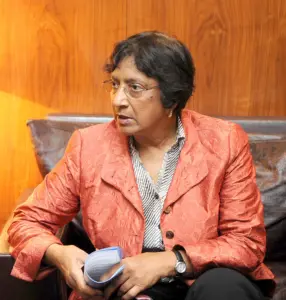
Ali Abu Awwad, known as the Palestinian Gandhi[1], spoke on November 6 at the Arab World Institute in Paris, at the initiative of the “Warriors of Peace[2].” This article is a summary of the remarks made by this “relentless advocate for peace” and justice, who is still relatively unknown among French activists and politicians who take a stance on the Israeli-Palestinian conflict.
Ali Abu Awwad was born in the West Bank to a family of Fatah activists, his mother even working alongside Yasser Arafat. He was imprisoned several times, notably in 1993 along with his mother. Both went on hunger strike, which proved successful. This experience led him down the path of non-violence, which was further reinforced by various encounters, despite the subsequent death of his brother, who was killed by Israeli soldiers’ bullets.
By Sabine Rubin
How did you come to embrace nonviolence given your militant past with the Palestine Liberation Organization (PLO) and the death of your brother?
It is necessary both not to consider oneself a victim and to perceive the humanity in others. This implies recognition of the other, which is an essential starting point for building a solution.
This recognition requires understanding the other, the beliefs that form the basis of their identity. For example, settlers do not see themselves as settlers; similarly, Palestinian activists do not see themselves as terrorists but as people demanding justice. As these identities cannot be changed, they must be understood and respected by both sides.
On the other hand, we cannot recognize the behaviors and actions committed by either side. Neither side tolerates these actions, but we must not succumb to revenge.
There are therefore three steps to reconciling with these unacceptable acts committed by one’s enemy:
1/ mutual recognition of the pain they cause each other;
2/ a political plan that reflects this mutual recognition of each other’s existence (the Israelis want Palestinians but not Palestine, and vice versa);
3/ a regional reconciliation movement.
Today, the trauma is collective, and Israelis remain very aggressive. Therefore, in order to advance nonviolent thinking, we must be on the ground, close to the people.
How does one’s enemy become a victim?
Ali Abu Awwad testifies that, while he was still part of the PLO leadership, he received a phone call from a Jewish man who had just lost his son, killed by Hamas, asking him to accompany him in his grief. His mother agreed to welcome this man: for the first time, he saw Israelis in tears coming to them.
Furthermore, his experience of hunger strikes in prison and the studies he undertook during his years of imprisonment (like many Palestinians, he learned a great deal in prison) enabled him to understand that non-violence worked: if he himself saw Israelis as victims, then he thought that they could also see his humanity.
However, his life is not easy: Palestinians see him as a traitor; Israelis see him as a “Palestinian.” Today, there are indeed two identities that cannot live together, a bit like Siamese twins: they have the same body but two heads, two minds.
However, since the Palestinians will not resign themselves to being refugees and the Israelis will not leave, the solution is:
1/ to recognize both identities;
2/ then to establish two states coexisting without subordination.
What should we think of Western societies and their mobilization?
We must first recognize and remember that, on the ground, Palestinians and Israelis are not equal. However, transposing the conflict in France between Jews and Arabs/Muslims is pointless. Without turning a blind eye to what Israel is doing, it is better to educate people and not reject Palestinians if you are pro-Israel, and vice versa. Finally, we must work with governments and politicians to get them to become partners in this nonviolent solution.
What does it mean to be a peace activist in the West Bank and how can we fight against extremists?
Even if the situation in the West Bank is not comparable to that in Gaza, it is very difficult: Israel is building roads that bypass villages, which are then closed off behind barriers at 5 p.m. There is a lack of water and education; it is very humiliating.
However, faced with the ideological and security confinement of the Israelis, the Palestinians’ response is neither to remain in their corner nor to respond with violence as Hamas does.
Understanding the fuel behind extreme ideologies, we must confront them with a concrete political plan underpinned by nonviolent methods.
More specifically, we must take control of communities to influence them positively and create a plan as a political alternative with things to gain. Today, it would be in people’s interest to fight corrupt leaders on both sides. Finally, international partnerships are important.
Answers to various questions from the public on:
The solution of a federated state – AAA – First, there must be two distinct states. In reality, there is already one nation/homeland with two peoples: Israelis are in the West Bank and Palestinians live in Israel. But the latter live under a form of occupation or suffer discrimination
The loss of confidence among Israelis following October 7 – AAA: In reality, Israel has long imprisoned people who work for peace. However, it is certain that the Gandhis and Luther Kings of the region will not come from the ranks of the Israeli government or Hamas, and that they must be approached with a strategy: fighting against the corrupt.
The role of religions in the conflict – AAA: This is a conflict with religious significance, not a religious conflict. Furthermore, the Palestinians want a secular state, as do some Israelis. The religious problem therefore lies with certain Israelis for whom Judaism is more than a religion: it is a political identity. However, some religious leaders (rabbis) are in favor of peace. He was struck by his encounter with an Israeli rabbi who refused to enter the home of a settler family displaying a banner that read “The land of Israel belongs to the people of Israel”; the rabbi even replied: “No, that is inaccurate and contrary to biblical texts and political common sense. The proposition must be reversed to say, ‘The people of Israel belong to the land of Israel,’ just as one could also say that the Palestinian people belong to that same land.”
Will Marwan Marghouti be released from prison? – AAA: Marwan is a symbol of the revolution. If he is released from prison, that’s a plus. But if we have a leader, it is to govern a state, not to make a revolution. We want a country in order to have peace. The Oslo Accords failed to address the issue of settlements and refugees… Two states make it possible to deal with both issues.
Notes
[1] See the website presenting the various actions he has initiated.
[2] The “Warriors of Peace” is a movement of women committed to peace, justice, and equality. Created in France, it brings together women of all origins and beliefs, particularly Jewish and Muslim women. It has been nominated for the 2025 Nobel Peace Prize.