Police are the foundation of a state’s law and order. Law enforcement agencies are central to public security, social peace, and crime suppression. But when the public begins to lose faith in this force, the overall stability of the state suffers.
by GM Forhadul Mozumder (Dhaka Bureau)
During the student-public uprising that took place in Bangladesh last year, the comprehensive anger of the general population was intensely directed not only at the autocratic ruling party leaders but also at the police. At that time, the police’s chain of command had broken down due to political subservience. As a result, the rule of law was widely questioned. Various events of the time- especially the excessive use of force against students during the movement, instability due to political loyalism, or accusations of excessive force- raised questions about the police’s image.
However, not all police members are bad; indeed, many have sacrificed their lives while performing their duties.
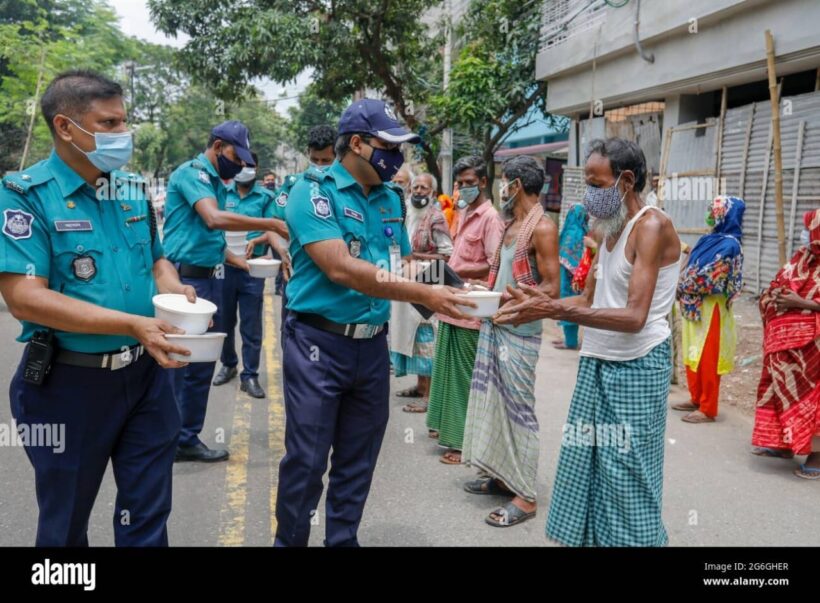
During the COVID-19 pandemic, the Bangladesh Police stood by the starving people with food to the best of their ability. Image: Courtesy of Police Department.
Nevertheless, some irregularities, weaknesses, and systemic flaws have tarnished the image of the entire force. It is urgent to overcome this situation, and for that, a cohesive, realistic, and humane action plan is necessary.
The first condition for restoring the police’s image is neutrality. The public will only believe the message that the law of the state is equal for everyone when they see that the police are not biased towards any particular party or group. If action is taken equally against any offender, irrespective of who they are, public trust in the police will rapidly increase. For this, a politically pressure-free environment and the creation of a strong ethical framework within the force are critically essential.
Secondly, the culture of excessive force must be controlled. When incidents of excessive force occur in managing protests or during any operation, prompt investigation, punishment of those responsible, and transparent disclosure of information are extremely important. When the public sees that mistakes are admitted and those responsible are punished, the belief that the law is equal for all is established.
Thirdly, building a humane relationship between the police and the public is now a demand of the time. The police station must be established as a place to seek service, not fear. If a citizen receives polite behavior, respect, and cooperation the moment they enter a police station, the initial perception is changed. Specifically, a safe environment for women, special assistance for the elderly and the poor, and humanity in receiving complaints- all these will enhance the prestige of the police.
Fourthly, Community Policing must be genuinely implemented. Regular meetings and dialogues in cities, villages, neighborhoods, awareness programs with students and the youth, and listening to local problems- these reduce the distance between the police and the public. If the police see people as partners, not enemies, social peace will naturally be established.
Fifthly, increasing the use of technology is essential. Body cams, CCTV, GPS tracking- these are effective not only in crime suppression but also in increasing the transparency of police work. Mandating the use of cameras during operations ensures the safety of both parties and facilitates the resolution of subsequent complaints.
Sixthly, the police force must adopt a strict stance against corruption. Strict surveillance and punishment are essential to stop bribery, broker rings, and harassing lawsuits. Only when corruption is stopped will the dignity of the police increase manifold.
In addition, providing quick service, promptness in emergencies, regular media briefings, complaint cells at the police station level, and transparent recruitment and promotion- all together, a combined effort can restore people’s lost confidence in the police.
Finally, the police are the state’s strength, but the people are the source of that strength. The stronger the police-public relationship, the more peaceful the society will be. Therefore, the time has come to rebuild the police’s image with trust instead of force, reliance instead of fear, and service instead of authority. If this roadmap is implemented, the Bangladesh Police can once again stand as the most reliable institution of public trust.
About the Author:

GM Forhadul Mozumder: Contributor of Pressenza, Dhaka Bureau.