By Maruf ul Alam (Dhaka Bureau)
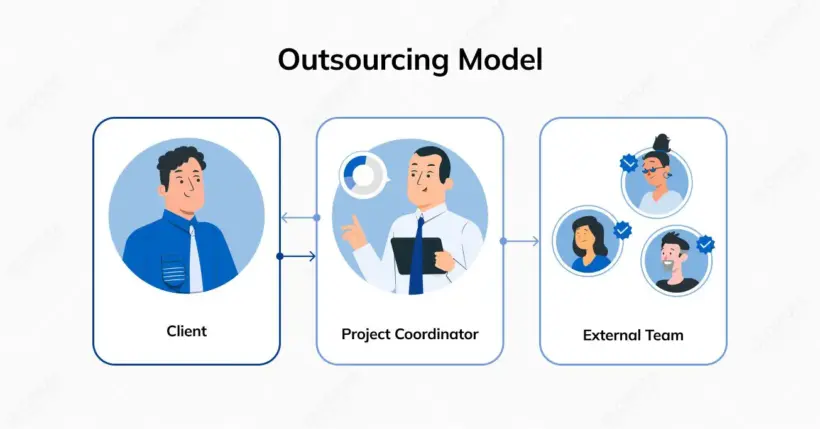
The use of outsourcing or contract-based employment in government offices has long been an effective method.
Limited revenue-funded positions, the need for rapid recruitment, and the advantages of project-based work have made the hiring of outsourced personnel a daily occurrence in a lot of government institutions. However, the hidden reality behind this system is different. Over the last few years, the lives of thousands of young people involved in this system have been plagued by terrible uncertainty, which many now refer to as the ‘Outsourcing Trap’.
Starting & Ending with a Project
Since 2000, numerous outsourced workers have been employed in various government ministries, directorates, autonomous bodies, and even local governments. They are usually hired on contracts of 1 to 3 years, with renewals if necessary. But the problem is: once the project ends, the majority of the workers lose their jobs. Even after working in the same office for five, sometimes seven years, they remain ‘temporary’ staff. New positions are not created, they are not made permanent, and there is no structure for evaluating their experience. They receive none of the benefits of government service, such as a pension, permanent pay grade, or future security. As a result, the moment the project concludes, they are practically relegated to the ranks of the unemployed.
Experienced, But No Future
Due to the scarcity of employment in Bangladesh, many initially considered outsourcing jobs as an ‘entry-point’. They believed that after working for a few years, the government might offer them permanent job opportunities based on their experience. The reality, however, is that there is still no clear mention in any central policy of the country that outsourced personnel who have served in government offices for a long time will be transitioned to the revenue sector, given priority in recruitment, or have their skills recognized. Consequently, countless skilled young people work every day under the fear of losing their jobs. Some of them, reaching 30-35 years of age, are forced to re-enter the labor market and compete anew—a task that is practically impossible.
Social and Mental Pressure
Job uncertainty is not just creating financial problems; it is triggering a major social crisis. Many run their families by taking bank loans, and when projects end, the burden of these loans increases. Unknown fears arise concerning family formation, children’s education, and healthcare. Many young people suffer from mental stress due to the lack of certainty about their own existence, despite working in the same office for a long time.
In the words of one employee, “Whether there is a job or not— the same fear every time the contract is renewed. Yet, I do the same work as the permanent employee sitting at the same desk.” An office assistant from the Passport and Immigration Office under the Ministry of Home Affairs stated that after working for five years under the outsourcing method, his contract was not renewed, making him unable to bear his family’s expenses. He is now trying to earn a meager living by acting as a middleman (broker) in the same office, which he describes as an unbearable mental strain.
Some Government Initiatives Exist, But Are Not Enough
In April 2025, the government formulated a policy that included some benefits, such as increasing the service fee for outsourced workers, providing festival bonuses, and maternity leave. This is undoubtedly a positive step— but this policy does not solve either the issue of ‘legitimacy for permanent employment’ or the ‘future of the worker after the project ends’.
Experts say it is essential to create a database of experienced personnel working in this sector. It is extremely important to evaluate those who have served for 3-5 years or more and provide them with priority in recruitment and skill certification. Furthermore, without a specific ‘Transition Pathway’ to the revenue sector, no one will be able to escape the outsourcing trap.
National Waste of Human Resources
In Bangladesh, many skilled workers are laboring for years in critical tasks such as IT, administrative systems, data management, and project implementation. But when they become jobless as soon as the project ends, the country is unable to fully utilize their expertise. This can be termed the ‘waste of human resources’, which has a negative impact on the country’s administrative capacity in the long run.
The Path to Solution

Members of the Bangladesh Outsourcing Employees’ Unity marched in protest and burned an effigy symbolizing the ‘contractor slavery system’ in Dhaka, Bangladesh, on September 24, 2025. They demand direct institutional recruitment, an end to outsourcing and daily wage-based employment, and job security for workers. (Photo: Collected).
According to policymakers, three major decisions would simplify the solution: 1. Creating an opportunity for outsourced workers who have provided service for 3-5 years or more to be made permanent or transitioned to the revenue sector on a special priority basis. 2. A national evaluation system to verify the skills and experience of all outsourced workers. 3. Rehabilitation or re-employment support for workers after a project ends, such as a Transition Fund or priority in new projects.
Finally, a segment of Bangladesh’s large youth population is suffering from an invisible crisis due to the outsourcing system. They are dedicating their skills and lives to the service of the country, but in return, they receive only uncertainty. Outsourcing can be an effective method for rapid recruitment, but ‘keeping the youth force in limbo’ through it is by no means sustainable development.
To protect the future of the youth society, ensuring ‘long-term certainty, skill recognition, and job security’ for outsourced workers is an immediate demand of the time.

About the Author:
Maruf ul Alam: Staff Correspondent & Head of Support Service- Pressenza, Dhaka Bureau.