by Genevieve Balance Kupang
Every February, Baguio City transforms into a living canvas of chrysanthemums, gladioli, roses, asters, orchids, among others. A million petals sway in the highland breeze. Panagbenga, the Baguio Flower Festival, derives its name from the Kankanaey word meaning “a season of blooming” (Baguio Flower Festival Foundation, Inc. [BFFFI], 2024). Conceived in 1995 by lawyer Damaso E. Bangaoet, Jr. as a community response to the 1990 Luzon earthquake devastation, the festival has grown into one of the Philippines’ most celebrated cultural events, drawing thousands of visitors annually to its grand float parades, street dancing, and landscape exhibitions (Rappler, 2024). Managed by the BFFFI, the festival is a proud member of the International Festival and Events Association (IFEA), reflecting its stature as a benchmark for excellence in cultural festival management (BFFFI, 2024). Through the years, the festival has grown in scale and grandeur. The 2024 Grand Float Parade featured a record 34 flower floats along Session Road, drawing an estimated 32,000 visitors (PNA, 2025).
Yet behind every floral-draped float and bouquet purchased by a visitor are soil-darkened, sun-kissed, industrious hands that wake before dawn and read the weather in the clouds over La Trinidad valley. These are the hands of Benguet’s flower growers. We celebrate them as significant partners of our festivities, and the very source of our highland bloom.
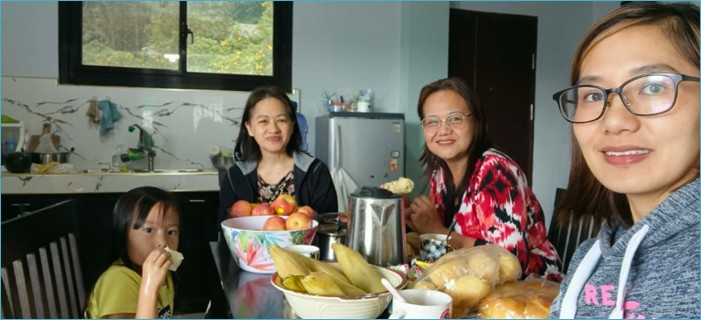 Before the garden walk and interview, the morning began with a generous welcome. Over a sumptuous breakfast at the Wakat residence in Bineng, La Trinidad, Benguet, Zoe Wakat, Dr. Jocelyn Nitron, Dr. Genevieve Balance Kupang, and host Dr. Irene Wakat gathered around a table before a day of flowers and stories.
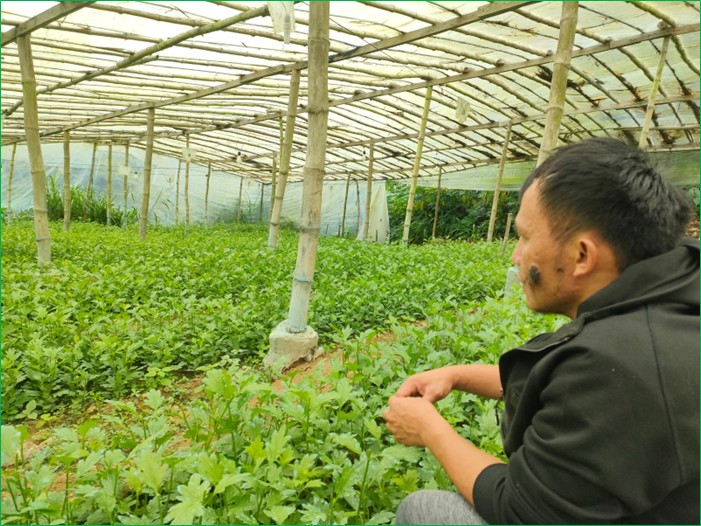 Mark S. Wakat sits quietly before his planted chrysanthemum beds, a moment of reflection, a silent prayer, that this next batch will bloom and bring his family another season of abundance. The seedlings were replanted just weeks before this visit. (Photo: Dr. Genevieve Balance Kupang)
Lessons from Mr. Mark Sapigao Wakat
We owe our gratitude to Benguet’s flower growers. In the rich mountain soil of Kagiskis, Bineng, La Trinidad, Dr. Jocelyn Nitron and I had the privilege of visiting the garden of Mr. Mark Sapigao Wakat and his wife, Dr. Irene Wakat. Walking through their rows of Malaysian chrysanthemums (Chrysanthemum morifolium), Wakat shared his knowledge of cultivation from cuttings, fertilization schedules, pest management, and how these blooms are harvested at stages of maturity for both local and Manila floral markets. I gathered that growers embody a sacred trust between grower and land (personal conversations with Wakat, December 8, 2025). His mastery of managing fungal disease during humid highland months, and his insight into the critical timing of photoperiod manipulation or photoperiodism control (1. Light Deprivation/Blackout Treatment; 2. Supplemental Lighting/Night Break Treatment) and harvest, represents knowledge accumulated across years of devoted, hands-on practice.
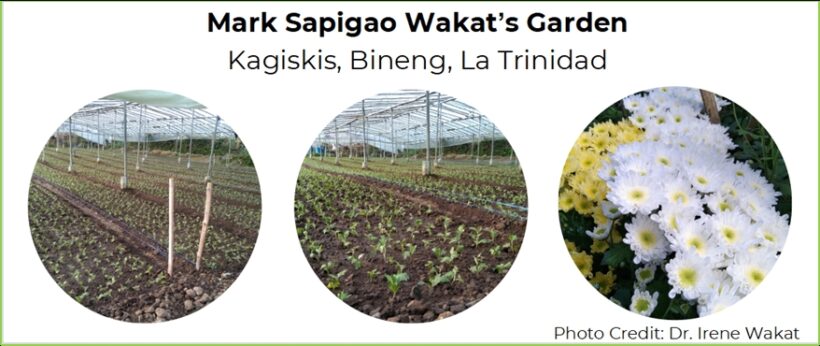 The Malaysian mum thrives in Benguet’s cool climate and commands market value for its long vase life and vibrant color palette. Chrysanthemum production is concentrated in La Trinidad barangays Bineng, Beckel, Ambiong, Lubas, and Shilan, and in municipalities like Atok, Tublay, and Kibungan (DOST-PCAARRD, 2019).
The province produces an average yearly output of 1.59 million dozen chrysanthemums alone, affirming its stature as a national floriculture hub (Baguio Herald Express, 2024). DOST-PCAARRD, in partnership with Benguet State University and the La Trinidad Cutflowers and Ornamentals Growers Association (LaTCOGA), has funded Good Agricultural Practices (GAP) programs that have enhanced yield, quality, and climate resilience for these farmers, a model of applied science meeting indigenous cultivation wisdom (DOST-PCAARRD, 2019).
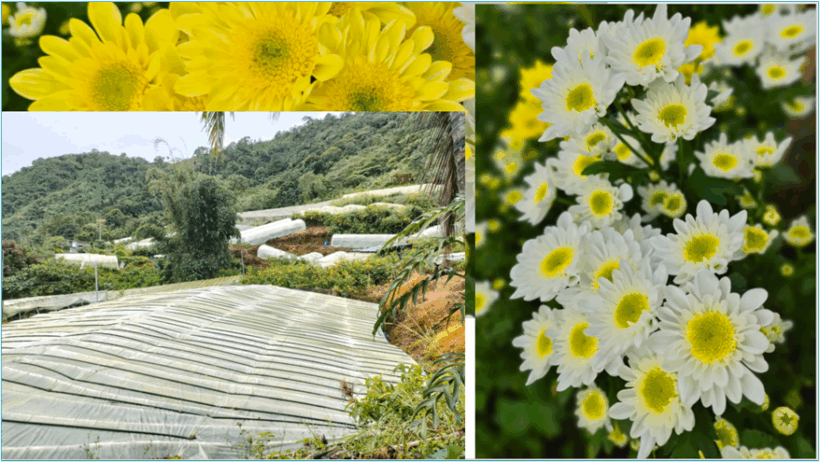 Inside the growing structures of the Wakat garden in Bineng. They are chrysanthemum beds at varying stages: freshly transplanted seedlings in nursery bays, juvenile plants in vegetative growth, and maturing stems approaching bloom. The structures are carefully engineered: bamboo poles sourced from Pangasinan form the framework, UV-resistant polyethylene film imported from China serves as cladding to shield crops from rain, wind, and temperature fluctuations, while a network of metal wires and supplemental grow lights lines the interior, essential for photoperiod manipulation that triggers and controls flowering. What appears simple from the outside is, on the inside, a precision growing environment.
Floriculture as Livelihood: The Economics of a Highland Industry
The Philippine floriculture market is projected to grow at approximately 6% annually, driven by rising consumer demand for chrysanthemums, roses, and lilies for gifting, decoration, and tourism (Baguio Herald Express, 2024). Benguet sits at the center of this growth: in 2022, the province’s cut flower gardeners produced close to 150 million dozen flowers across 6,765 hectares, a 32% rebound from pandemic lows, supplying both Panagbenga’s float industry and Manila markets, including the renowned Dangwa flower district (Inquirer, 2023). In applying the Cobb-Douglas production function to Philippine floriculture through our Master of Management group report on Shahzad Flower Farms, we found that labor (L) is the dominant input, reflecting the sector’s labor-intensive character (Paunlagui & Elazegui, 2021), while capital investments in greenhouses and irrigation systems play an essential supporting role (De Ocampo et al., 2022). Benguet’s cool mountain climate and soil confer a Total Factor Productivity advantage for temperate flower varieties, though growing technological adoption is shifting output elasticities over time (Rola et al., 2020; Matalog et al., 2024).
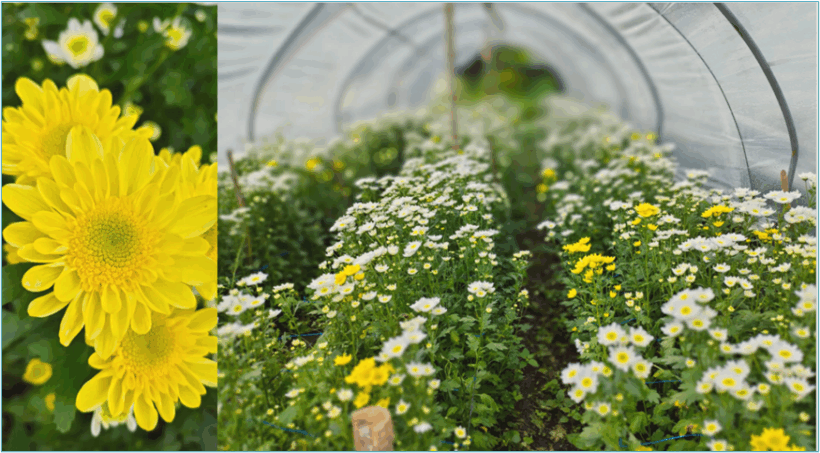 In full bloom. Yellow and white Malaysian Mums, the variety that has made Benguet a vital source of cut flowers for Luzon markets.
Global Parallels and Strategic Lessons from Shahzad Flower Farms
Our academic case analysis of Shahzad Flower Farms in Punjab, Pakistan, revealed instructive parallels for Benguet’s floriculture. The farm operates on a contract farming model that provides farmers with inputs, technical guidance, and guaranteed purchasing, a model worthy of adaptation in the Philippine highland context. An econometric Cobb-Douglas model (R² = 0.66) found that farmer experience, fertilizer application, and pesticide management are significant positive determinants of gladiolus yield, while excessive irrigation reduces output, a dynamic Wakat confirmed for chrysanthemum cultivation, where overwatering during the rainy season is a common pitfall. Globally, cut flowers ranked as the world’s 346th most traded product in 2019, with a total trade value of US$8.9 billion; as Mendoza et al. (2023) confirm, developing countries, including the Philippines, have assumed roles in the floriculture trade. Critically, Philippine horticultural output is driven more by human knowledge and care than by machinery, with labor elasticity consistently exceeding that of capital across production models (Mendoza et al., 2023; Matalog et al., 2024).
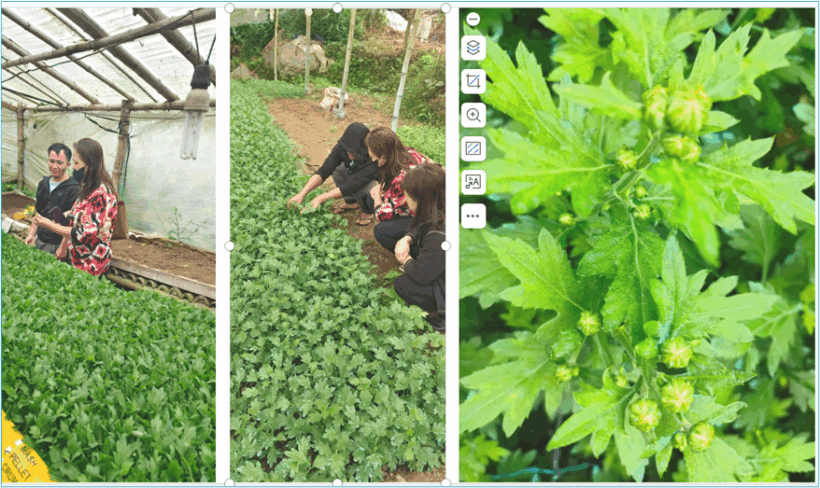 Mr. Wakat walks interviewers Dr. Kupang and Dr. Nitron through the essentials of chrysanthemum cultivation: seedling propagation, drip or furrow irrigation, manual weeding, integrated pest management, optimizing natural light exposure, and using shade nets or black plastic covers to regulate photoperiod, carefully controlling plant height and bloom timing. Every stage demands close attention. In Benguet’s flower industry, good blooms are not left to chance.
From Highland to Metro Manila: The Malaysian Mum’s Journey
Benguet’s Malaysian mums, harvested at precise stages of bloom maturity and bundled carefully, are loaded onto trucks descending Kennon Road or Marcos Highway toward the lowlands, arriving at Manila’s Dangwa market and the flower stalls of Cubao and Divisoria. This supply chain sustains farm families. Market linkages are both a strength and a vulnerability: Valentine’s Day, All Saints’ Day, events like weddings and graduation season bring premium prices, while typhoons and transport disruptions cascade through farm households. Robust cold chain logistics, fair pricing mechanisms, and sustained market access are business concerns.
A Call for Recognition and Institutional Action
As we celebrate Panagbenga each February, as we photograph the floats and cheer the street dancers, let us carry conscious gratitude for those who made it all possible. The farmers of La Trinidad, Tublay, Kapangan, Mankayan, Kabayan, and Atok do not take bows at the opening ceremony. By the time the festival begins, they are already back in their gardens, tending the next harvest. As BFFFI President Frederico Alquiros declared at the 2025 launch, “Panagbenga is our pride, identity, and collective story,” a story first written in Benguet’s soil (PNA, 2025).
Private institutions, government agencies, universities, and local government units can improve the condition of highland growers through: expanded farming with technical support for smallholders; investment in post-harvest cold chain infrastructure; farmer mentorship programs pairing experienced growers with new entrants; and participation in international floriculture exchanges (Kupang et al., 2025). The DOST-PCAARRD GAP program in La Trinidad has demonstrated this pathway’s effectiveness. Scaling these interventions, sustaining budget allocations, and building grower cooperatives can position Philippine highland floriculture more competitively and more equitably within the global floral value chain.
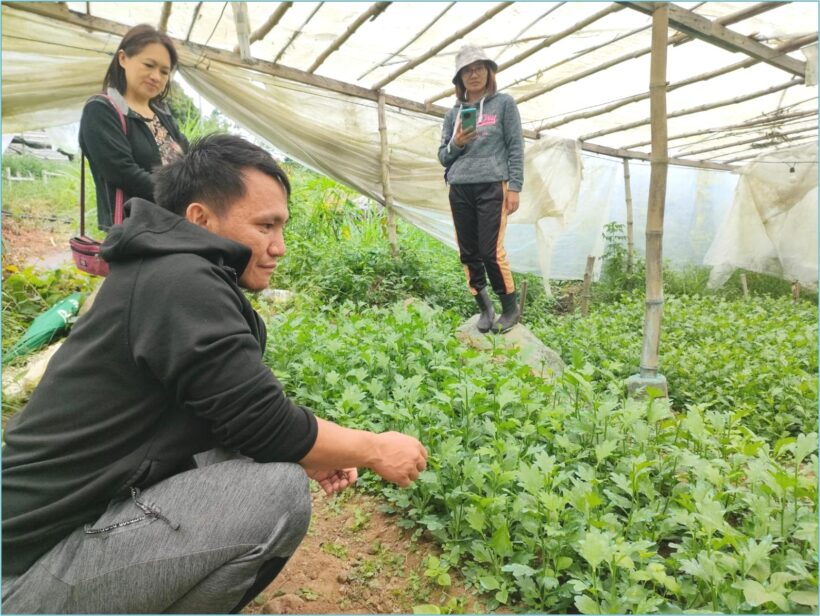 Two academics and a master cultivator: Dr. Jocelyn Nitron and Dr. Irene Wakat observe a bed of newly planted Malaysian Mums alongside grower Mark Wakat.
The Flower Is Not Possible Without the Farmer
Panagbenga is Baguio’s love letter to itself. It is a declaration of beauty, resilience, and community. But every love letter is carried by hands before it reaches the beloved. The hands that carry this one belong to growers like Mr. Mark Sapigao Wakat, whose garden in Kagiskis stands as a testament to dedication, ecological knowledge, and love of the land. My visit reminded me that behind every bloom is a dedicated floral gardener who chose to put their faith in the soil, seasons, and in the enduring human need for beauty.
As February closes, let us make a conscious choice: to see the grower in every flower, to honor the labor in every petal, and to support, through appreciation, policy, patronage, and partnership — the gardeners whose hands make the season of blooming possible. Peace, force, and joy to all who tend the earth so that others may celebrate it.
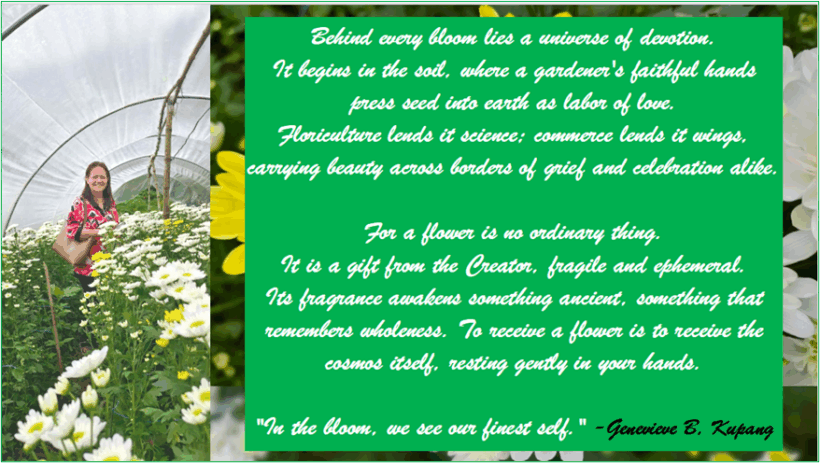 Surrounded by towering Malaysian Mums ready for harvest, Genevieve Balance Kupang takes a moment inside one of the Wakat growing structures in Bineng. A lifelong learner where curiosity and scholarship meet the soil, it was her Master’s in Management class who inspired her to step beyond the classroom and into the gardens, to sit down with flower cultivator Mark S. Wakat himself.
##########
References:
Baguio Flower Festival Foundation, Inc. (BFFFI). (2024). Panagbenga: The Baguio Flower Festival Official Website. https://www.panagbengaflowerfestival.com/about-us/
Baguio Herald Express. (2024, June 4). Cut-flowers stamp mark as dollar earner. https://baguioheraldexpressonline.com/cut-flowers-stamp-mark-as-dollar-earner/
Kupang, G. B., Dawaton, J., & Sto. Domingo, J. C. (2025). A case analysis of the Shahzad Flower Farms in managerial economics [Unpublished academic report]. University of the Philippines Baguio.
De Ocampo, A., Reyes, M., & Santos, L. (2022). Capital investment and productivity in Philippine ornamental horticulture. Philippine Journal of Agricultural Economics, 14(2), 45–63.
Department of Science and Technology – Philippine Council for Agriculture, Aquatic and Natural Resources Research and Development (DOST-PCAARRD). (2019). Benguet chrysanthemum growers to gain production best practices through PCAARRD project. https://www.pcaarrd.dost.gov.ph
Inquirer News. (2023, February 14). Supply of Benguet flowers enough for Valentine’s, fest. https://newsinfo.inquirer.net/1729362
Matalog, R., Buan, C., & Fontanilla, P. (2024). Technological adoption and shifting elasticities in smallholder floriculture: Evidence from Benguet. Journal of Philippine Agriculture and Natural Resources, 6(1), 78–94.
Mendoza, A., Cruz, J., & Villanueva, T. (2023). Labor-capital dynamics in Philippine horticulture: A production function perspective. Southeast Asian Agricultural Review, 11(3), 101–117.
Paunlagui, M. M., & Elazegui, D. D. (2021). Labor intensity and productivity in Philippine flower farming: Implications for rural development policy. Philippine Institute for Development Studies Discussion Paper Series, No. 2021-08.
Philippine News Agency (PNA). (2025, January 31). All systems go for Panagbenga 2025. https://www.pna.gov.ph/articles/1242971
Rappler. (2024, February 1). Baguio’s Panagbenga fest returns with floral display ahead of grand parade. https://www.rappler.com/philippines/luzon/baguio-panagbenga-festival-returns-february-1-2024/
Rola, A. C., Jamora, N., & dela Cruz, P. (2020). Total factor productivity in Philippine agriculture: Drivers and determinants. SEARCA Agriculture and Development Discussion Paper, 2020(3), 1–42.
Wakat, M. S. (2025, December). [Personal interview on Malaysian chrysanthemum cultivation and marketing at Kagiskis Flower Garden, Bineng, La Trinidad, Benguet]. Interview conducted by G. B. Kupang.
Photo Credits: Jocelyn Nitron, Irene Wakat, and Genevieve B. Kupang
About the Author:
Genevieve B. Kupang is a lifelong learner, cultural mapper, and applied cosmic anthropologist specializing in indigenous knowledge systems, peace education, graduate education, and mandala research, among others.