Proposal to Reduce Costs in the SME Sector through Solar Power
by Rita Bhowmick (Dhaka Bureau)
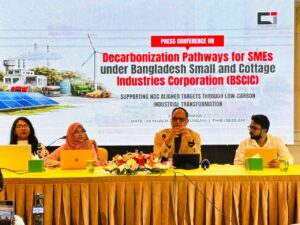
‘Change Initiative’, a research organization, has unveiled a groundbreaking roadmap to transition Bangladesh’s Small and Medium Enterprise (SME) sector from fossil fuel dependency to renewable energy. The study reveals that planned decarbonization measures could reduce the operational costs of this sector by 30% to 50%, significantly contributing to job creation and the achievement of climate targets.
The research report, titled ‘Energy Usage, Carbon Emissions, and Decarbonization Potential in SME Industries,’ was presented on Saturday at an event held in Tejgaon, Dhaka. The study highlights that by implementing decentralized rooftop solar panels in BSCIC industrial estates, it is possible to reduce carbon emissions by over 14.09 million tons annually. Furthermore, Bangladesh could generate approximately $0.40 million in annual revenue by utilizing ‘carbon credit’ facilities, serving as a role model for economic and environmental balance.
M. Zakir Hossain Khan, Chief Researcher of Change Initiative, stated, ‘To ensure energy sovereignty, we must reduce our import dependency. Adopting models similar to those in China, India, and Vietnam to provide reliable and affordable electricity to our SME sector is the need of the hour.’
The report underscores several critical statistics:
1. Over 90% of the country’s total industrial units fall under the SME sector.
2. This sector employs approximately 85% of the industrial workforce.
3. It contributes 25-30% to the national GDP.
Despite its importance, the sector currently relies on fossil fuel-based electricity for 95% of its needs, making it highly vulnerable to global market volatility.
The research focuses on four high-impact sectors within BSCIC industrial estates, showing significant potential for emission reductions:
• Plastic Production: 33-49% reduction potential.
• Leather Industry: 19-33% reduction potential.
• Light Engineering: 19-31% reduction potential.
• Packaging Industry: 15-28% reduction potential.
According to the researchers, utilizing just 10% to 20% of the vacant space in BSCIC industrial estates could generate up to 114 MW of solar power. Financial analysis shows that the investment for a typical 20 KW rooftop solar system can be recovered in just 4.2 years. Moreover, under the ‘OPEX’ model, small entrepreneurs can adopt solar energy without any initial investment, immediately reducing their electricity bills.
Roadmap and Recommendations: To ensure the success of this transition, the study proposes a ‘Decarbonization Pathway’ based on three key pillars:
1. Participatory Renewable Energy Systems at the industrial estate level.
2. Innovative Financial Models, including low-interest loans and green financing.
3. Strengthening Institutional Coordination between BSCIC and relevant government agencies.
M. Zakir Hossain Khan also urged the government to issue ‘SME Cards’ for small entrepreneurs, similar to the cards provided to farmers. He added that accelerating this transition through tax benefits and incentives would allow Bangladesh to strengthen its position in the global market as a robust, self-reliant, and eco-friendly economy.