Between inheritance and renewal in a world marked by violence, fragmentation and spiritual exhaustion
At a certain point, every movement must ask itself a difficult question: does it still exist as a living force in history, or has it become, little by little, the memory of its own inspiration?
For those shaped, directly or indirectly, by Silo, that question can no longer be deferred. The world has not moved closer to the overcoming of violence. On the contrary, violence has become more normalised, more diffuse, more technologically mediated, and more deeply embedded in the economic and political structures that organise everyday life. We continue to generate wealth without meaning, information without wisdom, and power without direction. At the same time, the Earth itself is being driven towards exhaustion by a civilisation whose organising principle is accumulation rather than humanisation.
And yet the need that gave birth to the Humanist Movement has not disappeared. If anything, it has become more urgent.
The original double demand
The original impulse was never merely political, nor merely spiritual. It was an attempt to unite personal transformation and social transformation in a single project. It understood that no lasting change could come from external restructuring alone if the human being remained internally divided, violent, fearful, and alienated. But it understood, too, that inner work cut off from history, cut off from injustice, and cut off from the suffering of others would become sterile, self-enclosed, and ultimately complicit with the world as it is.
That double demand remains decisive. It may be one of the movement’s most valuable contributions: the insistence that the human being must be transformed both inwardly and outwardly, and that neither dimension can be abandoned without falsifying the whole.
For that reason, it would be too simple to say that the movement has failed. It may be more accurate to say that, at the time of writing, it has not succeeded in becoming a sufficiently strong historical response to the crisis of civilisation. But that is not the same as saying that its truths were false, or that the seeds it cast into the world did not germinate.
What was already set in motion
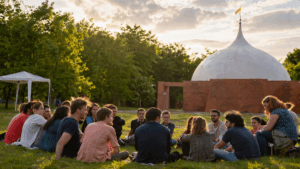
What has already been set in motion may be more significant than is sometimes acknowledged. The work inspired by Silo led to the formation of around 3,000 Masters in four different disciplines, all oriented towards opening access to the profound and inspired states of consciousness and to a belief in immortality and the certainty of transcendence. It also led to the establishment of around 50 Parks of Study and Reflection around the world, with Punta de Vacas in Argentina as the spiritual home.
This is not a negligible legacy. It means that the movement did not leave behind only books, memories, or sentiment. It left practices, trained people, and places. It left a body, however partial, through which a new historical moment might yet be born.
The question, then, is not whether there is anything to build from. The question is whether what already exists can become historically fertile once again.
That depends, first of all, on refusing to confuse inheritance with renewal. To preserve a teaching, a method, a discipline, or a sacred place is already something important. But preservation alone does not generate a movement. Renewal begins when what has been received becomes transmissible to new generations in a language they can understand, through practices they can enter, and in relation to the concrete crises of their own time.
The real problem is transmission
This means asking some uncomfortable but necessary questions. Can a young person with no prior connection to the movement encounter it and grasp, quickly and clearly, what it exists for? Can the disciplines be presented as living methods rather than esoteric attainments? Can the Parks become generative centres of practice, dialogue, service, and reconciliation rather than mainly sites of pilgrimage for the already convinced? Can the trained core act not as custodians of a completed past but as servants of a possible future?
These questions are decisive because the central problem is not the absence of inspiration. It is the problem of transmission.
Modern societies are profoundly different from those in which many earlier movements took shape. Attention is fragmented. Institutional trust is broken. Economic life exhausts people. Political feeling is often reduced to spectacle. Many are spiritually hungry, but suspicious of authority; morally concerned, but unable to sustain collective action; digitally connected, but socially isolated. A renewed Humanist Movement cannot simply repeat old forms and hope the present will receive them. It must learn how to become legible within a world marked by distraction, fatigue, loneliness, ecological anxiety, and the normalisation of violence.
That does not mean abandoning depth. On the contrary, depth is precisely what is lacking in the present. But depth must be joined to accessibility, and inspiration to form.
Small forms, real density
If renewal is to come, it will probably not begin through grand declarations or large public mobilisations. It will begin in smaller, denser forms: circles of practice, reflection, and mutual support; spaces where inner work and social commitment are consciously linked; communities that train people not only to understand nonviolence intellectually, but to embody it in relationships, work, conflict, and public action.
This may seem modest when set against planetary crisis. But nearly everything lasting begins in forms that look too small for the age.
A renewed movement would also need a moral centre that can be expressed simply and without jargon: that human life is sacred; that violence must be overcome in all its forms; that the Earth must be humanised rather than exploited; and that personal and social transformation are inseparable. If these truths cannot be spoken clearly, they cannot travel. And if they cannot travel, they cannot become historical force.
But clarity of purpose alone is not enough. The movement must also learn from the failures that accompany every spiritual, ethical, and political effort in history. One of the perennial tragedies of human experience is that institutions formed around liberation are repeatedly captured by prestige, ego, hidden hierarchy, economic interest, and the desire for control. No movement is exempt from this danger.
A renewed Humanist Movement would therefore need structures consciously designed to resist it: transparency around money, rotation of responsibilities, distributed leadership, protection against dependency on exceptional individuals, and a cultural insistence that any depth of experience or attainment only has value insofar as it is placed at the service of others.
The question for Masters
Here the question for Masters becomes especially important. If mastery is understood as completion, as a kind of achieved condition, the movement will tend towards enclosure. It will become a circle of those who know, remember, or have reached something. But if mastery is understood as service, as the responsibility to accompany, awaken, form, and transmit, then the Masters that remain could become the nucleus of renewal.
In that case, what has been accumulated is not symbolic capital but a reservoir of lived experience that can be placed at the disposal of a new historical moment.
The same can be said of the Parks. In an uprooted world, places matter. A Park of Study and Reflection is not merely a beautiful or meaningful site. It can become a counter-site to the dominant civilisation: a place in which another rhythm, another scale, another image of the human being is enacted. A place where silence is not emptiness, where reflection is not withdrawal, where reconciliation is not weakness, and where study is not the accumulation of information but a method of deepening consciousness.
If used well, the Parks are not retreats from history. They are laboratories for another possible future. But for that very reason, they cannot remain only pilgrimage destinations for the already convinced. They must become places from which humanising action returns to the world.
The disciplines and the crisis of meaning
The four disciplines, likewise, may be among the movement’s greatest gifts. If they truly allow access to profound and inspired states of consciousness, and if they truly open certainty of transcendence, then they answer one of the deepest crises of the present epoch: nihilism.
We live in a time in which many people are intellectually over-stimulated and spiritually malnourished. They have information, but no centre of gravity. They have stimuli, but no meaning. They have identities, but no inner centre. A movement that can offer not only analysis but experience, not only critique but access to the sacred dimension of existence, may possess something of immense historical importance.
And yet here too the challenge is decisive. Spiritual experience alone does not create movement. Many traditions possess genuine methods of depth and yet remain marginal because they cannot connect those experiences to an ethic, a social form, and a historical mission that ordinary people can enter. The question is not only whether the disciplines work. It is whether the fruits of those disciplines can become culture: whether they can shape ways of speaking, acting, organising, caring, educating, and struggling; whether they can nourish people not only in exceptional moments, but in daily life.
This is why the need to join inner and outer transformation remains so central. If the movement were to reduce itself to the pursuit of inspired states, it would betray one half of its original truth. If it were to reduce itself to activism or doctrine without profound inner grounding, it would betray the other half. The entire wager of the Humanist Movement was that these two dimensions could and must converge. That wager remains one of the most important things it has to offer.
Must we wait for another mystic?
Must we wait, then, for another inspired mystic to lead the way?
It is possible that singular figures will always play a role in opening new historical moments. Human history is full of such figures, and one should not dismiss the power of inspired consciousness when it appears embodied in a person. But a mature movement cannot depend on waiting passively for salvation in the form of another founder. If what has already been received cannot be embodied, transmitted, deepened, and historically reactivated by ordinary human beings, then the movement has not yet solved the problem of its own continuity.
What is needed now may not be another single revealer, but a distributed awakening: many people, in many places, carrying forward a common centre with coherence, humility, and persistence. Not the disappearance of inspiration, but its diffusion. Not the abolition of leadership, but its transformation into service. Not the repetition of a founding moment, but the discovery of how a founding truth can generate new forms without ceasing to be itself.
This may be the real task before those who remain linked, in one way or another, to Siloism: not to preserve ashes, but to protect and transmit fire. Not to ask nostalgically whether the past can return, but to ask whether the seeds already sown can find new soil in the present crisis of humanity.
A remnant, or a beginning?
The world does not suffer from a lack of information. It suffers from a lack of direction, a lack of meaning, and a lack of forms capable of resisting violence without becoming violent themselves. In such a world, even a small but real nucleus of humanising practice can matter immensely.
So perhaps this is the question we should be asking now: not whether the Humanist Movement has failed, but whether the seeds it planted — the disciplines, the Parks, the Masters, the living memory of a simultaneous personal and social transformation — can become the starting point of a new cycle.
If they can, then what now appears to many as a remnant may yet be revealed as a beginning.
And if they cannot, it will not be because the need disappeared, nor because the human being no longer longs for reconciliation, meaning, transcendence, and a truly human world. It will be because those who inherited a fire did not find the way to place it, once again, at the service of the human being.