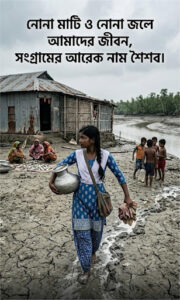
Reproductive Health of Coastal Adolescents in Crisis
By Rita Bhowmick (Returned from Shyamnagar, Satkhira) / Dhaka Bureau
The curse of climate change is no longer limited to rising sea levels or crop destruction; it has now invaded the wombs and minds of adolescent girls in Bangladesh’s coastal regions. A dire health crisis has emerged in the coastal villages of Shyamnagar Upazila, Satkhira. To escape menstrual complications caused by saline water, underage female students are consuming birth control pills (Contraceptive Pills) en masse- a trend that poses a severe threat to their long-term fertility and mental health. Health experts warn that these pills are not only a threat to reproductive health but can also have a negative impact on the brains of students when taken to stop or regulate periods.
In every household of Burigoalini and Gabura unions, adjacent to the Sundarbans- the world’s largest mangrove forest- the story is the same. Investigations reveal that shortly after reaching puberty, adolescent girls suffer from irregular menstruation or prolonged bleeding. The primary culprit: saline water. Lacking the means to buy sanitary napkins, these girls use rags during their periods, which they are forced to wash in salty water.
Mosammat Sanjida Khanam (18), a student at Burigoalini Gabura BG College, shared her ordeal. She started menstruating in the eighth grade. At that time, she did not use sanitary napkins. Using cloths washed and dried in saline water led to severe menstrual complications by the ninth grade. Her cycle became unpredictable- sometimes occurring every two to three months, and at other times, two or three times a month. In the tenth grade, she bled continuously for a month, prompting her mother to take her to a gynecologist.
‘The gynecologist examined me and prescribed birth control pills for three months to regulate my period,’ Sanjida said. ‘The doctor said it would make the cycle regular. But taking it makes me feel physically weak and dizzy. I lose the will to work. When I told the doctor, I was advised to take better care of myself and eat eggs and milk. While the pills sometimes help temporarily, the problem recurs shortly after. My mother took me to the Satkhira Medical College Hospital again, where they prescribed the same pills.’
The investigation found that students from the sixth grade to higher secondary levels are regularly taking these pills to ‘stop’ or ‘regulate’ their periods. Countless girls, like 12-year-old Rima Akter and 13-year-old Aachia Akter, are suffering from stomach pain, extreme physical weakness, and dizziness after consuming these medications.
Professor Dr. Samshad Jahan Shelly, former head of the Gynecology Department at BIRDEM General Hospital, described this trend as ‘alarming.’ She stated: ‘Contraceptive pills should not be consumed before the age of 25. It hampers the natural growth of adolescents and can lead to high blood pressure, diabetes, and future infertility. It even negatively affects their brain functions.’ She further emphasized that menstruation is a natural process and suppressing it is extremely harmful, leading to hormonal imbalances. She urged those taking pills without a doctor’s prescription to seek immediate medical advice.
Surprisingly, while this crisis is acute at the grassroots level, district and upazila health administrations lack specific data. The Civil Surgeon of Satkhira and officials of the Family Planning Department remain largely unaware of the gravity of the situation. Dr. Md. Abdus Salam, Satkhira’s Civil Surgeon, and Gazi Bashir Ahmed, Deputy Director of Family Planning, confirmed that the issue of adolescents taking birth control pills due to climate-related complications is not in their records.
Dr. Rumana Chowdhury, a gynecologist at Friendship Hospital in Shyamnagar, noted: ‘Many students come to us with menstrual complications due to climate change and saline water use. However, we have no data on exactly how many are affected.’ This data gap indicates that coastal women’s health has yet to reach the radar of national policymakers.
Non-governmental organizations like Naripokkho and Breaking the Silence have begun area-based campaigning and awareness programs. Samia Afrin, Project Director of Naripokkho, stressed that it is crucial to educate not only the students but also the parents. In many cases, mothers are the ones encouraging their daughters to take these pills.
Health experts in the country argue that it is high time to broadcast how suicidal it is to suppress menstruation for the sake of travel, exams, or religious ceremonies. Protecting the reproductive health of these climate-stricken adolescents requires more than just distributing medicine; it demands alternative water sources and safe menstrual hygiene management. Otherwise, an entire generation in Bangladesh’s coastal belt risks losing their fertility and facing permanent health hazards.
The author:
 Rita Bhowmick: Senior Journalist & Correspondent, Pressenza- Dhaka Bureau.