By Asif Showkat Kallol (Dhaka Bureau)
Bangladesh has moved ahead of China to become the second-largest apparel exporter to the United States, even as its own export earnings to the market declined in early 2026- highlighting a shifting landscape in global garment trade shaped by tariffs, geopolitical tensions, and changing sourcing patterns.
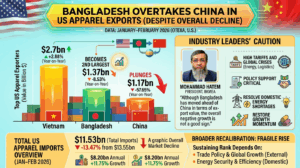
Data released on Saturday by the Office of Textiles and Apparel (Otexa) shows that Bangladesh exported garments worth $1.37bn to the US in January-February 2026, marking an 8.53% drop from $1.5bn during the same period a year earlier.
Despite the contraction, Bangladesh climbed to second place among apparel exporters to the US, overtaking China, whose shipments plunged sharply amid the impact of reciprocal tariffs and broader geopolitical pressures. Chinese exports fell to $1.17bn in the first two months of the year, down 57.65% from $2.77bn a year earlier.
Vietnam retained its position as the top apparel exporter to the US, recording $2.7bn in shipments over the same period, a modest year-on-year increase of 2.88%.
Overall, US apparel imports declined significantly, reflecting softer global demand and supply chain adjustments. Total imports stood at $11.53bn in January-February 2026, down 13.47% from $13.55bn a year earlier.
Industry leaders in Bangladesh have cautioned against overinterpreting the country’s improved ranking, noting that the underlying trend remains fragile. Mohammad Hatem, president of the Bangladesh Knitwear Manufacturers and Exporters Association, said higher tariffs and ongoing global crises- particularly conflicts affecting energy and logistics- have weighed on export performance.
‘Although Bangladesh has moved ahead of China in terms of export value, the overall negative growth is not a good sign,’ he said, warning that external shocks continue to disrupt demand and cost structures.
He added that policy support and resolution of domestic energy shortages would be critical to restoring growth momentum. ‘If the government can ensure consistent energy supply and provide the right incentives, the sector can recover quickly,’ he said.
The latest figures come after a strong performance in 2025, when Bangladesh’s ready-made garment (RMG) exports to the US grew by double digits. Annual export earnings reached $8.20bn, up 11.75% from $7.34bn in 2024, according to Otexa data. Export volumes also increased, with shipments rising to 2.66bn square metres, compared with 2.36bn a year earlier.
The contrasting trends underscore a broader recalibration in the global apparel supply chain. While China’s decline reflects both structural shifts and policy-driven disruptions, countries such as Bangladesh and Vietnam are competing to capture market share- often under increasingly complex economic and geopolitical conditions.
Analysts say Bangladesh’s rise to second place is symbolically significant but fragile, as it coincides with weakening overall demand in the US market. Sustaining that position will depend not only on external factors such as trade policy and global growth, but also on domestic reforms aimed at improving energy security, efficiency, and competitiveness in the country’s vital garment sector.
The Author:
 Asif Showkat Kallol: Works for a German-based online outlet, The Mirror Asia, as Head of News and Contributor, Pressenza- Dhaka Bureau.