By Asif Showkat Kallol
The tea industry remains one of the pillars of Bangladesh’s export economy. Yet the human cost behind every cup of tea tells a story of systemic deprivation, structural violence, and enduring marginalization. For generations, the tea garden workers of the country, concentrated heavily in the northeastern Sylhet region (including Habiganj and Moulvibazar), have fueled national prosperity while remaining trapped in an unbroken cycle of poverty.
However, recent grassroots resistance and a shift in state policy are beginning to open up new pathways toward social protection and human dignity.
The Structural Violence of Living on the Margins
Historically, tea garden workers have faced conditions that social scientists describe as ‘systemic marginalization’. Recent academic research and field surveys in Sylhet’s Doldoli and neighboring tea estates expose a stark reality of socio-economic vulnerability:
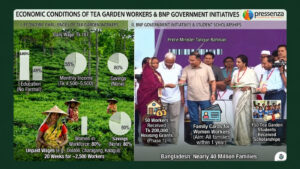
* The Wage Deficit: Many workers subsist on a daily wage of just Tk 187, with approximately 55% of households earning less than Tk 5,500 per month- an amount far below what is required to meet basic human needs in the current economic landscape.
* The Literacy Gap: Nearly 48% of the workers surveyed have been denied access to formal education, leaving families with limited tools to break free from generational labor bonds.
* Asset Deprivation: Eighty percent (80%) of the workforce has no financial savings or bank deposits. Combined with severely restricted land rights, families live in dilapidated housing with inadequate sanitation, healthcare, and safe drinking water.
This economic fragility regularly boils over into humanitarian crises. Recently, approximately 2,500 workers across the Burjan, Charagang, and Kalagul tea gardens were forced into weeks of protests and nonviolent road blockades after going 20 weeks without wages. For these families, delayed payments mean immediate hunger, reliance on high-interest loans, and cutting down on food consumption.
The Burden on Women Workers
In the tea sector, the face of labor is overwhelmingly female. Women constitute nearly 80% of the active workforce, carrying the dual burden of intensive physical labor in the fields and unpaid care work at home. Despite being the economic spine of the industry, they suffer the worst effects of weak social protection systems, lack of reproductive healthcare, and institutionalized wage disparities.
From a humanist perspective, empowering these women is not just an economic necessity; it is a foundational prerequisite for any meaningful societal transformation.
‘Our objective is not merely to provide assistance; it is to transform people’s lives. To change the destiny of Bangladesh, men and women must progress together’, Prime Minister Tarique Rahman.
A Turn Toward Social Protection: Recent Government Initiatives
Responding to prolonged worker advocacy and structural distress, the newly formed government has initiated a series of targeted social welfare measures aimed at providing an immediate safety net for this marginalized community. Speaking at a major public rally in Habiganj, Prime Minister Tarique Rahman announced the official rollout of promises made during his recent campaign, which was originally launched from Sylhet.
The government’s intervention framework focuses on three pillars: economic relief for women, housing security, and educational mobility.
* Family Cards for Women Workers: In a direct nod to gender-focused development, the state has begun distributing ‘Family Cards’ exclusively to female tea workers. This program bypasses traditional bureaucratic intermediaries, placing state financial subsidies directly into the hands of female heads of households. The administration aims to scale this program to cover almost all eligible tea worker families within the next year.
* Housing Grants for Shelter Security: To address the severe housing crisis, the first phase of an asset-building initiative has awarded direct cash grants of Tk 200,000 each to 50 tea workers to build permanent homes. Financial disbursements are being managed via local administrative channels.
* Educational Scholarships: Breaking the structural barrier of illiteracy, specialized scholarships have been awarded to the first batch of 150 students from tea worker backgrounds, aiming to prevent the next generation from being forced into low-wage ancestral labor cycles due to lack of choices.
The Road Ahead: From Relief to Structural Justice
While labor rights advocates and tea community leaders have welcomed these initiatives as a significant step forward in strengthening social safety nets, they emphasize that cash assistance and cards are entry points rather than final solutions.
For the tea gardens of Bangladesh to truly transition from spaces of exploitation to models of sustainable development, several structural reforms remain critical:
1. Wage Rationalization: The baseline daily wage of Tk 187 must be systematically revised to reflect real living costs and inflation.
2. Institutional Continuity: State welfare programs must be backed by transparent, long-term budgetary allocations to ensure they survive shifting political climates.
3. Enforcement of Labor Rights: Stricter regulatory oversight is required to eliminate wage arrears and hold estate managements accountable for timely payments.
4. Universal Public Services: Complementary and deep investments must be made directly within the plantation zones to build state-run schools, fully equipped healthcare clinics, and clean water infrastructure.
The survival and prosperity of Bangladesh’s tea industry cannot be separated from the well-being of the people who cultivate it. The current initiatives mark an important turning point, showing that when the state listens to the nonviolent demands of its most vulnerable citizens, the foundation for a more equitable and dignified future can be laid.
True progress will now depend on whether the government, labor unions, and estate managements can collaborate transparently to ensure that those who harvest the nation’s wealth are finally allowed to share in it.
##########
The Writer:
 Asif Showkat Kallol: Works for a German-based online outlet, The Mirror Asia, as Head of News and is a Contributor at Pressenza- Dhaka Bureau.