During the day in Tirana, life goes on as usual: people go to work, college students prepare for exams, children play in public parks, retirees have coffee at one of the many cafés and chat for hours… The first tourists, including a good number of Italians, visit the mosque and Skanderbeg Square. There are no posters, graffiti, or flyers… Everything is calm, in short, completely normal.
The only visible sign of what is happening are the booths collecting signatures for the two referendums to repeal the laws that allow environmental regulations to be circumvented, thereby facilitating real estate speculation even in Albania’s most beautiful protected areas. This is all to the benefit of local oligarchs, who launder dirty money from mafias around the world and, above all, open the doors to Trump’s Zionist son-in-law, who is said—though I cannot verify it—to be investing Israeli money… In short, the old, corrupt, and discredited political class of Edi Rama’s so-called “Socialist” party and Sali Berisha’s so-called “Democratic” opposition party is selling the country off to the most predatory form of capitalism.
At 6 p.m., everything changes: the people of Tirana gather in ever-greater numbers in Skanderbeg Square, and when Tirana’s largest square fills up, they begin marching toward Prime Minister Rama’s nearby office.
Men and women, the elderly and children. So many children—from newborns who, despite the din, manage to sleep in their strollers and in their mothers’ baby carriers, to older children on their parents’ shoulders or in their arms—who happily wave their little flags or signs written and drawn at home and chant the most popular slogans: “Rama and Berisha, it’s over for you!”, “Revolution! Revolution!”


The sign reads: “The future depends on us”
Yesterday was a special day: the event was not merely a national one, as it brought together in Tirana all Albanians, including those living in Kosovo, North Macedonia, southern Montenegro, and northern Greece—in short, the entire territory of so-called “Greater Albania” and members of the diaspora from all over the world, who took advantage of the holiday to return to their homeland and contribute to the liberation of their land.
A flood, an ocean of people that gradually swelled as far as the eye could see. Red, the color of the flag, dominated, along with the black double-headed eagle. Visible were the silhouettes of the Pink Flamingos moving in a line through the crowd, led by a white stork.

Protesters’ drones documented the event; one, to great applause, flew over the crowd waving the Albanian flag.
Speakers took turns on stage—intellectuals, artists, and representatives of civil society. Obviously, I didn’t understand a word, but the crowd applauded enthusiastically.
In front of the stage, dozens of shoes symbolized the emigrants forced to leave their country to seek work abroad.
No flags were visible from the three currently minor parties in Parliament, nor from environmental groups.
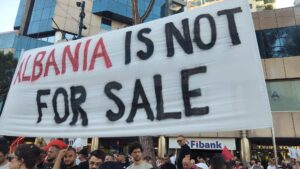
The New Albania Democratic Socialists carried a banner, without a symbol or signature, but bearing the slogan: “Albania is not for sale.”
Albanian patriotism has no supremacist sentiments and is free of xenophobic impulses: it is based on a bond with one’s homeland (like the patriotism of the Palestinians and Kurds, to be clear) and with their culture, which believes in and practices hospitality.
The steps leading up to Prime Minister Rama’s office were manned by about twenty police officers without helmets, shields, or batons, and without guns in their holsters. They politely asked people not to sit on the steps or climb the stairs. However, some “disobedient” children were playing tag in front of the ministry’s entrance without the police having anything to say about it.
Today and in the days to come, we will keep this up until the people’s victory, they tell me with peaceful determination.