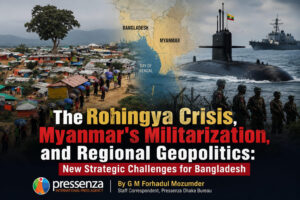
By G M Forhadul Mozumder (Dhaka Bureau)
Situated at the crossroads of South and Southeast Asia, Bangladesh currently faces an unprecedented and complex triangular crisis. The protracted Rohingya refugee crisis, coupled with neighboring Myanmar’s escalating militarization and intensifying geopolitical competition among superpowers over the Bay of Bengal, has created a new wave of security and diplomatic challenges for Dhaka.
Recent revelations regarding Myanmar’s partial recognition of the Rohingya, alongside leaked intelligence on its covert submarine construction program, have sparked renewed concern globally. Analysts are now asking: Is Bangladesh becoming trapped in a new matrix of simultaneous humanitarian, security, and geopolitical pressures?
The ‘PPRM’ Recognition and the Smokescreen of Repatriation
While there has been minor movement regarding the long-stalled Rohingya crisis, significant skepticism remains over its actual efficacy. According to the latest diplomatic data, Myanmar has recognized only 283,086 individuals from the lists sent by Bangladesh as ‘Persons Previously Resided in Myanmar (PPRM).’
Sources within the Ministry of Foreign Affairs in Dhaka confirmed that Bangladesh has handed over biometric and verified data of more than 800,000 Rohingya in various phases. Out of these, the Myanmar authorities have scrutinized approximately 354,000 individuals, ultimately verifying around 253,000 as former residents.
However, despite this partial verification, the future of hundreds of thousands of people remains entirely hanging in the balance. Furthermore, due to the ongoing civil war, political instability of the junta regime, and intense ethnic conflicts inside Myanmar, the so-called repatriation process remains practically paralyzed.
The Captivity of Statelessness and the Humanitarian Toll
Following the Myanmar military’s brutal ethnic cleansing campaign in 2017, Bangladesh became host to nearly 1.2 million Rohingya, making it one of the largest refugee populations in the world. For nearly a decade, Bangladesh has shouldered this massive humanitarian burden largely on its own.
However, the situation is growing more precarious due to a steady decline in international funding. The United Nations has already warned that if shortages in emergency humanitarian aid and funding persist, the law-and-order situation and living conditions within the refugee camps could face a severe downturn.
According to security and international law experts, the root of the crisis lies in Myanmar’s controversial 1982 Citizenship Law, which rendered the Rohingya completely stateless. Consequently, Dhaka has repeatedly emphasized that mere physical repatriation is not a sustainable solution. Recalling the bilateral agreement of 1978, where Myanmar recognized the Rohingya as “lawful residents,” Dhaka insists that ensuring full citizenship rights, safety of life and property, and a dignified rehabilitation process within Myanmar is the only viable international solution.
Myanmar’s Military Rise: New Power Equations in the Bay of Bengal
In parallel with the humanitarian crisis, Myanmar’s recent military maneuvers have deeply alarmed regional security analysts. Recent satellite imagery revealed that Myanmar is constructing a new diesel-electric mini-submarine, measuring approximately 40 meters in length, at its dockyards. Defense experts suggest that the design may bear direct influence or technological alignment with North Korea’s Sang-O class submarines.
The Myanmar Navy already operates a Kilo-class submarine acquired from India, alongside assets procured from China. Under these circumstances, this new domestic submarine project underscores the regime’s intent to boost its naval combat capabilities and project aggressive maritime power. Given that the Andaman Sea and the Bay of Bengal host vital international sea lanes and strategic waters, Myanmar’s naval modernization cannot be taken lightly.
Defense vs. Diplomacy: The Internal Debate in Bangladesh
Against the backdrop of Myanmar’s militarization, a past remark by Bangladesh’s Chief of Army Staff, General Waker-Uz-Zaman, has resurfaced in public discourse. He had noted that ‘had Bangladesh been militarily stronger, the situation surrounding the Rohingya crisis could have been different.’
This statement has ignited a fresh strategic debate within Bangladesh. A large segment of defense analysts believes that the Myanmar junta only understands the language of power and that maintaining a strategic military balance is essential to securing the borders. Conversely, international relations experts argue that the Rohingya crisis is fundamentally a product of institutionalized discrimination and ethnic persecution tied to Myanmar’s internal politics. Therefore, while military readiness is necessary for deterrence, a definitive solution can only be achieved through multilateral diplomatic pressure and international judicial tribunals.
Geopolitical Matrix and the Role of Superpowers
The Bay of Bengal has become a theater of competing strategic interests for China, India, the United States, and the Association of Southeast Asian Nations (ASEAN). The Myanmar junta enjoys deep economic and military backing from China, while India maintains ties with Naypyidaw due to its own geopolitical and strategic compulsions. Meanwhile, the United States and the Western bloc continue to impose sanctions on the junta over human rights violations and the suppression of democracy.
In this clash of multi-layered interests, Bangladesh finds itself walking a tight diplomatic tightrope. Although there is currently no public or credible evidence pointing to a specific foreign ‘conspiracy’ targeting Bangladesh, experts emphasize that Dhaka must employ hard, evidence-based, and long-term diplomacy to maintain the balance of power in the region.
The Way Forward for Bangladesh
According to diplomatic and security analysts, Bangladesh must prioritize several key areas to navigate these multifaceted pressures:
* Escalating Global Pressure: Engaging the UN, the OIC, and Western powers to maintain robust economic and political pressure on Myanmar, compelling the regime to accept the Rohingya with full citizenship rights.
* Border and Coastal Security: Strengthening surveillance by the Border Guard and Coast Guard to ensure that Myanmar’s internal conflicts do not spill over into Bangladeshi territory.
* Defense Modernization: Continuing the modernization of the Bangladesh Armed Forces in line with national defense goals, ensuring a credible deterrence capability against any potential external aggression.
* Long-Term Socio-Economic Planning: Developing a visionary national roadmap to manage the Rohingya population domestically and mitigate the environmental and economic strain as international funding declines.
The Rohingya crisis is no longer just a ‘humanitarian disaster’ confined within borders; it has evolved into the foremost geopolitical and security challenge in South Asia. Myanmar’s reluctance to repatriate, its evasion of the issue of citizenship, and its simultaneous naval expansion are adding layers of volatility to the region.
For Bangladesh, the ultimate test lies in striking a delicate balance: honoring its global humanitarian commitment while resolutely safeguarding its national interests, territorial integrity, and sovereignty. To maintain this equilibrium, Dhaka must seamlessly blend robust bilateral and multilateral diplomacy with a modern, capable defense posture.
##########
The Writer:
 G M Forhadul Mozumder: Staff Correspondent, Pressenza- Dhaka Bureau