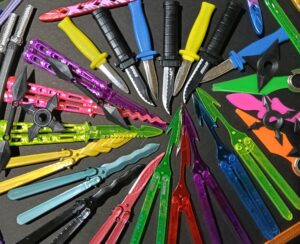
26 June 2026, Quezon City. Advocates for children’s health and safety called for reducing young children’s exposure to unauthorized and realistic weapon-themed toys. While aggressive behavior cannot be attributed solely to toy weapons, reducing exposure to such toys will help create safer, developmentally supportive spaces for kids.
Amid the deeply disturbing incidents of violence inside school premises, the EcoWaste Coalition, together with an early childhood development expert, drew attention to the unregulated sale of various types of unauthorized and unlabeled toy weapons, often with no age-grading, which are accessible to a curious child.
“Toy weapons, such as plastic balisong (butterfly knives), shinobi-sho (Ninja armaments), pellet guns, and other imitation firearms, are widely available in the market and we seem not to mind,” observed Aileen Lucero, National Coordinator, EcoWaste Coalition. “Sold without proper authorization and labeling information, including age specification, these weapon-themed toys have not been assessed for their quality and safety. Consumers, parents in particular, are also unaware of how these toys may influence a child’s behavior and development.”

These unauthorized toy weapons are sold cheaply in toy stores located outside public schools.
According to Dr. Angel Dy, an infant and early childhood mental health and development specialist, “When children play, they are not only having fun, but they are also learning about the world around them. The toys children are given can shape the themes they explore during play and influence what becomes familiar, interesting, or meaningful to them.
“While pretend play is a healthy and important part of childhood, the widespread availability of realistic or weapon-themed toys, especially those sold near schools and marketed to young children, deserves careful consideration,” she said.

Weapon-themed toys are often sold without proper authorization and labeling information in violation of toy safety and labeling regulations.
Research suggests that repeated exposure to aggressive themes during play may increase aggressive thoughts or behaviors in the short term, particularly among younger children who are still developing self-regulation and impulse control. However, aggressive behavior is complex and cannot be attributed to toy weapons alone.
“Children’s behavior is shaped by many factors, including family relationships, adult guidance, community influences, and exposure to real-life violence,” Dy said.
“Young children, particularly during the preschool years, are still developing the ability to distinguish fantasy from reality and to fully appreciate the consequences of their actions. Because of this, the toys and play materials we provide should ideally support creativity, cooperation, problem-solving, empathy, and emotional regulation rather than emphasize conflict or harm,” she added.
Parents and caregivers also play an essential role. Dr. Dy suggested that “when children engage in pretend play involving conflict or superheroes, adults can help guide the play toward themes of protection, teamwork, courage, and helping others rather than aggression or revenge.
“The goal is not to eliminate imaginative play, but to ensure that it promotes healthy social and emotional development,” she clarified.
Reducing children’s exposure to unauthorized and realistic toy weapons is one practical measure that may help support safer, more developmentally appropriate play environments, alongside responsive caregiving, positive role modeling, and opportunities for cooperative play, Dy and Lucero concluded.
Reference:
Watson, M. W., & Peng, Y. (1992). The Relation Between Toy Gun Play and Children’s Aggression. Early Education and Development, 3(4), 370–389.
Smith, S., et al. (2018). Learning to blast a way into crime, or just good clean fun?