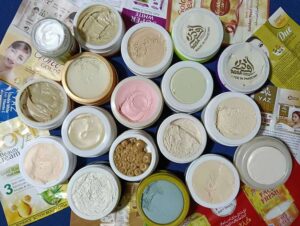
28 June 2026, Quezon City. The EcoWaste Coalition applauded the Chamber of Cosmetics Industry of the Philippines (CCIP) for joining the global fight against mercury in skin-lightening products in support of the Minamata Convention on Mercury.
“CCIP’s backing of the mercury ban in cosmetics is very significant because it aligns over 200 personal care and cosmetic companies – spanning manufacturers, importers, distributors, and retailers — with this vital public health and environmental goal,” said Aileen Lucero, National Coordinator, EcoWaste Coalition, which has been tracking mercury-laced cosmetics in the market since 2011 and pushing for the necessary regulatory action in the Philippines and across borders.
“With CCIP on board, we hope this will usher in the active involvement of other cosmetic industry groups, dermatological associations, and other players in the global effort to stop mercury use in skin lightening products,” she added.
The toxics watchdog group cited CCIP under the dynamic leadership of Dr. Janina Tan for the successful conduct of the forum focusing on “Breaking the Cycle: Ending Mercury Use in Skin Lightening Products,” which was held last June 18 as part of the three-day “Cosmobeaute Philippines,” touted as the country’s premier beauty trade show held at the World Trade Center.

Photo courtesy of Kaizzer Manuba, BusinessWorld.
Drawing some 150 participants, the forum sought to raise awareness and foster collaboration among stakeholders to eliminate mercury from cosmetics and safeguard public health and the environment.
The forum featured several experts who discussed mercury-related issues. Dr. Janina Tan (CCIP) covered the historical and scientific context of Minamata disease, while Dr. Raymond Jacinto Sucgang (Philippine Nuclear Research Institute) detailed the presence of mercury in online skin lighteners. Other speakers included Vina Rose Dahilig (Manila Adventist College), who discussed mercury in cosmetics; Dr. Geminn Louis Apostol (Ateneo Center for Research and Innovation), who delved into the associated health risks; and Engr. Ana Trinidad Rivera (Food and Drug Administration), who elaborated on cosmetic regulatory controls.
In his presentation, Apostol reiterated “mercury has no safe use in cosmetics, no safe dose, and no acceptable exposure,” stressing “mercury in skin-lightening products is a preventable public health crisis driven by colorism and regulatory gaps.” Dahilig warned that “mercury contamination may appear in unregistered and counterfeit cosmetics,” reminding “safe beauty begins with informed consumers.”
Among other things, Rivera informed the audience about an upcoming project to reduce the manufacture, trade, sale, and use of mercury-added skin lightening products in the Philippines. It will be carried out by the government, together with other stakeholders, to cut the risk of exposure to contaminated products, raise awareness of the health risks associated with their use, enhance supply chain management and controls, and strengthen enforcement and consumer safety controls.
At the event, the EcoWaste Coalition, represented by Manny Calonzo, assisted by interns and students from the Ateneo School of Medicine and Public Health, scanned cosmetics for toxic mercury. Using a portable X-Ray Fluorescence (XRF) analyzer, the team offered free screenings with this point-and-shoot scientific tool, which the group uses to quickly check for hazardous metals such as cadmium, lead, and mercury in materials and products.

The EcoWaste Coalition uses the XRF analyzer to rapidly screen skin lightening products for possible presence of mercury, which is banned in cosmetic product formulations.
The XRF device, in particular, helped the EcoWaste Coalition in identifying skin lighteners adulterated with mercury, which eventually led to the banning of at least 125 contaminated products by the FDA Philippines, as well as the FDA Thailand.

XRF screening allows the immediate detection of chemicals of concern, such as mercury, in analyzed products with no sample preparation required.
As explained by the United Nations Environment Programme (UNEP), mercury is added to some skin-lightening products “to block the production of melanin, leading to lighter skin tones,” with “kidney and liver damage, neurological problems, and development issues in children” among the health effects.
As stated by the World Health Organization (WHO), “mercury-containing skin lightening products are hazardous to health.” WHO has noted the “great need for public awareness given the worldwide increase in the use of cosmetic products containing mercury.” It pointed out that “information on the hazards of skin lightening products in general must be provided to consumers as even skin lightening products that do not contain mercury may contain other hazardous substances, such as hydroquinone.”
#########
Reference:
https://www.unep.org/globalmercurypartnership/our-work/mercury-products/eliminating-mercury-skin-lightening-products
https://www.who.int/publications/i/item/WHO-CED-PHE-EPE-19.13
https://www.facebook.com/share/r/18kPTsHqeH/