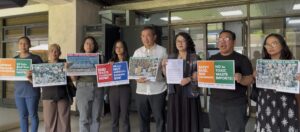
Call for Transparency to Protect Public Health and the Environment
Environmental groups under the Task Force END E-WASTE IMPORTS support the House Resolution No. 1164 filed by the MAKABAYAN Bloc, urging Congress to conduct an immediate investigation, in aid of legislation, into the shipment of 234 containers of suspected hazardous electronic waste (e-waste) and one container of plastic waste from the United States to the Subic Bay Freeport Zone.
Operation Can Opener (OCO), a monitoring campaign by the global waste trade watchdog Basel Action Network (BAN), traced suspected e-waste shipments to Subic and has sent 14 alerts to Philippine authorities regarding the illegal containers since March 2025. However, authorities have been unable to act due to a Manila Regional Trial Court (RTC) ruling in April 2025 that upheld the Subic Bay Freeport Zone as a separate customs territory, allowing unimpeded e-waste imports, undermining the role of the DENR-Environmental Management Bureau (DENR-EMB) and the Bureau of Customs (BoC) as the competent regulatory agencies. In a press conference last week, the Task Force also showed aerial footage of piles of e-waste and toxic ash from e-waste processing activities in Subic.
“The illegal shipment of e-waste or e-scrap raises grave concerns over the country’s ability to enforce environmental laws, safeguard public health, and uphold its international obligations against the illegal transboundary movement of hazardous waste,” said Thony Dizon, Advocacy Officer of BAN Toxics, on behalf of the Task Force.

Responding to statements made by the Subic Bay Metropolitan Authority (SBMA) that the imported materials are for recycling and not dumping, the Task Force argues that the materials being processed are still hazardous e-waste and that, under the global treaty the Basel Convention on the Control of Transboundary Movements of Hazardous Wastes and Their Disposal, the shipment of hazardous waste from a non-party to a party for recycling is illegal. The US is not a party to the Convention, while the Philippines ratified it in 1993.
“Whether it’s for recycling or dumping, those are hazardous waste. Those are e-waste from developed countries that exploit our cheap labor and regulatory loopholes, shifting their own waste burdens to countries such as ours. If the companies in SBMA are indeed capable of properly recycling e-waste, why not focus on our own domestic waste? We call for transparency to protect human health and the environment. May pera sa basura, pero may lason din sa basura,” Dizon added.
Article 4 of the Basel Convention states that “A Party shall not permit hazardous wastes or other wastes to be exported to a non-Party or to be imported from a non-Party.” It also states that such incidents of “illegal traffic in hazardous or other wastes is criminal.” The only exception, under Article 11, is when a bilateral agreement exists between the states involved. No such bilateral agreement between the US and the Philippines is available to the public.

“The shipment of e-waste or e-scrap from non-Parties to Parties is a clear violation of international law and creates a loophole that could enable hazardous waste dumping in the Philippines and other developing countries, regardless of their capacity to manage it,” Dizon explained.
The House Resolution cites that during congressional deliberations on proposed amendments to RA 6969, the SBMA expressed its intention to classify freeports such as the Subic Bay Freeport Zone as “Basel Convention-free zones,” a move that the Task Force argues would effectively allow hazardous waste shipments to bypass the country’s obligations under the Basel Convention.
“Even as a transit area, the Subic Bay Freeport is covered by the Basel Convention by virtue of it being under the jurisdiction of the Philippines,” Dizon said.

As e-waste is classified as hazardous waste under DENR Administrative Order (DAO) No. 2013-22, or the Revised Procedures and Standards for the Management of Hazardous Wastes, any country exporting e-waste or e-scrap is required to notify the Philippine Government and secure the Prior-Informed Consent (PIC) requirement from competent authorities before exportation can proceed. The PIC procedure is also a key control mechanism of the convention.
“If SBMA is importing such volumes of potentially hazardous wastes into the country, they are accountable to the public to be transparent on the shipment volumes, the companies involved, and pollution controls from the globally known polluting recycling processes such as smelting and its residuals, as shown in the aerial footage. The central question remains: if the port is willing to circumvent international law, how can we be sure that other laws are not violated?” Dizon emphasized.
The House Resolution also cites Section 7, Article II of the 1987 Constitution, which provides that the State shall pursue an independent foreign policy grounded on national sovereignty, territorial integrity, national interest, and the right to self-determination. It also invokes Republic Act No. 6969, or the Toxic Substances and Hazardous and Nuclear Wastes Control Act of 1990, which declares the policy of the State to “prohibit the entry, even in transit, of hazardous and nuclear wastes and their disposal into the Philippine territorial limits for whatever purpose.”
Speaking to members of the media, KABATAAN Partylist Representative Renee Co said, “This is an issue of both national sovereignty and environmental justice. It must be addressed with urgency and investigated thoroughly, particularly where there are indications of violations of an international agreement and Philippine laws. Our country must never become a destination for foreign waste at the expense of our people and our environment.”

“End waste colonialism now, we are not America’s dumping ground or recycling bin! No one should profit from toxic waste while our communities and our environment are left to suffer the consequences,” Dizon added.
The lawmakers and environmental groups stressed that the congressional inquiry is necessary to determine how the shipments entered the country despite existing laws and treaty obligations, clarify jurisdictional issues that have hindered enforcement, identify accountability among concerned agencies, and strengthen legislation to prevent the Philippines from becoming a destination for illegal hazardous waste imports.
##########
The Task Force END E-WASTE IMPORTS (Task Force Against Illegal E-Waste Imports to the Philippines) is composed of BAN Toxics, Basel Action Network (BAN), Global Alliance for Incinerator Alternatives (GAIA) Asia Pacific, Break Free From Plastic – Asia Pacific, Kalikasan People’s Network for the Environment, Greenpeace Philippines, Ecowaste Coalition, Center for Environmental Concerns – Philippines, Pangasinan People’s Strike for the Environment, Central Luzon Environmental Action Network, and Kabataan Partylist.
Media contact: Thony Dizon, Advocacy & Campaign Officer, BAN Toxics – 0917-8322616