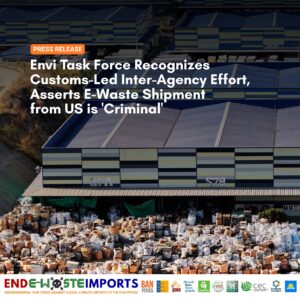
The Environmental Task Force Against Illegal E-Waste Imports to the Philippines (END E-Waste Imports) applauded the Bureau of Customs’ (BoC) initiative in leading the inter-agency dialogue held last Monday, July 6, 2026, to address the issue of e-waste shipments from the United States (US) entering the Subic Bay Freeport Zone.
“We thank the Bureau of Customs for initiating this important dialogue. We look forward to working with all the parties involved to ensure that our obligations to the Basel Convention are upheld, and that the environment and the rights of our waste workers are protected,” said Jam Lorenzo, Deputy Executive Director of BAN Toxics and one of the conveners of the Task Force.
Lorenzo reiterated that under the Basel Convention, the shipment of e-waste from the US is a “criminal act,” citing Article 4(5) of the said treaty, which states that “A Party shall not permit hazardous wastes or other wastes to be exported to a non-Party or to be imported from a non-Party.” The US is not a state party to the Convention, while the Philippines ratified it in 1993. Article 4 also states that “illegal traffic in hazardous wastes or other wastes is criminal.”
The Basel Convention on the Control of Transboundary Movements of Hazardous Wastes and Their Disposal is a global environmental treaty designed to combat toxic waste trade.
On June 25, 2026, END E-Waste Imports held a press conference exposing shipments of 234 containers of suspected e-waste from the US entering Subic, tracked by global waste watchdog Basel Action Network (BAN) from March 2025 to June 2026, with monitoring still ongoing. BAN has been alerting the BoC and the Environmental Management Bureau (EMB), the Basel competent authorities in the country, about said shipments. However, the said agencies were unable to act on the alerts because of a Manila Regional Trial Court (RTC) Branch 3 ruling in April 2025.
The RTC ruling questioned the constitutionality of DENR DAO No. 2013-22, or the Revised Procedures and Standards for the Management of Hazardous Wastes, and has since prevented the regulatory agencies from securing a pre-shipment importation clearance (PSIC) for the incoming shipments.
According to Lorenzo, the PSIC, which is akin to the prior-informed consent (PIC) requirement under the Basel Convention, is a key mechanism to ensure that shipments entering the country abide by treaty obligations.
Responding to statements by SBMA officials in their press releases that what companies are importing in Subic are not hazardous waste but recyclable materials, Lorenzo argued that under the Convention, all e-waste shipments, regardless of whether they are hazardous or not, are required to secure a PIC from a Basel-competent authority.
“This RTC ruling has been weaponized to allow unimpeded entry of illegal waste shipments such as those from the US. We hope the inter-agency dialogue led by the BOC will be able to come up with a solution to this predicament as soon as possible. We also call on US authorities to take action and stop the exporting of waste to our country,” Lorenzo said.
The END E-Waste Imports Task Force is currently working on their position paper on the issue for submission to the BOC.
“We are being turned into a dumping ground of waste from developed countries under the guise of a circular economy. Contrary to statements of SBMA officials, e-waste is waste, whether it is for recycling, recovery, or disposal, and the Basel Convention was created exactly to protect developing countries from being turned into waste receptacles for developed nations.”
##########
Media contact:
Thony Dizon, Advocacy and Campaign Officer
BAN Toxics, 0917-8322616