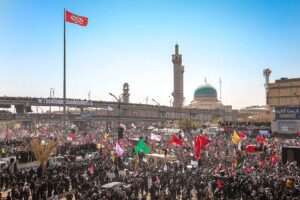
Khamenei’s funeral, Trump’s bombings, and the war the planet watches as though it were not its own
“When a maritime strait becomes the world’s windpipe, every missile stops being regional and begins breathing for everyone.”
The image of Ali Khamenei’s massive funeral was not merely a religious, political, or funerary scene. It was a photograph of wounded power. Thousands, perhaps millions, marching under the heat, amid flags, mourning, anger, and chants against Donald Trump, revealed something Washington seems not to understand, or does not want to understand. Bombs do not always break people. Sometimes they bind them together. Sometimes they transform internal differences, social anger, economic exhaustion, and political fractures into a single national emotion. Khamenei ceases to be merely a leader. He becomes a flag. And when an empire creates martyrs, it is later surprised that peoples learn to march behind their dead.
“There are funerals that do not close a story; they turn it into fuel.”
The United States is trying to prevent Hormuz from becoming a weapon against world trade; China demands stability because it depends on Gulf oil; Russia watches the tension as a strategic opportunity; Iran reminds the world that it controls the northern shore and retains the capacity to respond; Israel presses to limit its military power; India fears for its energy imports; the EU seeks to prevent a price crisis; and Pakistan, trapped among rivalries, knows that the fire could cross its borders. None of them wants an open war, but all are preparing scenarios to contain it, survive it, or exploit it. Hormuz is not merely a strait: it is the place where the powers measure how much risk the world can bear.
“When everyone watches the throat, no one hears the planet breathing.”
Trump continues bombing Iran and says he wants to keep the Strait of Hormuz open. But the real question is another one. Does he want to open Hormuz, or does he want to prove that he can still place his hand around the throat of the world’s oil? Hormuz is not just another maritime passage. It is a strategic artery through which a fundamental share of the oil and gas that fuels Asia, Europe, and much of the global economy flows. If Hormuz closes, Iran does not close. The necks of India, China, Japan, South Korea, Europe, and every country that imports energy at panic prices are squeezed. Trump is playing with a throat that does not belong to him.
“The sheriff always shoots far away, but the funeral bill arrives at home.”
Iran is not Iraq in 2003 or Libya in 2011. It is an ancient civilization, a cultured, proud, resilient people battered for decades by sanctions, threats, isolation, and other people’s wars brought to its border. Reducing Iran to its internal political structure is a Western convenience. What is at stake today is not an academic discussion about its model of government, but the right of a country not to be bombed as though its territory were a strategic testing ground. Confusing this with the fantasy that bombing will bring order to the country is one of the most dangerous illnesses of the West. Bombs can destroy radars, depots, bridges, bases, and antennas. What they cannot easily destroy is accumulated humiliation.
“The missile shatters concrete, but it almost never understands history.”
“When powers cannot explain their bombs, they always begin giving lessons in democracy.”
Israel appears in this war as the original partner, strategic beneficiary, and central actor on the board. Although the latest reported rounds of attacks fall mainly on the United States, Israel is not outside the equation. It is inside the political, military, and ideological architecture of the conflict. Netanyahu knows that a war against Iran shifts the focus away from Gaza, rearranges alliances, justifies military spending, and reinstalls the narrative of absolute survival. But he also knows that a region in flames does not distinguish for long between strategy and the abyss. Israel can gain time, support, weapons, and diplomatic room. What it cannot win forever is legitimacy over endless ruins.
“Whoever turns defense into permanent doctrine ends up living inside his own trench.”
China watches with the coldness of a creditor who knows the fire can also burn down his warehouse. For Beijing, Iran is not a romantic cause. It is energy, corridor, Eurasia, the Silk Road, access, influence, and a counterweight to Washington. China does not want a total war, because a total war raises oil prices, damages trade, disrupts maritime routes, and forces it to reveal its cards too early. But neither does it want a clear victory by the United States and Israel, because that would mean the humiliation of the Eurasian axis and a direct message to Taiwan, the South China Sea, and the strategic corridors. Beijing does not need to shout. It only needs to calculate.
“China does not always raise its voice; sometimes it moves the world with an eyebrow.”
Russia watches from within its own war, its exhaustion, and its obsession with proving that the Western order no longer orders anything. For Moscow, Iran is an ally, a military partner, an energy piece, and living proof that the multipolar world was not born in seminars, but in sanctions, drones, and cemeteries. Russia does not want Iran to fall, because an Iranian collapse would be a Western victory in its geopolitical rear. But it also cannot open too many fronts while Ukraine continues consuming resources, prestige, and blood. Putin knows that every American missile striking Iran also helps him tell the Global South that international rules are selective decoration.
“Moscow condemns someone else’s fire while keeping matches in its pocket.”
India walks a tighter rope than its speeches suggest. It needs energy, maritime stability, trade with the Gulf, a relationship with the United States, channels with Iran, and balance against China. New Delhi cannot celebrate the burning of Hormuz, because a decisive share of its energy security passes through that area. But neither can it break with Washington when its main strategic rival is Beijing. India wants to be an autonomous power, but autonomy is tested when empires demand silence. In this crisis, India is not watching from afar. It is watching from the fuel line.
“Neutrality is more elegant when the oil is still reaching the port.”
Pakistan, for its part, appears as a pivotal country, a possible mediator, and an emotionally vulnerable territory. It has a strategic border, ties with Iran, a military relationship with Saudi Arabia, economic dependence, a population sensitive to the conflict, and a history marked by impossible balances. If the war expands, Pakistan will not be able to pretend the fire is on the other side of the map. Every escalation in the Gulf strikes its domestic politics, its streets, its alliances, and its relationship with the powers. In a nuclearized region, even prudence seems to walk beside a can of gasoline.
“Pakistan does not need to enter the fire to begin smelling of smoke.”
The European Union once again appears to be that regulatory giant that arrives late at the scene, with impeccable statements and trembling hands. It speaks of restraint, international law, regional stability, and a diplomatic solution, but remains trapped between military dependence on the United States, historical guilt toward Israel, energy fears, migration pressure, and internal fragmentation. Europe hopes someone will put out the fire without forcing it to choose too much. But there are moments when refusing to take sides is also a way of taking one. If a hot bomb falls on the energy, migration, or nuclear board, Brussels will discover that geopolitics does not ask permission in several languages.
“Europe often writes good prologues when the book is already burning.”
The gravest part of this crisis is not only Khamenei’s death, nor Trump’s bombings, nor the Iranian response, nor the calculated silence of China, Russia, India, Pakistan, or the European Union. The gravest part is the naturalness with which the planet accepts being administered by men who confuse power with destiny. A strait is militarized, a people buries its leader, another government calculates its advantage, markets tremble, powers reposition themselves, and humanity keeps watching the screen as though war were a distant series. But it is not. Hormuz is not an Iranian throat.
“It is a global throat…”
“And when that throat closes, the same people who applaud the missiles today will ask who turned off the lights…”
“The planet is not at the edge of the abyss; it is learning to charge admission.”
Bibliography
U.S. Energy Information Administration (EIA). World Oil Transit Chokepoints: Strait of Hormuz. Washington, D.C., 2025.
Yergin, Daniel. The New Map: Energy, Climate, and the Clash of Nations. Penguin Press, 2020.