Friday, July 10, 2026. Florence City Hall.
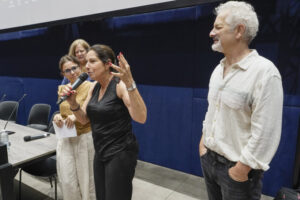
A festive press conference with the Mayor of Florence, held as part of Noa’s Reimagine Festival. The room is packed with artists, journalists, and guests. It’s hot outside, hot inside, and the excitement is real.
I’m looking for Mai, my friend and fellow member of Combatants for Peace. I can’t see her. She isn’t answering her phone or replying to my messages.
“Mai didn’t make her flight from Jordan to Italy,” one of the wonderful women from GARIWO tells me sadly. “We did everything we could. We tried to find her another flight, but it’s impossible for her to arrive in time for your film screening tomorrow.”
Mai Shahin is a therapist, a peace activist, a member of Combatants for Peace, and a co-founder of SATYAM. Both of us appear in the documentary There Is Another Way, directed by Stephen Apkon, and we were invited by NOA and GARIWO to speak with the audience following the film’s screening at the festival in Florence.
Steve, as an American, and I, as an Israeli, can simply board a plane in the countries where we live and fly to Italy.
But Mai is Palestinian. She lives in the occupied West Bank.
To get to Florence, she first has to obtain a visa to enter Italy. Then she must travel through the Allenby Bridge Crossing, cross into Jordan, and continue to Queen Alia International Airport in Amman. For Palestinians living in the West Bank, this is their only gateway to the outside world.
The other two land crossings between Israel and Jordan—the Jordan River Crossing (Sheikh Hussein) in the north and the Yitzhak Rabin Crossing in the south—are open to Israeli citizens and foreign tourists, but not to Palestinians from the West Bank.
The Allenby Crossing is open only five days a week, from 8:00 a.m. to 1:30 p.m., and on Fridays until 12:30 p.m. It is closed on Saturdays. Its operating hours are determined by the Israeli authorities. The joint Israeli-Palestinian administration of the crossing, established under the Oslo Accords, was discontinued in the early 2000s.
One border crossing. Limited opening hours. Millions of people who depend on it as their only way to reach the outside world.
This reality has even created a business of selling places in line, with Israelis and Jordanians offering “queue-jumping” services to people who have no other choice.
This is not the first time I have heard from my Palestinian friends about international trips ending in missed flights, unexpected hotel stays in Amman, or hours—and sometimes an entire night—spent waiting at the crossing.
During the summer, when travel peaks, a functioning border crossing is not a luxury. It is a basic necessity.
For comparison, the land border crossing between Israel and Egypt is open twenty-four hours a day, seven days a week, for Israeli citizens and foreign tourists.
Mai left home on Wednesday night. She knew she would face long hours of waiting in the 35-degree heat. What she did not know was that on Thursday morning the Israeli crossing staff would go on strike. The strike may have been directed at their employer, but the people who paid the price were the Palestinian travelers, who had no alternative.
Mai had no chance of making her flight.
Like families with young children, elderly people, and many other travelers, she was forced to give up. She turned around and went back home—to life in the West Bank, behind fences, walls, and checkpoints.
Mai Shaheen is my friend. She is my colleague. She is a courageous, wise, and inspiring woman. She, her daughter, and every human being living in this land deserve lives of freedom, dignity, and the freedom to move.
“Occupation” is an abstract word.
But everyday life under occupation is anything but abstract. It is found in the small details: a border crossing that doesn’t open, a missed flight, a meeting that never takes place, lives interrupted over and over again for reasons that gradually become routine.
Perhaps this is precisely the kind of everyday injustice that Hannah Arendt wrote about—the way continuous harm inflicted on human beings becomes ordinary, almost invisible, to those who do not experience it themselves.
Iris Gur, Combatants for Peace