The European Commission against Racism and Intolerance (ECRI), established by the Council of Europe, is an independent human rights monitoring body specialised in questions relating to the fight against racism, discrimination (on grounds of “race”, ethnic/national origin, colour, citizenship, religion, language, sexual orientation and gender identity), xenophobia, antisemitism and intolerance. It is composed of independent and impartial members appointed based on their moral authority and recognised expertise in dealing with racism, xenophobia, antisemitism and intolerance. According to the ECRI REPORT ON SLOVENIA (sixth monitoring cycle) published last summer, in Slovenia, “there were insufficient integration and inclusion initiatives at the local level” (p. 5). In my opinion, to be effective and achieve long-term success, integration and inclusion must start from kindergartens and schools.
By Milena Rampoldi, ProMosaik.
The report talks about the discrimination against Roma communities, against people of different sexual orientations (the LGBT community), against Muslims who are ethnically recognisable, and against refugees, including the Ukrainian people coming to Slovenia after the Russian aggression against Ukraine.
Concerning Muslims, studies suggest that Slovenian media do not fairly represent them, possibly contributing to “racialised Islamophobia”, as affirmed by Jurekovič in his study written in 2024 entitled “Islamophobia beyond Explicit Hate Speech: Analyzing the Coverage of Muslims in Slovenia’s Public Broadcasting.”
I absolutely agree with Jurekovič when he speaks about the importance of religious literacy, which, in his opinion, is a “prerequisite for the successful governance of religious diversity”. And I am convinced that Slovenia is a multi-religious country and is characterized by religious diversity. According to his research, the coverage of Muslims is Islamophobic for two reasons: On one hand, Muslims are underrepresented in Slovenian media, and on the other, there is a so-called “racial homogenization” when it comes to Muslims living in Slovenia.
In the ECRI report, examples of violence against religious minorities in Slovenia are mentioned. Examples are the following:
“In May 2021, three Muslim tombstones were desecrated when red liquid and pieces of pork meat were deposited on the graves. In November 2023, the Jewish Community Centre in Ljubljana was vandalised with a Nazi swastika. In January 2025, the Maribor Synagogue was defaced with antisemitic graffiti, notably with the slogan “Death to Jews, glory to Slovenia”.
ECRI regrets to note that there is no official data collection on the inclusion of Roma children in school education. At the same time, studies indicate that the completion rate for all nine grades of primary school among Roma students is very low, at just 21.3%, with only 12.3% in the south-eastern part of the country.
The bilingual booklet published by ProMosaik in English and Slovenian, translated by Teja Prosenc and entitled “Fables Against Racism,” would like to promote interreligious and intercultural dialogue by telling 5 fables written by two bilingual children, Leyla and Sarah Uzunlar, living in Istanbul.
The fables were written over the years, since 2017, and were translated in various languages by ProMosaik Children. For Slovenia, where the integration of Roma children is fundamental to the struggle against racism, I would like to introduce the fable of the rabbit and the mouse opposing cultural separation/discrimination in schools. Diversity is one of the most peculiar characteristics of schools in multicultural and multireligious societies. Indeed, in the introduction to the booklet, it says:
“Adults sometimes do not understand the importance of tolerance, peaceful cooperation, dialogue, and intercultural collaboration. So, we would like to give children the opportunity to tell us a fable in which animals decide not to make fun of others because they are different.”
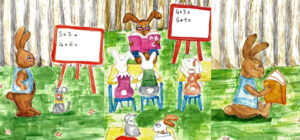
The fable of the rabbit and the mouse is the “Manifesto” of an inclusive school in which all children participate. Nobody is discriminated against because he/she has a different skin colour, cultural background, or religion.
The Rabbit and the Mouse
Once upon a time, there was a rabbit. He lived on a beautiful, green meadow. Around the meadow, there was a big wood. The rabbit read a book in the meadow because he was keen on books. He was the only rabbit around who could read.

He had practiced reading with children. They had told him how nice it was to read books and to hear new stories.
Gradually, the other rabbits also wanted to learn to read, so he built a school for rabbits on the meadow next to the wood.
After a while, he grew old, and his eyesight faded. So he bought rabbit-glasses.
In the rabbit school, the rabbit children learned to read and count. They also learned painting and did handicrafts with the rabbits’ teacher.

One day a mouse came along the school. It wanted to ask a question to the rabbits. It asked whether the rabbits would be able to help it to build a school for mice, since also mice were keen on learning reading and counting. Also, the mice wanted to read new stories.
But the rabbit replied: “You can study with us! You do not need to build a school for mice!”
Then the mouse replied: “But I am not a rabbit, and this is a school for rabbits. This is not a school for mice. I am a grey mouse, and I am much smaller than you. And you are a big, brown rabbit”.
The rabbit said:
“We can study all together in the same school. This will be an animal school for all animals. Here, all animals can read, count, paint, and write together. It will be wonderful.
Every animal talks about its own world. You can tell me about your world of mice, and I will tell you about the world of rabbits. And all animals will learn from the others. What do you think?”
