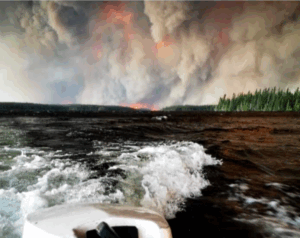
Today more than 1,800 people are displaced in northern Ontario as nearly 200 wildfires continue to rage.
Meanwhile, the entire city of Kimberley, B.C., in the province’s southeast region near the Alberta boundary has been placed on evacuation alert due to an out-of-control wildfire. The Regional District of East Kootenay says more than 8,000 residents have been warned to be ready to evacuate at a moment’s notice.
The nearby fire is nearly six square kilometers in size, as a rash of lightning strikes and new blazes sparked in the province over the weekend. Kimberley’s acting mayor, Sandra Roberts, says in the evacuation alert notice that residents would be given as much advance notice as possible but fire conditions are fast-changing.
There are four other fires across B.C. with wildfire-of-notice designation, meaning they are threatening public safety and critical infrastructure or are highly visible. The number of active fires in B.C. has spiked over the weekend to about 102, with hundreds of properties evacuated or on alert in the Boston Bar area in the Fraser Canyon.
The BC Wildfire Service says the fire near Kimberley started at high elevation and in steep and mountainous terrain, and combined with strengthening fire behavior it’s making it unsafe for crews to attack directly. It says firefighters have been setting up control lines and using existing natural barriers, including roads and trails.
In the Northern of Ontario on Monday there were 190 active fires in the province, with 56 of them considered out of control. In addition, 112 fires were being observed, six being held and 16 under control. Most of the fires are burning in the province’s northwest.
Thirteen communities have been evacuated or are in the process of evacuation. Evacuees have been flown into hub cities, namely Thunder Bay and Red Lake, before being transported to cities that are hosting them. Neskantaga First Nation is planning the evacuation today, with evacuees heading to Toronto due to limited hotel space in Thunder Bay.
The majority of the fires are burning in the Northwest region. The Whitewater Lake First Nation reported widespread destruction, including homes, belongings, and vital infrastructure, deepening concern and loss across remote communities.
According to Mr. Heintzman a member of the community, the residents had been monitoring the fire since July 13 with the help of local outfitters.
We never received any official notification from the province of Ontario informing us that the fire was approaching our community, said Mr. Heintzman, adding that the majority of residents are now sheltering in Thunder Bay.
Dramatic photos and videos showed residents fleeing by boat as a massive wall of smoke and flames rose behind them. Also at 200 kilometers north of Collins First Nation, another community was being evacuated over the weekend.
Fire crews say they will prioritize lives, property, and critical infrastructure, while restricted fire zones and open-air burning bans remain in place until further notice across the northwest.
In Ontario, there are currently 155 fire crews working to battle the flames, with approximately 80 water bombers and helicopters in operation.
About the town of Kimberley
Kimberley, a picturesque mountain town in southeastern British Columbia. The town is located within the traditional territory of the Ktunaxa Nation, whose people have lived in the region for over 10,000 years.
Ktunaxa people have occupied the lands adjacent to the Kootenay and Columbia Rivers and the Arrow Lakes of British Columbia, Canada for more than 10,000 years.
(ʔamakʔis) Ktunaxa covers about 70,000 square kilometers within the Kootenay region of southeastern British Columbia. Historically, (ʔamakʔis) Ktunaxa included parts of Alberta, Montana, Washington and Idaho.
For thousands of years, the Ktunaxa enjoyed the natural bounty of the land, moving throughout (ʔamakʔ) is Ktunaxa to follow vegetation and seasonal hunting cycles.
Today, Ktunaxa First Nations and Kootenay Tribes (based in Montana and Idaho) are rebuilding self-governance, revitalizing their language, and bringing their values and stewardship principles forward as they assert their right and responsibility to care for ʔa·kxam̓is q̓api qapsin (all living things) in ʔamakʔis Ktunaxa. But recent forest fires threaten their life style, values and ancestral territories.
____________________________________________________________________________________________
Source: AptnNews, CP and CityNews Ktunaxa First Nations