Interpretive Essay and Critical Reading of a Foundational Document
The speech delivered by Chinese President Xi Jinping at the opening of the 2026 World Artificial Intelligence Conference goes far beyond the technological debate. His proposal places artificial intelligence at the heart of the reorganization of the international order and argues that its development, security, and distribution cannot be left under the monopoly of a few corporations or powers. Behind concepts such as openness, collaboration, shared benefit, dialogue among civilizations, and strengthening of the Global South, a broader thesis emerges: future peace and stability will depend on humanity’s ability to collectively build the rules of an infrastructure that will transform all spheres of life.
Introduction
Foundational speeches are rarely recognized as such at the moment they are delivered.
In general, their true dimension is only understood years or decades later, when the processes they announced have already transformed institutions, economies, power relations, and everyday life. Before becoming events, major historical changes are often formulated as ideas, doctrines, declarations, programs, or questions addressed to an era that still cannot fully grasp their scope.
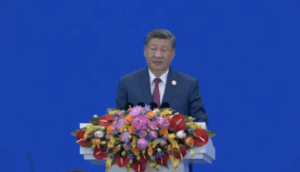
The speech delivered by the President of China, Xi Jinping, on July 17, 2026, during the opening of the World Artificial Intelligence Conference and the High-Level Meeting on Global AI Governance, held in Shanghai, potentially belongs to that category.
Its title already contains a political definition: “Joining hands to build a just and equitable global governance system for artificial intelligence.”
This is not a technical conference about generative models, computing capacity, industrial automation, or commercial advantages. Nor is it merely a presentation of Chinese advances in this field. The core of the speech lies on another level: who will set the rules of artificial intelligence, with what legitimacy, under which institutions, for whose benefit, and according to what conception of international coexistence.
Xi begins by recalling that seventy years have passed since the Dartmouth meeting held in the United States in 1956, generally considered one of the founding moments of artificial intelligence as a field of research. From that historical reference, he compares the ongoing transformation to the steam engine, electricity, and the Internet—technologies that not only introduced new tools but reorganized the forms of production, communication, and social life.
The comparison is decisive. It places artificial intelligence in the category of civilizational infrastructures.
A civilizational infrastructure is not simply a technology used within a society. It is a technology that modifies the society that uses it. It reorganizes work, knowledge, education, state administration, security, medicine, cultural production, the exercise of power, and the relationship between human beings and machines.
For that reason, the central question can no longer be limited to which country will produce the most advanced system or which company will first achieve artificial general intelligence. The decisive question is who will write the rules of the planet’s new cognitive infrastructure.
The Shanghai speech offers a Chinese answer to that question.
Not an exclusively national answer, at least in its declared formulation, but a proposal for an international architecture based on four principles: openness and shared benefit; security and human control; inclusion and learning among civilizations; solidarity and multilateral governance.
These principles contain a conception of world order. Read together, they maintain that artificial intelligence should not be developed as the exclusive patrimony of a few powers, as a tool of geopolitical containment, or as a technology detached from the problems of inequality that affect humanity.
AI instead appears as a cumulative creation of human knowledge and, therefore, as a good whose governance must incorporate the international community.
This is the thesis that organizes the present analysis:
Artificial intelligence is the visible vehicle. The underlying proposal is a new architecture of global governance.
An architecture in which collaboration does not constitute a secondary instrument of peace, but one of its structural conditions.
I. A Speech Delivered at a Turning Point
Xi’s speech cannot be understood in isolation from the historical moment in which it was delivered.
Humanity is going through a convergence of transformations that, individually, would already be sufficient to modify the international system: technological acceleration, automation, climate crisis, the shift of the economic axis toward Asia, the relative weakening of multilateral institutions, prolonged wars, trade fragmentation, reorganization of supply chains, political growth of the Global South, and competition for control of digital infrastructures.
Artificial intelligence enters this scenario not as just another sector of the economy, but as a transversal technology capable of altering all others.
For that reason, the technological race has quickly become a geopolitical race.
Advanced semiconductors, data centers, critical minerals, energy networks, cloud computing, foundation models, algorithms, data, and scientific talent are already part of the strategic infrastructure of states.
The language of innovation increasingly coexists with that of national security.
The United States and its allies have imposed restrictions on the export of certain chips, manufacturing equipment, and advanced technologies to China. Beijing, for its part, has accelerated technological substitution, strengthened its domestic industry, and deployed a strategy that combines state planning, market forces, scientific research, industrial production, and international cooperation.
AI has ceased to be solely a space for scientific experimentation.
- It is territory of sovereignty.
- It is productive capacity.
- It is military power.
- It is informational control.
- It is accumulated knowledge.
- It is planning capacity.
- It is the possibility of establishing the standards under which a growing part of the economy and social life will operate.
In this context, Xi formulates several questions that condense the civilizational dilemma: how to coexist with machines capable of “thinking”; how to protect security when algorithms intervene in decision-making; how to address ethical problems through governance capable of adapting; and how to ensure that artificial intelligence reaches everyone when the technological gap continues to widen.
These are not questions directed exclusively at engineers.
They are political, legal, philosophical, and social questions.
They challenge the relationship between human power and machines, responsibility in the face of automated decisions, the concentration of capabilities in large corporations and powers, and the possibility that a technology born from the historical accumulation of human knowledge deepens existing inequalities.
At this point, one of the most important conceptual shifts of the speech occurs: the problem of artificial intelligence is not defined only by what it can do, but by the system of relations under which it will be developed.
Technology does not appear separate from the political order.
The question of AI is also a question about the world.
II. From Technological Race to Dispute Over Rules
A superficial reading of the contemporary landscape could conclude that the United States and China are competing to develop the best models, manufacture the most advanced chips, or lead automation markets.
All of that is real, but insufficient.
The deeper competition is not waged solely within the technological system. It is waged over the capacity to define the system itself.
Whoever establishes the norms, standards, institutions, security protocols, and criteria of legitimacy does not merely participate in technological development: that actor conditions the space in which the others must act.
This is a form of structural power.
It does not simply consist in forcing other actors to do something. It consists in shaping the conditions within which those actors will make their decisions.
During much of the twentieth century, the central institutions of the international economic and political order were designed under clear Western hegemony. The United Nations, the International Monetary Fund, the World Bank, the Bretton Woods system, the World Trade Organization, and numerous regulatory structures emerged from historical power alignments in which the United States and Europe occupied the center.
Although many of those institutions acquired a multilateral character and made essential contributions, the distribution of power within them never ceased to reflect, in different degrees, the order from which they came.
Artificial intelligence now opens a new space for institutionalization.
The rules are not yet settled.
There is no world AI government.
There is no single authority capable of establishing universal rules.
National regulations, regional frameworks, voluntary commitments, corporate principles, United Nations initiatives, and proposals formulated by different powers coexist.
We are therefore in a constitutive phase.
Xi intervenes at that moment to affirm that the design of governance cannot become the privilege of a reduced group of countries. His proposal insists on the coordination of strategies, norms, and technical standards, with the United Nations as the central space of legitimation and with expanded participation from the Global South.
In other words, China no longer presents itself only as a user, manufacturer, or technological competitor.
It presents itself as a producer of institutions.
That transition is historically significant.
For decades, China was described as the world’s factory. Then as the great emerging trade power. Later as a technological competitor. The Shanghai speech reveals an additional stage: China aspires to intervene in the writing of international rules.
There is a qualitative difference between rising within an order and participating in the construction of the order.
The first action changes a country’s position.
The second changes the system’s structure.
III. First Axis: Artificial Intelligence as Infrastructure of the New International Order
The first axis of the speech consists in elevating AI from the technological plane to the civilizational plane.
Xi explicitly links the current revolution with the steam engine, electricity, and the Internet. This is not an ornamental analogy. Each of those technologies transformed the organization of power.
The steam engine multiplied production, reorganized labor, and sustained the expansion of industrial economies.
Electricity changed cities, industry, communication, and domestic life.
The Internet reorganized the circulation of information, finance, trade, politics, and social relations.
Artificial intelligence adds a new dimension: it intervenes in the production of knowledge, in the classification of reality, and in decision-making.
It does not only execute tasks.
It selects, predicts, ranks, recommends, interprets, and produces content.
It can assist a doctor, control a factory, organize traffic, draft a law, identify a face, direct a weapon, evaluate a worker, predict behavior, diagnose an illness, or construct a political narrative.
For that reason, governing AI means governing a transversal layer of social life.
The speech recognizes this problem when it raises the need to keep it under human control, establish laws and regulations, create systems of technological monitoring, early warnings, and emergency responses, and prevent both abuse and malicious use.
But the proposal goes beyond risk containment.
Xi maintains that AI should become a driver of shared prosperity and common security.
The expression “common security” is particularly relevant. It stands in opposition to a conception according to which one state can build its own security by reducing the capacities of others.
In the speech, the security of artificial intelligence should not be organized as a zero-sum game.
Global governance thus appears as an attempt to prevent the cognitive infrastructure of the twenty-first century from fragmenting into closed systems, incompatible technological blocs, and permanent hierarchies of access.
The goal is not merely to prevent algorithmic accidents.
It is to prevent the technological structure from reproducing and deepening the unequal structure of world power.
IV. Second Axis: The Dispute Is Not Only About Technology, but About Rules
The second axis lies in the confrontation between two tendencies.
The first understands artificial intelligence as a strategic capability that must be protected, restricted, and used to maintain national advantages.
The second holds that, while recognizing risks and state interests, the transnational nature of AI requires cooperation, shared standards, and multilateral mechanisms.
Xi’s speech is clearly located in this second formulation.
Its first principle is openness. It calls for promoting open source, collaboration, exchange, and the application of AI in the real economy. Its declared objective is that traditional industries, new sectors, and future activities may all benefit from it.
However, the speech immediately introduces a limit: openness must coexist with security, regulation, and human control.
It does not propose technological circulation without rules.
It proposes open governance, but not deregulated governance.
This combination is important because it avoids a frequent false dichotomy in the debate: either absolute freedom of innovation or authoritarian control.
The real problem is to build institutions capable of allowing innovation without handing corporations or states unchecked power.
The Chinese formulation must be critically examined, of course. Like any normative project driven by a great power, it is also tied to national interests, legitimacy needs, and strategic objectives.
But recognizing those interests does not eliminate the relevance of the proposal.
All major international architectures have been formulated by actors who had interests.
The issue is not to imagine a disinterested policy, but to analyze what institutions are proposed, what degree of participation they admit, what rights they protect, how they distribute benefits, and what mechanisms they establish to limit power.
In Shanghai, Xi expressly rejected the excessive expansion of the concept of national security in the field of AI and the idea of placing one country’s security above that of others.
The implicit target is evident.
The technological restrictions imposed on China are presented by Beijing not as mere commercial controls, but as attempts to preserve a technological hierarchy through exclusion.
From the American perspective, by contrast, those measures are justified by military risks, national security, protection of sensitive technologies, and defense of strategic advantages.
The tension between both positions defines a central part of the contemporary conflict.
There is no dispute here between a purely cooperative policy and a purely competitive one. China also protects capacities, regulates data, develops strategic technologies, and pursues autonomy.
The difference lies in the normative project each actor presents outward.
The Shanghai speech seeks to turn openness and cooperation into sources of international legitimacy in the face of a Western policy perceived by many countries as increasingly restrictive.
This dispute will be decisive for the Global South.
Because for many states, the problem is not choosing between Washington and Beijing in ideological terms. It is gaining access to technology, infrastructure, training, financing, and regulatory capacity without being trapped in a new relationship of dependency.
V. Third Axis: Common Security Against Technological Fragmentation
Security occupies a central place in the speech.
But it is not presented only as protection against uncontrolled systems, cyberattacks, algorithmic manipulation, or autonomous weapons.
It also refers to the security that emerges from a less fragmented international order.
Xi states that AI must remain under human control and that it is necessary to respond to its inherent and derivative risks. At the same time, he rejects the expansive use of national security to slow the technological development of other countries.
These two propositions must be read together.
The first recognizes that technology requires limits.
The second warns that the language of risk can become an instrument of power.
Security, in effect, is never a neutral concept.
Whoever defines what constitutes a threat gains the ability to prohibit, exclude, sanction, and control.
In the field of AI, that capacity can determine who gains access to advanced chips, which laboratories participate in international networks, which models may circulate, which companies operate in certain markets, and which countries remain relegated to consuming technologies they do not control.
Technological fragmentation could produce a world made up of incompatible ecosystems, separate networks, rival standards, and supply chains subjected to political alignments.
In that scenario, artificial intelligence would not unite humanity.
It would digitally reproduce the logic of blocs.
Xi has maintained this criticism in previous speeches. In his address to the 2022 World Economic Forum, he defended integration over decoupling, called for rules for AI and the digital economy based on broad consultation, and rejected the construction of “exclusive small yards with high walls” and parallel systems. He also linked peaceful coexistence with cooperation for mutual benefit and held that confrontation does not solve problems, but can produce catastrophic consequences.
The continuity is evident.
The 2026 speech is not an improvisation motivated solely by current restrictions.
It is the application to the field of artificial intelligence of a discursive line sustained for years: interdependence, rejection of decoupling, multilateralism, cooperation, and shared development.
This allows us to understand that, in the vision presented by Xi, collaboration is not a moral concession or a later stage after stability.
It is one of its foundations.
The argumentative sequence can be formulated as follows:
- Respect for diversity.
- Dialogue among civilizations.
- Broad consultation.
- Joint construction.
- Shared benefit.
- Development.
- Common security.
- Stability.
- Peace.
This is not to affirm that Chinese foreign policy in reality always reproduces that scheme perfectly. No power fully coincides with the normative image it constructs of itself.
But it is to recognize that this sequence constitutes a persistent element of the diplomatic thought expressed by Xi Jinping.
VI. Fourth Axis: Collaboration as the Architecture of Peace
This is one of the deepest cores of the speech.
Xi does not present cooperation as a useful tool for managing international relations that would, in essence, continue to be governed only by confrontation.
He presents it as the organizing principle of a stable order.
In his speeches, collaboration appears on multiple levels: development, infrastructure, trade, health, security, culture, science, education, climate, technology, and governance.
The Belt and Road Initiative was defined in 2023 through the principles of joint planning, joint construction, and shared benefit. In that same intervention, Xi held that the spirit of the ancient Silk Road was based on peace and cooperation, openness, inclusiveness, mutual learning, and reciprocal benefit.
At the 2022 World Economic Forum he stated that cooperation was the only appropriate path to face a global crisis and described countries not as small isolated boats, but as passengers on the same great ship.
In Shanghai, the same logic is expressed through a different image: “A single thread cannot make music and a single tree does not make a forest.” Artificial intelligence, he argued, should not become the solitary performance of one country, but a “symphony of international cooperation.”
The recurrence of these images is not accidental.
- The shared ship.
- The symphony.
- The forest.
- The Silk Road.
- The garden of civilizations.
All represent systems composed of different elements whose existence depends on relationship.
They do not propose erasing diversity, but coordinating it.
In this conception, peace is not simply the absence of war.
It is the existence of relations sufficiently dense, just, and reciprocal for war to cease being considered a rational solution.
Collaboration produces interdependence.
Interdependence generates shared interests.
Shared interests create incentives for stability.
Stability enables development.
And development strengthens the material conditions of peace.
We can synthesize this vision in an interpretive formulation:
In the political thought expressed by Xi Jinping, collaboration is not an instrument of peace; it is its architecture.
This sentence is not a literal quote from the Chinese leader.
It is a conclusion that emerges from a transversal reading of his speeches.
And it must be submitted to critical analysis.
Interdependence does not automatically eliminate war. History shows that deeply connected countries can also enter into conflict. Trade is not enough to neutralize nationalism, territorial dispute, militarism, or the struggle for hegemony.
However, it does not follow from that that cooperation is irrelevant.
It follows that it must be accompanied by institutions, rules, dispute-resolution mechanisms, and a reasonably fair distribution of its benefits.
Collaboration without equity can become dependency.
Interdependence without institutions can become vulnerability.
Lasting peace therefore requires something more than ties: it requires an architecture that prevents those ties from being used as instruments of coercion.
It is precisely at this point that the speech links collaboration with governance.
VII. Fifth Axis: The Global South and the Possibility of a New Historical Injustice
One of the most relevant passages in the speech is Xi’s warning about the possibility of creating a “new historical injustice” in the era of artificial intelligence.
The phrase deserves attention.
It does not speak simply of a technical gap.
It speaks of historical injustice.
The conceptual choice places technological inequality within a longer sequence of colonial concentration, economic subordination, resource extraction, industrial dependency, and asymmetrical distribution of knowledge.
If AI capabilities remain concentrated in a reduced group of countries and companies, the rest of the world will not only have less technology.
It will have less autonomy.
States that do not possess computational infrastructure, data, energy, scientific talent, and regulatory capacity will depend on systems developed outside their societies.
Those systems could interpret their languages, cultures, needs, and realities through categories produced elsewhere.
The AI gap is therefore also a gap of representation.
A language absent from training data has less existence within the system.
A poorly represented community may be classified inaccurately.
A country without its own technological capacity may be limited to buying solutions designed according to external priorities.
A public administration dependent on external providers may lose sovereignty over strategic data.
An economy without competitive automation may become trapped in lower-value activities.
For that reason, access to artificial intelligence cannot be reduced to consumer access to certain applications.
It requires the capacity to create, adapt, audit, regulate, and govern.
In Shanghai, China announced that over the next five years it will provide 5,000 training and seminar opportunities in AI for developing countries; promote international cooperation centers with ASEAN, the Arab League, the African Union, the Community of Latin American and Caribbean States, the Shanghai Cooperation Organization, and the BRICS; and allow thirty countries to use MAZU, an AI-assisted weather warning system.
These measures have practical value, but also political value.
China is building a direct relationship between its technological project and the Global South.
It offers not only products.
It offers training, institutions, platforms, and participation in a narrative of more equitable governance.
This should not be analyzed naively.
China seeks influence, alliances, markets, legitimacy, and normative capacity. International cooperation is also part of its strategy of ascent.
But reducing all cooperation to propaganda would be equally naïve.
The rigorous question is not whether China has interests.
The question is what this cooperation materially produces, under what conditions, with what decision-making capacity for participating countries, and what alternatives it offers to existing structures.
For Latin America, Africa, and broad regions of Asia, the discussion is existential.
To be merely a territory for the extraction of critical minerals and a market for imported technologies would mean repeating in the digital economy a known subordinate position.
Participating in the creation of rules, institutions, applications, and knowledge opens, at least potentially, another path.
VIII. The Epistemological Dimension: Who Has the Right to Think the Twenty-First Century
The Chinese proposal does not only challenge the material distribution of power.
It also challenges the distribution of the capacity to produce legitimate thought about the world order.
For much of the nineteenth and twentieth centuries, the main categories used to interpret international politics were built and legitimized in Western intellectual centers.
Concepts such as modernization, development, security, democracy, governance, economic rationality, and international order circulated from universities, governments, multilateral organizations, and think tanks located mainly in Europe and the United States.
This does not mean that thought did not exist outside the West.
There was and is enormous diversity of philosophical, political, and social traditions.
The problem was the inequality in their capacity for circulation and legitimation.
A limited set of institutions obtained the power to define which theories were universal and which were considered local, cultural, or peripheral.
The shift of the world’s economic and technological center now also compels a review of the epistemological center.
It is no longer enough to ask who has greater military, productive, or financial capacity.
We must ask:
Who produces the ideas with which the world interprets the twenty-first century?
Who defines the problems?
Who establishes the categories?
Who decides what form of modernization is valid?
Who determines which risks are universal and which can be ignored?
Who translates the experience of most of humanity into concepts capable of guiding global institutions?
Xi’s insistence on consultation, joint construction, learning among civilizations, and the participation of the Global South allows the reflection to be extended to the terrain of knowledge.
The Chinese leader does not literally formulate a theory about the “collaborative production of contemporary thought.”
That is an interpretation.
But it is an interpretation grounded in the coherence of his proposal.
If world institutions must be built through broad consultation, joint contribution, and shared benefit, it is legitimate to ask why the thought intended to understand them should continue to be concentrated in a single intellectual tradition.
Artificial intelligence makes this issue even more urgent.
AI systems do not merely process information.
They incorporate taxonomies, languages, values, priorities, and representations of the world.
If most of those systems are built from data, criteria, and objectives defined by a restricted group of companies and countries, technological concentration will also become epistemological concentration.
Humanity runs the risk of delegating part of its memory, interpretation, and imagination to systems that do not reflect its diversity.
The governance of artificial intelligence must therefore include governance of representation.
It is not enough to ensure that different countries can use AI.
It is necessary that they can participate in defining what those systems know, how they classify, what languages they understand, what cultures they represent, and what values they protect.
Technological cooperation thus acquires a civilizational dimension.
It is not only about sharing tools.
It is about sharing the capacity to produce meaning.
IX. The Diversity of Civilizations as a Limit to Technological Universalism
Xi’s third principle in Shanghai calls for promoting inclusion and mutual learning among civilizations.
The speech maintains that the application of AI should not erode civilizational diversity or the cultural singularity of countries. It also states that technology should increase understanding, tolerance, exchange, and the capacity to share among civilizations.
This passage introduces a discussion that generally remains in the background.
Artificial intelligence tends to present itself as a universal technology.
But no system is culturally neutral. The data on which it learns reflect concrete societies.
The definitions of security, truth, harm, privacy, freedom, responsibility, and well-being are not identical in all political traditions.
The challenge is to avoid two extremes.
The first is to impose as universal the values and categories of the technologically dominant actors.
The second is to accept, in the name of cultural diversity, any practice that violates fundamental rights.
A plural governance cannot be a simple sum of relativisms.
It needs common ground.
Xi speaks of “common values of humanity,” but leaves open a decisive question: how those values are defined, who participates in their formulation, and by what procedures they can become applicable norms.
That gap does not invalidate the proposal. It points to the political work that remains pending.
Dialogue among civilizations cannot be limited to diplomatic ceremonies. It must translate into real processes of deliberation, negotiation, and normative construction.
At this point, AI could become both a risk and an opportunity. It can homogenize languages, reinforce stereotypes, and concentrate cultural production. But it can also facilitate translation, recover archives, broaden access to knowledge, and enable unprecedented forms of dialogue among communities.
The direction it takes is not determined by technology. It will depend on the political architecture that governs it.
X. Institutionalization: From Rhetoric to WAICO
A speech acquires greater relevance when it begins to be translated into institutions.
The Shanghai Conference was not limited to a declaration of principles. In its context, the creation of the World Artificial Intelligence Cooperation Organization, WAICO, was formalized through an agreement initially signed by representatives of twenty-nine countries.
According to the Chinese Ministry of Foreign Affairs, the organization seeks to coordinate development strategies, governance rules, and technical standards, promote safe and equitable AI, and strengthen the capacity of Global South countries. Beijing maintains that this initiative should operate in a way compatible with the central role of the United Nations.
The creation of WAICO constitutes a qualitative step.
So far, international AI governance has developed through a dispersed constellation of processes: United Nations resolutions, UNESCO frameworks, G7 initiatives, OECD recommendations, regional regulations, security summits, voluntary agreements, and corporate policies.
WAICO introduces an organization directly promoted by China and explicitly oriented toward international cooperation.
Its future relevance will depend on several factors:
The number and diversity of its members.
The real participation of the Global South.
The transparency of its procedures.
Its capacity to produce rules and not just declarations.
Its relationship with the United Nations.
The degree of influence held by smaller states.
The participation of universities, workers, scientific communities, and civil society.
The existence of evaluation mechanisms.
The way it resolves tensions between sovereignty, human rights, security, and development.
We still do not know whether WAICO will become an influential institution, a coordination forum, or mainly a diplomatic space.
But its creation shows that China has moved from formulating principles to promoting an international structure.
Institutions often begin as modest projects.
Their historical importance depends on the capacity they acquire to produce habits, norms, expectations, and networks of cooperation.
For that reason, it would be premature to compare WAICO with Bretton Woods in terms of effective power.
But it is not premature to recognize that it participates in a dispute comparable in nature: the dispute over building the institutions of a new era.
XI. What the Speech Says and What It Does Not Say
Every serious analysis must distinguish between the normative project and reality.
Xi’s speech proposes openness, collaboration, common security, cultural diversity, multilateralism, and equity.
It is also necessary to examine its silences.
It does not develop in depth how individual rights will be protected against surveillance systems.
It does not define independent audit mechanisms.
It does not explain how conflicts between state sovereignty and human rights will be resolved.
It does not specify what participation workers affected by automation will have.
It does not establish how the economic benefits generated by AI will be distributed.
It does not sufficiently address corporate concentration.
It does not develop the environmental impact of computational infrastructure.
It does not explain what limits should apply to the military use of autonomous systems.
It does not determine how scientific freedom will be guaranteed within an international governance system.
These gaps are significant.
They do not diminish the speech’s historical importance, but they prevent treating it as a finished solution.
It must be read as a proposal of principles and direction, not as a complete regulatory model.
It is also necessary to avoid idealizing China.
The country has a centralized political system, a broad surveillance infrastructure—although almost no one feels truly surveilled—a conception of the relationship between individual, society, and state different from Western liberalism. Those characteristics could be part of the debate over any global normative role that China aspires to play.
But the analysis cannot stop there.
Criticism of China does not exempt one from examining the concentration of private technological power in the West, commercial surveillance, massive data extraction, algorithmic bias, the military use of AI, or the ability of a few corporations to influence essential infrastructures without democratic mandate.
There is no pure model facing another defective one.
There are different systems with their own contradictions, interests, and risks.
Precisely for that reason, governance should not remain in the hands of a single power, company, or political tradition.
Plurality here is not a diplomatic gesture. It is a mechanism of checks and balances.
XII. A Political Corpus, Not an Isolated Speech
The Shanghai text must be read as part of a continuity.
For more than a decade, Xi has articulated a series of recurring concepts:
Community with a shared future for humanity.
Broad consultation.
Joint contribution.
Shared benefit.
Common development.
Common security.
Multilateralism.
Dialogue among civilizations.
Rejection of Cold War mentality.
Opposition to zero-sum games.
Respect for different paths of modernization.
Strengthening of the Global South.
These concepts appear in his speeches on the Belt and Road, the World Economic Forum, the United Nations, the BRICS, the Shanghai Cooperation Organization, and China’s initiatives on development, security, civilization, and governance.
In 2022 he called for rules for AI and the digital economy drawn up through full consultation. In 2023 he defined Belt and Road cooperation as shared planning, construction, and benefit. In 2026 he applies the same framework to artificial intelligence.
This makes it possible to identify a doctrine.
Not a closed doctrine in the legal sense, but a relatively coherent conception of the international order.
Its premise is that humanity faces transnational challenges that no state can solve in isolation.
Its diagnosis holds that existing institutions present deficits of representation and effectiveness.
Its critique points to unilateralism, fragmentation, protectionism, hegemony, and the extension of national security into economic and technological spheres.
Its proposal is structured around sovereignty, multilateralism, development, and cooperation.
Its emerging political subject is the Global South. Its horizon is a community with a shared future. Artificial intelligence does not replace this doctrine. It is incorporated into it. That is why the Shanghai speech is so relevant: it shows how a vision built over years adapts to the technology that will probably reorganize the twenty-first century.
XIII. Journalism, Primary Sources, and Interpretive Sovereignty
There is a fundamental journalistic reason to read this speech extensively.
We live in an ecosystem of fragmented information.
Speeches reach the public turned into headlines.
Strategic documents are reduced to three phrases.
Agencies select what they consider newsworthy.
The media reorganize that material according to their own editorial lines.
Social networks separate statements from their context.
Algorithms privilege immediate reaction over understanding.
The result is a paradox.
We have never had access to so much information and yet a growing part of public debate takes place without reading the original sources.
For investigative and interpretive journalism, this renunciation is dangerous.
Those who do not consult primary documents end up depending on someone else’s selection.
And every selection contains a point of view. Reading the full speech does not mean adhering to it. It means recovering interpretive sovereignty. It allows us to examine the argumentative architecture, the recurrences, the omissions, the concepts, and the internal relationships that disappear when the text is fragmented.
In this particular case, citing the relevant passages extensively is indispensable because the importance of the document does not reside in an isolated phrase. It resides in the articulation of a system:
Openness linked to innovation.
Security linked to human control.
Diversity linked to civilizations.
Solidarity linked to governance.
Governance linked to the United Nations.
Cooperation linked to the Global South.
Technological development linked to peace and stability.
The unity of meaning is lost when those elements are presented separately.
For this reason, the incorporation of relevant quotations does not serve a decorative function.
It allows the reader to observe directly the source on which the analysis is built.
In a time of propaganda, disinformation, and geopolitical simplification, showing the source is also a democratic practice.
XIV. Not an Adherence, but an Invitation to Think
The publication and analysis of this speech should not be interpreted as automatic adherence to Chinese policy.
Journalism does not work with primary documents to venerate them.
It works with them to understand power.
The speech must be read critically.
Its concepts must be compared with practice.
Its promises must be examined over time.
Its institutions must be evaluated by their results.
Its silences must be questioned.
But rigorous criticism begins with knowing what one criticizes.
For too long, part of the Western debate about China has been built through inherited categories, ideological simplifications, and secondary sources. And a lot—much, much, very much—disinformation.
At the same time, part of the favorable discourses about China has fallen into the opposite error: replacing critical analysis with a celebratory narrative.
Both approaches are insufficient.
China should neither be demonized nor idealized. It should be studied.
And studying it means recognizing that it produces political thought, institutions, technologies, and proposals capable of influencing the future organization of the world.
The debate cannot be reduced to deciding whether the West or China “is right.”
The historical question is broader:
How will we build an order capable of incorporating different political traditions without renouncing the universal protection of human dignity?
How will we prevent multipolarity from becoming a new imperial competition?
How will we ensure that collaboration does not reproduce dependency relationships?
How will we transform diversity into deliberative capacity?
How will we guarantee that AI increases human autonomy instead of diminishing it?
How will we distribute its benefits?
How will we prevent the new technological order from consolidating earlier inequalities?
These questions still do not have definitive answers.
That is precisely why we must formulate them collectively.
Conclusion
The speech delivered by Xi Jinping in Shanghai can be read as an intervention on artificial intelligence. But that reading would be insufficient.
It is also a speech about the international order.
About the distribution of power.
About sovereignty.
About security.
About the diversity of civilizations.
About the right of the Global South to participate in building the rules.
About the possibility that a technology born from the accumulated intelligence of humanity may be appropriated by a minority.
And, above all, it is a speech about collaboration as the foundation of stability and peace.
Its historical relevance does not depend on all its proposals being realized.
Foundational documents matter because they make an aspiration visible, identify a conflict, and provide a language for organizing the future.
In Shanghai, China declared that it does not want to limit itself to competing within the existing technological order. It wants to participate in building its institutions.
The emergence of WAICO, the training offer for developing countries, the cooperation centers proposed with Global South organizations, and the defense of the United Nations as the axis of legitimacy show that this aspiration has begun to translate into concrete actions.
We still do not know what scope they will acquire.
Nor do we know whether international cooperation will be able to overcome bloc logic, rivalry among powers, and corporate concentration.
But we do know that humanity stands before a choice.
It can allow the cognitive infrastructure of the twenty-first century to be built through exclusions, monopolies, unilateral controls, and deep inequalities.
Or it can try to create an international system that distributes capacities, establishes limits, protects diversity, and subjects technological power to broader deliberation.
The Chinese proposal must be discussed, contrasted, and criticized.
But it cannot be ignored.
Because it expresses one of the central features of the epochal shift: strategic thought no longer has a single center of gravity.
The ideas intended to organize the twenty-first century are beginning to emerge from diverse spaces across the planet.
This shift does not guarantee a fairer world.
But it opens the possibility that the future will cease to be defined by a single political tradition, a single power structure, or a single interpretation of modernity.
Proposing new perspectives thus becomes an urgent necessity. And building them collaboratively becomes a historical responsibility.
Not because all civilizations must think in the same way. But because none, on its own, has sufficient answers to govern a transformation that will affect all humanity.
In this hour of inflection, thinking together is not an act of intellectual courtesy.
It is a condition of survival.
***
Main Address by H.E. Xi Jinping, President of the People’s Republic of China, at the Opening Ceremony of the 2026 World Artificial Intelligence Conference (AI) and the High-Level Meeting on Global AI Governance
Shanghai, July 17, 2026
Dear colleagues and guests,
Ladies and gentlemen,
Friends,
Seventy years ago, a group of young scholars first proposed the concept of artificial intelligence (AI) at the Dartmouth Conference in New Hampshire, United States. Over the following 70 years, AI scientists and researchers from around the world explored this unknown territory, moved forward through twists and turns, and achieved breakthroughs through their persistent and arduous work. Today, seventy years later, in the face of the new wave of AI development, we gather on the banks of the Huangpu River to deliberate on how to promote AI globally for the positive, for the good, and for humanity. All this makes our meeting highly important. On behalf of the Chinese Government and people, I would like to extend our warm welcome to all of you.
Looking back at history, the invention of the steam engine ushered in industrial civilization, the widespread access to electricity ignited modern society, and the birth of the Internet connected the whole world. Each of these technological revolutions has deeply restructured our way of working and living, and enabled a tremendous leap in economic and social development.
Today, unprecedented global changes in a century are accelerating their evolution. A new round of technological revolution and industrial transformation is advancing more rapidly, and the world has entered an unprecedented period of active innovation in AI technologies. Intelligent connectivity, human-machine collaboration, cross-sector integration, co-creation and sharing, and other intelligent technologies are unleashing enormous energy. All this brings great opportunities as well as governance challenges. Human beings must answer the questions of our time: How do we deal with the machine that begins to think? How do we ensure safety when the algorithm is part of decision-making? How do we address ethical challenges arising from technologies through adaptive governance? How do we make AI a reality for all when the gap continues to widen? These are all questions that require serious reflection and joint responses from the international community.
China believes that all countries should adopt a people-centered approach and develop AI for the positive and for the good. We must ensure that AI becomes an important driver of shared prosperity and common security. We must join hands to build a fair and reasonable global AI governance system. To that end, I would like to share four observations.
First, we must adhere to the principle of openness and shared gains, and promote innovation-driven development. As a new engine of global economic growth, and an accelerator in replacing old growth drivers with new ones, AI is moving from the digital world into the physical world. We must seize the rarely occurring historic opportunities to encourage open source, openness, cooperation, and sharing. We must comprehensively facilitate technological innovation, industrial development, and scenario-based application of AI. We must advance in a coordinated manner the transformation and upgrading of traditional industries, the cultivation and growth of emerging industries, and the forward-looking planning of future industries, so that all sectors and businesses can benefit from AI.
Second, we must strengthen our risk awareness and ensure that AI is safe and controllable. AI must be a trustworthy tool for humanity. We must take seriously the various types of inherent and secondary risks that AI may generate. We must establish systems of laws and regulations, technical monitoring, risk early warning, and emergency response, in order to strengthen the security line, prevent abusive and malicious use, and ensure that AI is always under human control. At the same time, we must jointly reject conduct such as generalizing the concept of national security in the field of AI and putting one country’s security above that of others.
Third, we must encourage inclusiveness and promote mutual learning among civilizations. The development and application of AI must not erode or undermine the diversity of world civilizations or the uniqueness of the cultures of different countries. We must shape AI values in accordance with the common values of humanity, and make good use of AI technologies to enhance understanding, inclusiveness, exchanges, and mutual learning among all civilizations. We must carefully cultivate the garden of civilizations so that the beauty of each can be appreciated and shared.
Fourth, we must advocate solidarity and improve global governance. AI is an invaluable reservoir in which the collective wisdom of all humanity is crystallized. We must practice true multilateralism and effectively uphold the important role of the United Nations. We must strengthen the articulation and coordination of AI development strategies, governance rules, and technical standards in order to form as soon as possible a global governance framework based on consensus, allowing this cutting-edge technology to better benefit humanity. We must carry out broad international cooperation and help Global South countries build their capacities to close the digital and AI divide, promote sustainable development, and avoid causing new historical injustice in AI.
Ladies and gentlemen,
Friends,
This year marks the beginning of China’s 15th Five-Year Plan. It lays out the master blueprint for China’s economic and social development in the coming five years, and it also offers immense opportunities for the international community. In recent years, China has embraced AI with open arms. We have promoted interaction between an efficient market and a well-functioning government, strengthened AI innovation, actively advanced the AI Plus Initiative, and cultivated a healthy ecosystem for all entities to prosper together. The value of key industries in the smart economy has exceeded one trillion yuan. Smart terminals in numerous households have truly improved the well-being of the people. Smart manufacturing in China has already become another shining calling card of Chinese modernization.
At the same time, China places great emphasis on both the development and the security of AI. With a deep understanding of the trends and logic of AI development, we have been continuously improving laws, regulations, policies, mechanisms, application standards, and ethical principles in this regard, in order to ensure that AI is safe, reliable, and controllable, and that this vigorous AI steed gallops both quickly and steadily.
As a large responsible country, China is always committed to providing global public goods in the field of AI. Since I proposed the Global AI Governance Initiative, China has promoted the consensus adoption of the UN General Assembly Resolution on Enhancing International Cooperation on Capacity-Building of Artificial Intelligence, published the Action Plan for Capacity Building in Artificial Intelligence for the Good and for All People, announced the AI Plus International Cooperation Initiative, and advocated the establishment of the World Artificial Intelligence Cooperation Organization (WAICO), continuously contributing to global AI governance.
As we Chinese often say: “A single thread cannot make music and a single tree cannot make a forest.” The development of AI should not be a solo performance by a single country, but a symphony of international cooperation. Thanks to our joint efforts, WAICO has been founded in Shanghai, making our vision from one year ago a reality. This is a major measure by China to respond to the call of the Global South and unite the international community to vigorously promote AI development and governance. This will be an important milestone in the history of AI development.
To further support global AI development and advance global AI capacity-building, I announce that over the next five years, China will offer developing countries 5,000 training and seminar opportunities on AI; will build international cooperation centers for AI applications with the Association of Southeast Asian Nations, the League of Arab States, the African Union, the Community of Latin American and Caribbean States, the Shanghai Cooperation Organization, and BRICS; and will facilitate the use of Mazu, an AI-powered weather warning system, for 30 countries to safeguard the security of families around the world.
Ladies and gentlemen,
Friends,
As ancient Chinese observers said: “A wise person adapts to changes, and an intelligent person acts according to circumstances.” With AI advancing at astonishing speed, we must make its development positive, good, and beneficial for humanity. We must ensure that its supervision and governance are precise and effective, and timely refine measures to prevent loss of control. It is imperative that we guide AI development with human wisdom and international consensus, so that it truly becomes a major positive force that promotes human well-being and advances human civilization.
China is ready to be more open, to take more practical actions, and to adopt a more visionary perspective. We are willing to work with all parties to seize the opportunities of AI development, confront the challenges, and join hands to create a brighter future for humanity.
Thank you all.
***
Note on the inclusion of the speech.
This essay incorporates quotations and central content from the speech delivered by President Xi Jinping on July 17, 2026, at the opening of the World Artificial Intelligence Conference and the High-Level Meeting on Global AI Governance, held in Shanghai.
The incorporation of its relevant passages responds to four methodological reasons.
First, it is an indispensable primary source for understanding the official Chinese position on global AI governance.
Second, its meaning does not reside in an isolated statement, but in the relationship among openness, security, civilizational diversity, solidarity, multilateralism, and strengthening of the Global South.
Third, direct reading makes it possible to distinguish what Xi Jinping expressly stated from the interpretations developed in this essay.
Fourth, its documentary value goes beyond the conference context and allows the study of the evolution of a line of thought present in other speeches and international initiatives of China.
Any reproduction, translation, or editorial incorporation of additional content from the speech must be attributed to Xinhua and carried out in accordance with the current collaboration agreement between Xinhua and Pressenza.
References
Government of the People’s Republic of China. (2026, July 17). Full text: Keynote speech by Chinese President Xi Jinping at opening ceremony of 2026 World AI Conference. Published by Xinhua.
Ministry of Foreign Affairs of the People’s Republic of China. (2026, July 17). Foreign Ministry Spokesperson Lin Jian’s Regular Press Conference on July 17, 2026. Official information on the World Artificial Intelligence Conference, the creation of WAICO, its founding members, and the programs announced for the Global South.
Xi, J. (2023, October 18). Building an Open, Inclusive and Interconnected World for Common Development. Opening speech at the Third Belt and Road Forum for International Cooperation. Xinhua.
Xi, J. (2022, January 17). Forge Ahead with Confidence and Fortitude to Jointly Create a Better Post-COVID World. Special address to the virtual session of the World Economic Forum. Xinhua.
Ministry of Foreign Affairs of the People’s Republic of China. (2025, October 27). Implementing the Global Governance Initiative for a Community with a Shared Future for Humanity. Speech by Wang Yi at the 23rd Lanting Forum.