By Asif Showkat Kallol (Dhaka Bureau)
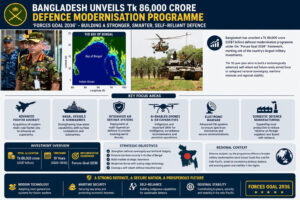
Against the backdrop of escalating strategic competition and shifting security dynamics across the Indo-Pacific, Bangladesh has announced an ambitious military modernization programme. Valued at approximately Tk 86,000 crore (around US$7 billion), the proposed initiative represents one of the largest single investments in defence capabilities in the nation’s history.
Formulated under the broader ‘Forces Goal 2036’ framework, the long-term plan aims to strengthen the operational capacities of the country’s land, naval, and air forces over the next decade while expanding its indigenous defence manufacturing base.
Evolving Security Dynamics and Technological Push
According to the government’s outline, the programme prioritizes the acquisition of advanced combat aircraft, modern naval surface vessels, submarines, integrated air defence systems, and unmanned aerial platforms (drones). Officials also indicated a strategic push toward artificial intelligence-enabled military technology and building domestic defence production capabilities.
Analysts observe that Bangladesh is acting to safeguard its strategic positioning in response to maritime security concerns, offshore economic interests, and the heightened presence of global powers in the Bay of Bengal. In recent years, South Asia and the broader Indian Ocean region have witnessed a steady rise in military expenditure driven by strategic competition involving India, China, and external powers.
A Structural Shift in Defence Posture
The core pillars of the proposed plan reflect key technological and strategic shifts:
* Layered Air Defence: Moving beyond traditional reliance on fighter aircraft, the initiative prioritizes integrated surveillance, electronic warfare, and missile defence to build a comprehensive multi-layered air defence network.
* Maritime Security in the Bay of Bengal: To protect blue economy initiatives and vital sea lines of communication, the navy’s capability will be enhanced through new surface combatants and submarines to expand maritime domain awareness.
* Building a Domestic Industrial Base: To reduce dependence on foreign vendors and enhance supply-chain resilience, targeted investments will support local manufacturing of military hardware, including drones and related technologies.
Domestic Debate and Regional Implications
At a time of growing concern over regional militarization, Bangladesh’s substantial defence allocation has drawn interest from both domestic and international observers. Critics may question the prioritisation of large-scale defence spending alongside pressing socio-economic requirements. Supporters, however, argue that robust national security serves as an indispensable foundation for economic stability in an increasingly unpredictable geopolitical environment.
As Bangladesh moves forward, international peace monitors and neighboring states will closely observe how the country balances strategic ambitions with fiscal sustainability, and how this modernisation effort impacts the broader security landscape of South Asia.

Asif Showkat Kallol: Works for the German-based online outlet The Mirror Asia as Head of News and is a Contributor at Pressenza-Dhaka Bureau.