By Asif Showkat Kallol (Dhaka Bureau)
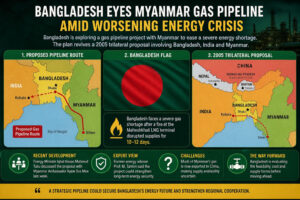
Severe power and gas shortages have paralyzed industrial manufacturing and daily life across Bangladesh. Confronted with one of the most critical energy crises in recent history, the government in Dhaka is bringing a long-dormant, ambitious diplomatic and infrastructural blueprint back to the negotiating table: importing natural gas directly from neighboring Myanmar via a cross-border pipeline.
The urgency follows a major disruption at a floating liquefied natural gas (LNG) terminal operated by US-based Excelerate Energy in Maheshkhali. A recent fire incident at the offshore facility abruptly disrupted national supply lines. With industries, power stations, and residential units facing severe supply deficits for nearly two weeks, the emergency has exposed the acute vulnerability of relying heavily on a centralized, limited LNG import infrastructure.
Diplomatic Momentum and a 20-Year Legacy
The proposal regained fresh political momentum following a high-level meeting in Dhaka between Bangladesh’s Minister of Power, Energy and Mineral Resources, Iqbal Hasan Mahmud Tuku, and the Ambassador of Myanmar to Bangladesh, Kyaw Soe Moe. During the session, Bangladesh formally expressed interest in importing natural gas via a direct cross-border pipeline while also exploring the feasibility of short-to-medium-term LNG shipments. Official sources reported that the envoy responded positively, suggesting that the plan be evaluated through the Bangladesh-Myanmar Joint Technical Committee.
From a geopolitical perspective, the cross-border pipeline initiative is not entirely unprecedented:
The 2003–2005 Trilateral Framework: Under the BNP-led administration of former Prime Minister Khaleda Zia, Bangladesh, India, and Myanmar engaged in trilateral negotiations to construct a transit pipeline connecting Myanmar’s offshore gas fields to northeastern India via Bangladeshi territory.
Reason for Collapse: The project ultimately collapsed due to additional strategic and transit conditions demanded by Dhaka, which were subsequently rejected by New Delhi.
Two decades later, facing shifting South Asian dynamics and an unprecedented surge in domestic energy demand, Bangladesh is seeking to re-evaluate the project. Policymakers suggest the initiative could also be integrated into the broader China-Myanmar-Bangladesh Economic Corridor framework, provided regional multilateral cooperation deepens.
Hard Realities: Geopolitics and Supply Constraints
While an Asian cross-border energy pipeline presents a compelling vision for regional integration, independent energy analysts and geopolitical experts urge caution, citing fundamentally altered commercial and regional realities.
‘The central question is not merely political willingness, but actual export capacity. The vast majority of Myanmar’s current gas production is already committed to China under long-term bilateral purchase agreements’- Prof. M. Tamim, Former Energy Adviser to the Caretaker Government of Bangladesh.
Challenge Domain, Core Structural & Geopolitical Reality
Existing Commitments Myanmar’s major offshore gas reserves are heavily tied to long-term supply contracts with China, leaving minimal uncommitted capacity for new regional pipelines.
Capital & Timeline Constructing a cross-border pipeline requires multi-billion-dollar capital investments and an execution timeline spanning several years.
Immediate Redress Long-term pipeline infrastructure cannot offer immediate relief to Bangladesh’s ongoing, emergency fuel supply deficit.
Lessons for Future Resilience and Sustainable Energy Transition
With Bangladesh’s domestic gas reserves steadily depleting, combined with volatile global LNG spot prices, export-oriented manufacturing- most notably the ready-made garment (RMG) sector- faces heightened operational risks.
The current crisis vividly demonstrates how over-reliance on a fragile, import-dependent supply chain can disrupt an entire national economy. While a cross-border pipeline with Myanmar could theoretically strengthen long-term regional energy security, Bangladesh’s immediate challenge lies in diversifying its short-term supply channels and accelerating investments in grid-connected renewable energy infrastructure to build lasting resilience.

Asif Showkat Kallol: Works for the German-based online outlet The Mirror Asia as Head of News and is a Contributor at Pressenza-Dhaka Bureau.