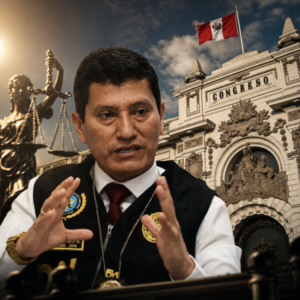
Congressman Harvey Colchado announced, during the installation session of the Ethics Commission of the Congress of Peru, held on August 10, that he was placing his appointment as a member of that working group at the disposal of the full chamber. The decision came after the prosecution’s request to indict him for the alleged crimes of incompatible negotiation and ideological falsehood became known.
By: Jhovana Yauri
Unlike other recent cases in Congress, Colchado chose to submit his continued membership to the judgment of the full chamber before formally assuming the position. With this decision, he avoided having the debate over his legal situation condition the composition and functioning of the Ethics Commission.
His action can be interpreted as a gesture of political and institutional responsibility, by allowing Congress itself to determine whether he should continue, rather than remaining in office while facing the prosecutorial proceedings.
According to the prosecution’s theory, the investigation into Cholchado is related to the lease of a property owned by his parents to the National Police of Peru for the operation of the Comas Criminal Investigation Department (DEPINCRI), since 2018, a period during which he served as head of the High Complexity Investigations Division (DIVIAC).
Public problem: protection of corruption investigators
Beyond Harvey Colchado’s legal situation, this case highlights a public problem: the need to strengthen institutional guarantees that protect those who investigate corruption and ensure the continuity of high-impact investigations.
Before joining Congress, Colchado led and participated in some of the most relevant anti-corruption investigations of recent years. These include the Los Cuellos Blancos del Puerto case, which revealed an alleged corruption network made up of judges, prosecutors, former advisers to the defunct National Council of the Magistracy, businesspeople and politicians. In addition to investigations linked to Lava Jato, the Cócteles case and proceedings related to Fuerza Popular, according to information from the Public Prosecutor’s Office.
In the Los Cuellos Blancos del Puerto case, prosecutor Diana Paico was investigated in 2023 for influence peddling. Today, that same prosecutor is part of the Public Prosecutor’s Office team requesting 9 years and 4 months in prison for Harvey Colchado for the alleged crimes of incompatible negotiation and ideological falsehood.
The other cost of the fight against corruption
The accusation against Colchado did not occur in isolation. In 2021, DIVIAC lost 96 of its 161 members following a series of reassignments that IDL-Reporteros described as a “purge”. In 2022, an attempt was made to remove him from the police team supporting anti-corruption investigations. In 2024, after leading the raid on President Dina Boluarte’s home and intervening in investigations into the Los Waykis en la Sombra case, he was temporarily removed from DIVIAC. He subsequently faced public scrutiny over the rental of a property belonging to his parents, was reassigned to patrol duties and ultimately retired from the National Police.
Each of these events resulted from different decisions and had their own grounds. However, viewed together, they have fueled debate over the State’s ability to guarantee the continuity of high-impact investigations when the officials leading them change or are removed.
The real public problem
The fundamental issue is not solely the prosecution’s accusation against Harvey Colchado. The real public problem is whether the State has institutional mechanisms that guarantee that officials responsible for investigating and prosecuting corruption can perform their duties autonomously and that investigations continue independently, regardless of who leads them.
This fact raises a public policy question: are the existing institutional guarantees sufficient to prevent ongoing proceedings from ultimately weakening the participation of officials who have led high-impact investigations?
If the answer is negative, that vulnerability could be exploited by actors interested in reducing the scope of corruption investigations.
Therefore, this case demonstrates that Peru’s challenge is to build institutions that protect the independence of those who investigate, and ensure the continuity of investigations while generating public trust.
When the rule of law is respected, democracy wins; however, there is always a risk that the public interest will be relegated in favor of particular interests.