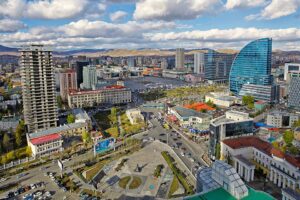
The United Nations Convention to Combat Desertification Conference (UNCCD COP17) will take place in Ulaanbaatar, Mongolia, from August 17 to 28, 2026, bringing together governments, international institutions, businesses and civil society to address land degradation, drought and restoration.
The global food system is facing a convergence of crises: wars are disrupting food supplies and driving up prices, while droughts, floods, wildfires and other extreme weather events are increasingly threatening harvests and the livelihoods of millions of people.
Against this backdrop, the United Nations Convention to Combat Desertification Conference (UNCCD COP17), taking place in Ulaanbaatar from August 17 to 28, will put land degradation, drought and restoration at the center of international discussions.
For the World Wide Fund for Nature (WWF), however, the challenge cannot be addressed through land policy alone. The organization is calling for a transformation of food systems—how food is produced, consumed and wasted—as a way to connect environmental agendas that have too often been addressed separately.
The timing is significant. The UN’s major international processes dealing with land, nature and climate are concentrated within a three-month period this year, creating an unusual opportunity to bring together policies that have traditionally operated in parallel.
“Overhauling our food systems is long overdue,” WWF argues, pointing to the possibility of using already available tools to produce food while restoring rather than degrading the natural systems on which agriculture depends.
Food, climate and nature are interconnected
Agriculture and food production sit at the intersection of several of the world’s major environmental challenges. According to WWF, food systems are responsible for approximately one-third of global greenhouse gas emissions and are associated with around 80 percent of deforestation.
This means that changing the way food is produced could potentially generate benefits across several areas simultaneously: reducing emissions, protecting biodiversity, restoring degraded land and improving food security.
The organization is particularly promoting nature-positive agriculture, regenerative approaches to farming, sustainable diets and reductions in food loss and waste.
The objective is not simply to produce more food, but to develop agricultural systems capable of producing sufficient and affordable food while restoring the ecosystems that make production possible.
Joao Campari, WWF’s Global Leader for Food and Agriculture, is expected to focus at COP17 on mobilizing political action and financing for food-system transformation as a means of protecting and restoring land.
Such an approach could also address one of the increasingly visible consequences of climate change: recurring drought. Healthier soils and landscapes can retain more water, improve agricultural resilience and reduce vulnerability to extreme weather.
From separate agendas to a shared mission
Martina Fleckenstein, WWF’s Global Food and Agriculture Policy Director, argues that governments have an opportunity to connect their food and agricultural policies with national climate and biodiversity commitments.
The challenge is institutional as much as environmental. Climate negotiations, biodiversity protection and efforts to combat desertification have often developed as separate international processes, despite dealing with ecosystems and human activities that are fundamentally interconnected.
COP17 could therefore become an important test of whether governments can move beyond this fragmented approach.
Rather than treating food production, land restoration, water security, biodiversity and climate action as separate problems, the emerging approach seeks to address them as parts of the same system.
Grasslands, forests and water
The discussion extends beyond farmland.
Less than 10 percent of the world’s grasslands and savannahs are formally protected, according to WWF, while roughly half are already degraded. These landscapes support biodiversity, store carbon and provide food, water and livelihoods for more than 500 million pastoralists worldwide.
Their importance is receiving additional attention during the International Year of Rangelands and Pastoralists.
WWF’s Leonie Meier argues that recognizing the ecological and economic value of grasslands and rangelands is essential to achieving the UN objective of Land Degradation Neutrality—ensuring that the amount and quality of productive land remains stable or improves.
Forest restoration and soil health will also be central to the discussion. Restoring degraded landscapes can strengthen biodiversity while improving food and water security and increasing communities’ resilience to climate change.
For WWF, healthy soil should be treated not simply as an agricultural resource but as a foundation of food security and climate resilience. Regenerative and agroecological approaches can contribute to rebuilding this foundation.
Water represents another critical connection. Increasing water stress and drought are already affecting many agricultural regions, making integrated land and water planning increasingly important.
Mongolia as a living example
The choice of Mongolia as the host of COP17 brings particular relevance to the discussion of grasslands, pastoralism and land degradation.
WWF-Mongolia has been working in the country’s Eastern Steppe on sustainable grazing, landscape conservation and community-based management of natural resources. These initiatives aim to restore severely degraded grasslands while supporting wildlife and local communities.
The experience illustrates a broader principle emerging from the conference: land restoration does not necessarily mean choosing between environmental protection and human livelihoods. With appropriate management, restoring ecosystems can also strengthen the economic and social systems that depend on them.
A critical three months
The coming months could provide an opportunity to rethink how the international community approaches some of the world’s most interconnected crises.
The challenge is enormous. Food systems must feed a growing population while facing climate instability, declining biodiversity, water scarcity and increasingly degraded soils. At the same time, conflicts and economic pressures are exposing the vulnerability of global food supply chains.
Yet these crises also reveal the limits of addressing each problem independently.
The UNCCD COP17 in Mongolia opens a three-month period in which land, nature and climate negotiations can potentially reinforce one another rather than compete for political attention.
The deeper question is whether governments, businesses, financial institutions and civil society can move from managing individual crises toward transforming the systems that connect them.
If food production can become a force for restoring soils, protecting biodiversity, conserving water and reducing climate pressure, agriculture could move from being seen primarily as part of the environmental problem to becoming an important part of the solution.
That transformation, however, will require more than technical innovation. It will require political commitment, investment and a willingness to break down the institutional boundaries that have kept interconnected global challenges in separate policy silos.
UNCCD COP17 may be an important opportunity to begin doing exactly that.