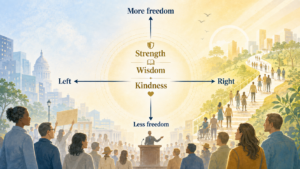
- A Pressenza model prepared with the use of AI tools over 5 days assesses political leaders on strength, wisdom and kindness across 12 policy areas.
- Each policy area is judged by whether political action expands or contracts the field of human freedom.
- Claire Hanna (SDLP) comes first, closely followed by Zack Polanski (Green) and John Swinney (SNP).
Claire Hanna, leader of the Social Democratic and Labour Party (SDLP) in Northern Ireland, comes top of a Pressenza assessment of ten political leaders active in UK politics. Behind her come Zack Polanski, leader of the Green Party of England and Wales, and John Swinney, leader of the Scottish National Party (SNP) and First Minister of Scotland, followed by Mary Lou McDonald, president of Sinn Féin and Leader of the Opposition in the Republic of Ireland.
At the other end of the table, Kemi Badenoch, Conservative leader and Leader of the Opposition at Westminster, and Nigel Farage, leader of Reform UK and MP for Clacton, receive strongly negative scores.
The exercise asked a deliberately unusual question. Instead of asking which leader is most popular, electorally successful, media-friendly or conventionally “competent”, we asked: who demonstrates strength, wisdom and kindness in ways that increase the field of human freedom?
The results
| Rank | Leader | Party | Score | Coverage |
| 1 | Claire Hanna | SDLP | +23 | 8/12 |
| 2 | Zack Polanski | Green Party | +22 | 9/12 |
| 3 | John Swinney | SNP | +21 | 10/12 |
| 4 | Mary Lou McDonald | Sinn Féin | +20 | 8/12 |
| 5 | Rhun ap Iorwerth | Plaid Cymru | +19 | 10/12 |
| 6 | Ed Davey | Liberal Democrats | +14 | 6/12 |
| 7 | Andy Burnham | Labour | +9 | 12/12 |
| 8 | Gavin Robinson | DUP | 0 | 6/12 |
| 9 | Nigel Farage | Reform UK | -11 | 7/12 |
| 10 | Kemi Badenoch | Conservative | -17 | 10/12 |
A score based on eight of the twelve areas does not mean that the leader performed well in the other four; it means there was not enough evidence during the period studied to make a defensible judgement. Leaders for whom we found evidence across eleven or twelve areas also had more opportunities for contradictions and weaknesses to become visible. The table should therefore be read as a snapshot of observable leadership over a fixed period, rather than as a definitive ranking of political character.
Another axis for politics
Politics is usually represented along a single axis, from left to right. That remains useful, but from a Humanist perspective it leaves out another question that interests us at Pressenza: how much freedom do we collectively have?
By freedom we do not mean simply freedom from government interference. We mean the real field of possibilities available to human beings: whether people can obtain food, shelter, healthcare and education with dignity; participate in decisions that affect them; associate, move, refuse, create, learn and care; exercise control over their bodies and their time; and construct their own life projects. Political decisions can increase that field of possibilities or reduce it.
This means that policies conventionally associated with the left will often score well when they redistribute concentrated power or secure the material conditions that make freedom possible, but they do not score well simply because they are left wing. Equally, a policy associated with the right can score well where it genuinely protects autonomy, distributes power or refuses to treat human beings merely as members of a category. The familiar left–right axis is not being discarded; we are trying to add another one.
Where did the idea come from?
The exercise began during a conversation with AI about political leadership and Silo’s Humanise the Earth. If the human being is understood not simply as a passive object of circumstances, but as an intentional being capable of transforming the world and constructing a future, what qualities should we look for in someone exercising political power?
We arrived at three qualities Silo indicates: strength, wisdom and kindness. They seemed to form a remarkably complete triad: strength without wisdom can become forcefulness; wisdom without kindness can become coldness; kindness without strength can become ineffectual. Put the three together and you have someone capable of orienting without dominating.
From there we built a fixed set of Humanist policy directions around a single question: would movement in this direction tend to expand or contract the field of meaningful human freedom?
We then examined public interventions by the ten leaders over the same three-month period, from 9 May to 9 August 2026. Where there was enough evidence in a policy area, we scored Strength, Wisdom and Kindness separately. Strength asked whether the leader used the powers actually available to them, persisted when necessary and was willing to confront powerful interests. Wisdom concerned the quality of the analysis: whether causes and consequences were understood, evidence was taken seriously and the proposed means were capable of producing the stated end. Kindness looked at the effects on concrete human beings: whether their dignity, autonomy and capacity to direct their own lives were enlarged or diminished.
Each dimension was scored from 1 to 5. For the final total the scores were centred around 3: a 1 contributed −2, a 2 contributed −1, a 3 contributed zero, a 4 contributed +1 and a 5 contributed +2. Where there was insufficient evidence, we recorded N/E and did not score the area.
The three scores were deliberately kept independent. Someone can act with great determination in pursuit of an unwise or dehumanising policy; a humane proposal may be pursued without sufficient strength; and an intellectually sophisticated policy can still disregard the people who have to live with its consequences. That distinction became important when we looked at the results.
What the results show
Claire Hanna’s first place was driven less by the quantity of evidence than by its quality. Her approach to possible Irish unity is a good example. She supports constitutional change, but does not treat it as something that can simply be won by assembling 50 per cent plus one and then imposed on everyone else. Preparation, participation, identity and the legitimacy of people reaching different conclusions all formed part of the picture. The same concern with the people actually affected appeared in her interventions on food, discrimination and technological power.
Just behind her, Zack Polanski’s result was notable for the way apparently separate questions were connected. Housing, rent, extreme heat, working conditions, ownership and political power repeatedly appeared as parts of the same structure rather than isolated policy problems. That tendency to ask who holds power, who bears the consequences and how those relationships might be changed is a large part of why he scored so strongly.
John Swinney’s third place needs a qualification of a different kind. The SNP’s defining political objective is Scottish independence, but during the period we examined it was not making major moves towards that objective, nor taking substantial political risks to force a confrontation with London. Its strong result came much more from governing. On child poverty, public services, renewable energy, social protection and international economic justice, the SNP is effectively behaving as a left-of-centre administration and implementing policies which frequently increase people’s practical field of freedom. Under this test, that deserves credit independently of how effectively the party is advancing independence.
Mary Lou McDonald also scored highly, particularly where political change was connected to practical human autonomy. Her support for removing Ireland’s mandatory three-day waiting period for abortion services was a clear example: there was a concrete legislative measure and a direct reduction in unnecessary interference with bodily autonomy. Her approach to reunification similarly stressed preparation rather than imagining that a referendum result would by itself settle all the human and social questions involved.
The result for Rhun ap Iorwerth, leader of Plaid Cymru and First Minister of Wales, reflects the advantage — and the burden — of actually governing. The Welsh evidence included NHS investment, childcare, school meals, housing rights and greater worker participation. These are no longer simply proposals. At the same time, we resisted awarding exceptional scores too early: a new government still has to show that its direction can survive budgets, opposition, institutional inertia and time.
Ed Davey, leader of the Liberal Democrats, had less coverage but produced some of the strongest democratic thinking in the study. His proposals for proportional representation, limits on large political donations, constitutional reform and decentralisation fitted very closely with the Humanist concern to distribute political power. His support for deeper European military integration pulled in a different direction and scored correspondingly lower.
Then there is Andy Burnham, leader of the Labour Party and Prime Minister of the United Kingdom during the latter part of the assessment period. His case is probably the best warning against reading the table too simply. Burnham was the only leader for whom we could assess all twelve areas, and that exposed both considerable strengths and significant contradictions.
His approach to poverty and welfare often looked beyond the benefits system itself to the conditions producing dependency. He supported greater public control of essential services, devolved political and fiscal power away from Westminster, acted on rough sleeping and moved on social care. But his turn towards a more “pragmatic” approach to North Sea oil and gas scored badly on climate, while continued major investment in Britain’s nuclear deterrent ran directly against the Humanist direction of nuclear disarmament. His seventh place is therefore not the same thing as saying that the six people above him are simply “better politicians”. In his case almost the entire field was visible.
Gavin Robinson, leader of the Democratic Unionist Party in Northern Ireland, produced a much smaller and more mixed body of evidence. His response after the conviction of former DUP leader Jeffrey Donaldson, including commissioning an independent review into what the party knew and how concerns had been handled, showed genuine institutional responsibility. His interventions on trade-union power and migration were less convincing.
The bottom of the table illustrates why Strength had to be kept separate from the other two qualities. Nigel Farage, leader of Reform UK and newly-elected MP for Clacton, is often strong in the narrow sense used by the model: he takes clear positions, pursues them forcefully and has political impact. But a military-led operation in the Channel framed in terms of an “invasion”, together with proposals affecting foreign nationals in social housing, scored extremely poorly when tested against proportionality, causal reasoning and the dignity of the people affected. Strength without wisdom and kindness can simply become the capacity to impose.
Kemi Badenoch, Conservative leader and Leader of the Opposition at Westminster, also received a strongly negative overall score, but for different reasons across a broad range of evidence. Greater military expenditure linked to welfare reductions, restrictions on foreign nationals in social housing, punitive approaches to criminal justice and retreat from climate commitments all pulled her result down. Yet the model also forced us to look for what did not fit that pattern. Her economic programme contains a substantive argument even where we found its assumptions and consequences unconvincing, and her insistence that people should not simply be reduced to group categories contains a recognisably Humanist element. If the framework could only discover virtue in politicians with whom we already agreed, it would not be very useful.
What exactly are we measuring?
There is an unavoidable normative choice behind any political assessment. “Economic competence”, “electability”, “security”, GDP growth or fiscal restraint are not neutral measures either; each assumes that certain outcomes are worth pursuing. Our assumption is explicit: the human being comes first.
States, markets, borders, property systems and political parties are human constructions. We judge them according to what they do to the real possibilities available to human beings. That does mean policies associated with the political left often perform well when they redistribute concentrated power, secure material dignity or extend democratic control. But being left wing is not itself the test. A centralised state which removes human agency in the name of equality could score very badly; a policy from the political right which genuinely decentralised power or enlarged personal autonomy could score well.
Likewise, national independence is not intrinsically Humanist, and neither is preserving an existing union. What matters is whether people can genuinely determine their collective future and whether the human beings living within whatever arrangement is chosen retain the material and social conditions of dignity. That is what the second axis is intended to reveal.
An open experiment
Three months is a short period. Governments can produce evidence of implementation which opposition parties cannot, although Strength was always judged relative to the powers actually available. Some leaders spoke or acted across nearly every area; others did not. An N/E means only that we did not have enough evidence to make a defensible judgement, and the scores can change as new evidence appears.
For that reason, transparency is part of the method. The Humanist policy framework is included in this article, so anyone can take it, gather a different body of evidence and apply it to another set of politicians, another country or another period. Appendix 2, published as a separate PDF, contains the complete evidence we collected and the scores we assigned to it. Readers can inspect the sources, challenge an individual judgement, recalculate the results or use the same model with evidence of their own.
The point is not that everyone should arrive at precisely our league table. It is that they should be able to see exactly how we got there — and try it themselves.
Strength, wisdom and kindness
At the end of the exercise, the original triad still seems remarkably useful. Strength without wisdom can become forcefulness; wisdom without kindness can become coldness; kindness without strength can become ineffectual. Political leadership capable of expanding human freedom needs all three.
Perhaps that brings us back to the quality we were looking for in the first place: someone capable of orienting without dominating.
Appendix 1 — The Humanist policy directions
The framework covers twelve areas. These are not intended as a conventional manifesto, but as directions against which political action can be assessed according to whether it tends to enlarge or restrict the field of human freedom.
- Peace and international relations: progressive demilitarisation, nuclear disarmament, diplomacy and nonviolent collective security.
- Poverty and material dignity: reliable access to the material and social conditions necessary for a dignified life, with welfare expanding autonomy rather than humiliation or dependency.
- Economic power and ownership: reduction of concentrations of economic power that allow some people or institutions to control the lives of others; wider distribution of ownership, participation and the gains from productivity.
- Health and care: universal, high-quality care centred on autonomy, informed consent, prevention, dignity and the ability to live independently.
- Housing, land and basic services: secure access to a decent home and essential services as prerequisites of freedom; housing primarily as a place to live rather than a speculative asset.
- Migration and asylum: humane and fair asylum procedures, protection from exploitation, and reduction of the violent and economic conditions that force people to migrate.
- Climate and ecology: preservation of the material conditions necessary for the freedom of present and future generations, with structural assessment of energy, production, housing, transport and ecological impacts.
- Democracy and decentralisation: distribution of political power towards the people affected by decisions, proportional representation, meaningful participation, decentralisation and genuine self-determination.
- Personal freedom and discrimination: equal dignity and the ability of human beings to construct their identities, relationships and bodily choices, bounded by the equal intentionality of others.
- Education, culture and information: education directed towards critical thought, creativity, cooperation, practical competence and the ability to construct one’s own life project rather than obedience, ranking and credential competition.
- Violence and criminal justice: prevention, restoration, rehabilitation and protection rather than vengeance or punitive suffering, with coercion limited to what is genuinely necessary.
- Technology and surveillance: technology serving human intentionality rather than concentrating power over it; privacy, democratic accountability, meaningful control of data and broad sharing of technological gains.
Appendix 2 — Evidence and scoring
See accompanying PDF: Measuring Leadership – Appendix 2: Evidence and scoring record. The PDF contains the final domain matrix, evidence summaries, rationales, audit log and complete source register.
Download our results here.