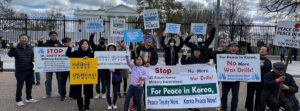
Anti-war and progressive organizations are planning demonstrations in five U.S. cities on Saturday, August 15, protesting the U.S.-South Korea military exercises known as Ulchi Freedom Shield and calling for an end to what organizers describe as the continuing militarization of the Korean Peninsula and the wider Pacific.
The demonstrations, organized as part of Nodutdol for Korean Community Development’s US Out of Korea campaign, are being held in solidarity with anti-war activists and progressive organizations in the Republic of Korea, where protests are also expected against the annual military exercises and the continuing presence of U.S. forces.
Rallies are scheduled for Los Angeles, San Francisco, Seattle, Minneapolis and New York.
The New York demonstration will take place at 4 p.m. EDT in Times Square. Events in Los Angeles, San Francisco and Seattle are scheduled for 1 p.m. PDT, while the Minneapolis action is scheduled for 1 p.m. CDT.
Military exercises at the center of protests
Ulchi Freedom Shield is an annual joint U.S.-South Korean military exercise designed, according to the two governments, to strengthen their ability to respond to threats against South Korea. This year’s exercise is scheduled to run from August 17 through August 27 and will involve approximately 18,000 South Korean troops. Training will include live, virtual, constructive and field-based exercises across multiple military domains.
U.S. Forces Korea describes the exercise as part of efforts to strengthen the combined defense posture of the United States and South Korea and improve the alliance’s response capabilities.
North Korea, however, has condemned the exercises as provocative and warned that they could lead to a stronger military response. Pyongyang has particularly criticized the growing military cooperation among the United States, South Korea and Japan, describing it as part of an increasingly nuclear-oriented alliance.
The organizers of Saturday’s demonstrations argue that the scale and character of the exercises raise broader questions about the possibility of military escalation on the Korean Peninsula and throughout the Pacific.
They point in particular to preparations involving advanced weapons and multidomain warfare. The U.S. Army’s 3rd Multi-Domain Task Force participated in the earlier Freedom Shield 2026 exercise in March and is expected to participate in future combined exercises, including Ulchi Freedom Shield. The unit integrates capabilities involving long-range precision fires, cyber, intelligence and space operations.
A permanent U.S. military presence
The protests also focus on the much larger question of the U.S. military presence in South Korea.
Approximately 28,500 U.S. troops are currently stationed in the Republic of Korea. Most are based at Camp Humphreys, which has become the largest U.S. overseas military installation by land area. The U.S. military presence dates back to the Korean War and is maintained under the U.S.-ROK Mutual Defense Treaty.
A June 2026 Congressional Research Service report noted that the traditional focus of the U.S.-South Korea alliance has been the North Korean threat, but that the alliance is now evolving amid growing concerns involving China, Russia and North Korea. The report says Washington and Seoul appear prepared to broaden the alliance’s mission and increase South Korea’s role within it.
For anti-war organizations, this evolution is particularly significant. They argue that military preparations on the Korean Peninsula can no longer be viewed solely through the lens of North Korea, but must also be understood within the increasingly confrontational strategic environment between the United States and China.
From the Korean Peninsula to the Pacific
The demonstrations therefore come at a moment when military alliances and deployments across the Pacific are undergoing significant changes.
Supporters of the U.S.-ROK alliance maintain that the military presence is necessary to deter North Korea, whose nuclear and missile programs continue to develop. North Korea has also deepened its military relationship with Russia, including through its involvement in the war in Ukraine.
Opponents of the military buildup counter that expanding exercises, nuclear deployments and increasingly sophisticated military planning can reinforce a cycle in which each side’s efforts to increase security are interpreted by the other as preparation for war.
That dilemma is at the heart of Saturday’s protests.
For the organizers, the question is not simply whether the United States and South Korea describe Ulchi Freedom Shield as defensive. It is whether a region containing nuclear-armed states can achieve lasting security through increasingly elaborate preparations for military confrontation.
The demonstrations in five U.S. cities are intended to connect the anti-war movement in the United States with activists in South Korea who are challenging the country’s permanent military alignment with Washington.
As tensions rise across the Pacific, the protesters are calling for a different approach: reducing military confrontation, ending the expansion of war preparations and pursuing diplomacy and cooperation as alternatives to an increasingly militarized regional order.
Saturday, August 15 demonstrations:
- Los Angeles: 1 p.m. PDT — Wilshire/Western Station
- San Francisco: 1 p.m. PDT — San Francisco Federal Building
- Seattle: 1 p.m. PDT — Fisher Pavilion, Seattle Center
- Minneapolis: 1 p.m. CDT — 301 Cedar St.
- New York: 4 p.m. EDT — Times Square
The demonstrations are part of Nodutdol for Korean Community Development’s US Out of Korea campaign.