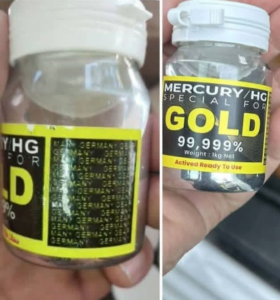
16 August 2026, Quezon City. As the Minamata Convention on Mercury hits its nine-year mark today, environmental health and justice group EcoWaste Coalition called on the government to intensify enforcement of policies and regulations aimed at protecting people and ecosystems from mercury, a dangerous poison that harms human brains and bodies.
The Minamata Convention on Mercury—named after the Japanese city devastated by decades of industrial methylmercury poisoning—took global effect on August 16, 2017. The Philippines officially ratified the accord three years later, joining as its 123rd party on July 8, 2020.
“Through the adoption of critical policies and the rollout of impactful projects, our nation has made significant progress in protecting citizens and ecosystems from mercury contamination,” said Aileen Lucero, National Coordinator, EcoWaste Coalition. “But much more needs to be done to keep our people and the ecosystems safe from mercury.”

The EcoWaste Coalition identified some of the challenges requiring immediate action:
— Smugglers continue to transport mercury for mining use, such as through the Indonesia-Davao route, circumventing the strict prohibitions on mercury use in artisanal and small-scale gold mining (ASGM) under Executive Order No. 79, series of 2012. According to the government’s report submitted to the Minamata Convention Secretariat in 2021, “the formalized small-scale mining sectors are compliant with this policy. However, the use of mercury is rampant to the informal small-scale mining sectors.” A related report submitted in 2023 stated that “smuggling of mercury for use of ASGM remains an issue.”
— Traders take advantage of online shopping and social media platforms to market and sell mercury, especially for mining purposes, where mercury is used to separate precious gold from crushed ore, as the trade of mercury is not completely and unconditionally banned by the Minamata Convention.
— Contraband skin-lightening products continue to penetrate the local market despite the ban on mercury as an ingredient in cosmetic product formulations under the ASEAN Cosmetic Directive adopted in 2007, as well as the 2020 and 2025 phase-out deadlines for the manufacture, import, and export of mercury-added cosmetics under the Minamata Convention.
— Mercury-containing sphygmomanometers and thermometers continue to be traded online, albeit not as rampant as the sale of mercury cosmetics, despite the phase-out of such medical devices in hospitals under Department of Health Administrative Order No. 2008-0021, which Food and Drug Administration (FDA) Circular No. 2022-003 reinforced by banning dental amalgam capsules and liquid mercury for use in dental restorative purposes.
— The improper disposal of mercury-containing lamps continues to be a public health threat due to the lack of a systematic collection program for busted or spent bulbs, absence of convenient drop-off points, lack of safe and secure storage site, failed extended producer responsibility (EPR) policy, and non-utilization of a $1.37 million Lamp Waste Management Facility (LWMF) with mercury recovery.
The EcoWaste Coalition called for increased compliance monitoring and enforcement of all national and global phase-out targets, and expanded bilateral, regional, and international cooperation to stop the smuggling of mercury and banned mercury-added products into the country’s ports.
The group likewise pushed for a stronger Minamata Convention to protect public health and the environment from mercury trafficking and pollution, such as by ending the global trade in mercury and setting a global phase-out deadline for mercury use in ASGM with a hard cut-off date.
##########
Reference:
https://minamataconvention.org/sites/default/files/documents/national_report/Report_Philippines_2023_English.pdf
https://minamataconvention.org/sites/default/files/documents/national_report/Report_Philippines_2021.English.pdf
https://chemical.emb.gov.ph/wp-content/uploads/2019/11/DAO201920MERCURY.pdf