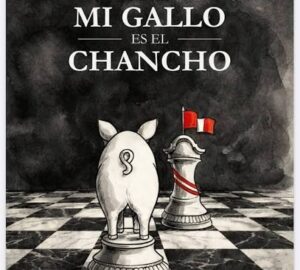
In a democracy, freedom of expression protects even those publications that generate controversy, rejection or ridicule. A book may be praised, criticized or ignored by citizens, and no authority should censor it because of its content. However, the debate changes completely when that publication has been financed with State resources. At that point, the discussion ceases to be political or literary and becomes a matter of legality, accountability and proper use of public funds.
The recent controversy surrounding the digital book Mi gallo es el chancho, written by Francisco “Pancho” de Piérola about Rafael López Aliaga and financed by Renovación Popular with resources from Direct Public Financing, precisely highlights this dilemma. The problem does not lie in the existence of the book or in the opinion it expresses, but in determining whether the use of money coming from the national treasury complied with the purpose established by law.
Direct Public Financing does not constitute a freely disposable subsidy for political parties. The Law on Political Organizations and the ONPE Regulation on Financing and Supervision of Party Funds establish that such resources must be allocated to institutional strengthening, political education, training of members, research and dissemination of knowledge that contributes to the democratic system. Consequently, any publication financed with these resources must demonstrate that it responds to those objectives and not to strictly propagandistic interests or personal promotion.
Precisely for this reason, ONPE objected to this expenditure, considering that the work did not sufficiently demonstrate a purpose of political education or research and, furthermore, raised questions regarding the procedure followed for its procurement, including the lack of plurality in supplier quotations. Such observations do not constitute a judgment on the ideas contained in the book, but rather on the legality of the use of public resources and compliance with the principles governing the administration of the State budget.
From the perspective of Administrative Law, there is a fundamental principle: all public expenditure must strictly serve the purpose for which it was authorized. This principle of purpose constitutes a safeguard against the arbitrary use of taxpayers’ money and requires every entity or institution that administers State funds to demonstrate that each sol invested fulfills the objective established by the regulation. When this does not occur, the oversight mechanisms must be activated and the corresponding administrative responsibilities determined.
In this context, it is important to distinguish between two concepts that are frequently confused. One thing is the freedom to publish a work, a right fully protected by the Constitution; quite another is to seek to have such publication financed with State money without demonstrating that it meets the legal requirements for doing so. Any failure to comply with the purpose of the financing does not imply censorship of the book or its withdrawal from circulation. What is appropriate is to assess the legality of the expenditure and, if applicable, order the administrative measures provided for by the legal system, including the return of resources that were improperly used, without prejudice to any other responsibilities that the competent bodies may establish.
Finally, this case leaves a reflection that transcends any political party. Citizens’ trust in institutions also depends on how public resources are administered. Every sol allocated to strengthening democracy must serve the general interest and not the individual promotion of political leaders. Because the real debate should never have been whether the book is good or bad; the real debate is to determine whether the money of all Peruvians was used in accordance with the law. And when it comes to public resources, transparency and accountability cease to be an option and become a legal and ethical obligation.