He enjoyed being photographed with my teddy bear, as he welcomed the idea of using something familiar to people’s (inner) child to introduce them to something less familiar – something usually perceived as “foreign.” The Palestinian artist Sliman Mansour met with me in 2022, shortly before the Israeli elections brought the current government to power.
He passed away at the age of 79 on August 24, 2026. I am grateful to have had the opportunity to get to know this warm-hearted man.

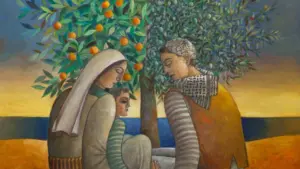
He dreamed of a Palestine from the Mediterranean to the Jordan River, where Palestinians and Israelis would live side by side with equal rights. He often spoke of how he would likely die a year before this dream became reality. He was optimistic and worked tirelessly toward this vision through his art. He painted his dream: a tree bearing oranges on its left half – the fruit for which Jaffa, on the Mediterranean coast, was famous – and olives on its right half, representing the livelihood of the Palestinian people and a symbol of their deep-rootedness in the land, as illustrated by the woman embracing the tree.

Yet he can consider himself a significant contributor to that journey through his art: despite the ongoing destruction of Palestinian homes, the uprooting of olive trees, displacement and land seizure, the denial of Palestinian existence, and despite dehumanization, killings, and genocide, efforts to erase Palestinian identity have failed.
Sliman Mansour was born in Birzeit in 1947—the year before the State of Israel was established within its current borders, a time when more than 700,000 Palestinians were displaced and denied the right of return, a denial that persists to this day in violation of UN Resolution 194. He studied art at the Bezalel Academy of Arts and Design in Israel, as the Israeli occupying power had banned opportunities for agricultural and artistic studies following the Six-Day War and the occupation of East Jerusalem, the West Bank, and Gaza.
“Art colleges and agricultural colleges were not allowed” Sliman tells me in our talk in 2022, “This prohibition is founded on the Zionist attitude towards our existence as Palestinians. We have no right to our land and are forbidden to express ourselves in a universal language.”
In a 2024 interview, he adds that he feels sadness and anger over the fact that journalists and artists are now being killed directly in unprecedented numbers.
“I’m sad and angry. But it fits the thinking of the Israelis. For them, the narrative is very important. And who tells the narrative – it should be them only, because that’s the truth for them. Anybody who speaks another narrative should be put in prison. Or now they are killed.”
He rejects expressing himself through learned abstract expressionism and chooses realistic subjects from Palestinian life, with which his fellow citizens can identify. He also decided to have his paintings printed as posters so they wouldn’t be confined to galleries. Soon, they were hanging in Palestinian living rooms.
An Israeli-Palestinian community organizer (Abed Abou Shhadeh) recalls his childhood in the 1990s in the Ajami district of Jaffa, when he saw Mansour’s painting of „an old man, barefoot and dressed in worn clothes, walking into the wilderness and carrying an entire city on his back” among the photos on the living room wall in his grandfather’s house. He and his cousins were convinced that the picture showed their great-grandfather—a man who had worked hard all his life, a fact clearly etched into his physical appearance. They wondered why he kept going despite the burden, and why it was so important to him not simply to put it down.

It concerns the famous painting “Jamal Al-Mahamel” (Camel of Burdens), of which Sliman Mansour had to create three versions (1973, 1976, and 2005). At an event featuring Sliman Mansour just months before his death, the Shhadeh wanted to share that he had regarded the old man in the painting as his own great-grandfather – a man who died of a stroke while watching Israeli bulldozers uproot orange trees from his land that had been expropriated after 1948. However, a young woman and a young man beat him to it, telling a nearly identical story.
This is precisely what makes Sliman Mansour’s art so magnificent. It shapes consciousness without dictating how to think. It draws upon the private memories of people who do not even know one another and connects them in a shared history. Without relying on any written interpretation, Sliman Mansour enables individuals to identify with the work, thereby instilling in everyone a sense of a collective Palestinian identity. The old man in the painting is specific enough to be a Palestinian, yet universal enough to be a member of any Palestinian family. This art connects Palestinians to their history and to one another, makes them aware of their identity, and strengthens their resilience – their sumud (steadfastness) – empowering them to carry on despite their lived experiences, both past and present, just like the old man.
Sliman Mansour depicts Palestinian people – women in cross-stitched thobes (garments that reflect their life stories) – as well as olive trees and the everyday reality of life in Palestine. He employs the universal language of art to present that reality.
“In expressing the idea of identity I have absorbed influences from many sources, from our ancient Canaanite, Egyptian and Babylonian culture, from Islamic art, ornamental elements and calligraphy, from folk art, Palestinian customs, embroidery (Tatreez = cross stitches on women’s clothes) and food – to show our connection with land, to prove the human-land-relationship and last but not least from modern art, such as Picasso and his dove of peace or prison bars.” He tells me in our talk.
The renown and popularity of his paintings attest to his success in bolstering the self-esteem of the Palestinian people – and, by extension, their resistance to the occupation. The Israeli occupation forces recognized this as well. In 1980, he exhibited his work at Ramallah’s first art gallery. Just four hours after the opening, the Israeli military shut down the event and took the keys. He got the keys back a month later, but only four of the forty paintings remained. An Israeli officer instructed him and his colleagues to stop creating political art and paint flowers instead. The Palestinian flag – and its colors – were banned; if they painted a flower using those colors, the painting would be confiscated. The Israeli officer added, “Even if you paint a watermelon, the painting will be confiscated.” That marked the birth of the watermelon as a symbol of Palestinian resistance. „Anything that made Israel angry later became a symbol.“
Sliman Mansour: “They wanted to fight the notion of a Palestinian identity, because our existence here, for them, is ‘antisemitic’. That we exist, only. It’s not what we do — just our existence here is something that they hate. It does not fit their narrative about Israel. What are these people doing here? We came to a land that should be empty. So our existence here is something that makes them angry. Existence as workers — that we work for them in the fields or in factories and so on — that’s okay. But existence, existence as a national identity, as Palestinians — that’s what makes them mad. And that’s the reason they forbid us to paint in these colours. Because these colours are the colours of the Palestinian flag and the flag is a symbol of the people.”
His art embodies the concept of resistance known as sumud. He depicts neither the Israeli military nor combat operations, for that matter: „A painting shouldn’t be full of force and bloody violence. If I paint just a beautiful landscape or people working in the field, it’s part of the sumud thinking.”
Sliman has given expression to the Palestinians’ strong sense of identity and their deep connection to their land. Seeing him sitting next to my teddy bear, I understand how powerfully he invites people around the world to let the beauty of his art speak to them—encouraging them to acknowledge, accept, and support the Palestinian desire to live peacefully and side by side with Israelis in the land of Palestine.