by Irshad Ahmad Mughal
For centuries, the Arctic was humanity’s final frontier—a realm of perpetual ice, polar night, and the kind of cold that could kill a man in minutes. It was a place nature had reserved for itself. Not anymore.
Today, the Arctic is undergoing a transformation so profound that it is rewriting the rules of global power. The ice is melting at an accelerating pace, and where the ice retreats, ambition advances. What we are witnessing is nothing less than a new Great Game. But this time, the prize is not the passes of Central Asia. It is the frozen roof of the world. And the players are not just Britain and Russia, but the United States, China, Russia, and a host of others who have suddenly realized that the North Pole is the most valuable piece of real estate on the planet.
Climate change is the engine driving this entire transformation. Without it, the Arctic remains inaccessible, its resources locked beneath ice that never melts. With it, the region becomes a highway, a treasure chest, and a battlefield all at once. Data from the National Snow and Ice Data Center tells a stark story. The average winter sea ice extent has shrunk by approximately 27 percent compared to the 1981 to 2010 baseline. The thick, multi-year ice that once survived for decades is being replaced by thin, seasonal ice that melts away each summer.
The Arctic is warming four times faster than the rest of the planet—a phenomenon known as Arctic amplification. This is not an environmental story. It is a geopolitical one. Because when the ice melts, the ocean opens. And when the ocean opens, ships can sail. When ships can sail, trade routes emerge. When trade routes emerge, resources become accessible. And when resources become accessible, nations will fight—diplomatically, legally, and militarily—to control them.
Consider the numbers. A container ship travelling from Shanghai to Rotterdam via the traditional Suez Canal route covers approximately 11,000 nautical miles. The same journey via the Arctic’s Northern Sea Route, which hugs the Russian coastline, is only about 6,500 nautical miles. That is a reduction of nearly 40 percent. The implications for global trade are staggering. Faster deliveries. Lower fuel costs. Reduced reliance on chokepoints like the Suez Canal, the Strait of Hormuz, and the Malacca Strait.
In 2025, the container ship Istanbul Bridge became the first liner vessel to sail from China to Europe via the Northern Sea Route, completing the journey in approximately 20 days— half the time of the traditional route. China, which has declared itself a near-Arctic state, is investing heavily in ice-capable vessels. Russia, which controls the Northern Sea Route, is building a fleet of nuclear-powered icebreakers—the largest in the world—to ensure year-round navigation. The ice is retreating, and the ships are coming. The question is: who will control the highways?
But shipping routes, as valuable as they are, are only part of the story. The real prize lies beneath the seabed. According to the United States Geological Survey, the Arctic holds an estimated 13 percent of the world’s undiscovered conventional oil and 30 percent of its undiscovered natural gas. Beyond fossil fuels, there are vast deposits of rare earth minerals, lithium, and other critical metals essential for modern technology. Greenland, which sits atop much of this mineral wealth, is increasingly seen as a geological treasure chest.
To claim these resources, a nation must claim the seabed. The United Nations Convention on the Law of the Sea, or UNCLOS, grants every coastal state an Exclusive Economic Zone extending 200 nautical miles from its shore. But if a state can prove that its continental shelf extends beyond that limit, it can claim an extended shelf and the resources beneath it. Russia, Canada, Denmark on behalf of Greenland, and Norway have all submitted claims. The map of the Arctic seabed is being redrawn, not by diplomats, but by geologists and lawyers. This is a race to secure the wealth of the future.
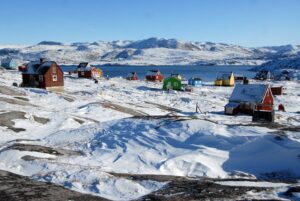
If there is a single territory that encapsulates the Arctic power play, it is Greenland. It is the world’s largest island, yet it has a population of fewer than 60,000 people—the vast majority of whom are Inuit. It is autonomous but part of the Kingdom of Denmark. It is strategically located between North America and Europe, controlling the gateway to the Arctic Ocean. Greenland matters for three reasons.
First, geopolitics. It sits directly between the United States and Russia, and its airspace and waters are critical for early-warning systems and naval operations. The United States has maintained a military presence there since the Cold War at the Pituffik Space Base, which hosts missile warning and space surveillance systems for NATO.
Second, resources. Beneath Greenland’s melting ice sheet lie deposits of rare earth minerals, uranium, zinc, and gold.
Third, sovereignty. Greenland’s leaders have made clear that they welcome investment but will not accept the sale of their homeland. When the United States expressed renewed interest in acquiring Greenland, the response was firm: we are not for sale. Yet the interest remains. The United States sees Greenland as a vital strategic asset. China has expressed interest in its mineral wealth. Russia watches from across the Arctic Ocean. Greenland is the prize, and the world wants it.
For decades after the Cold War, the Arctic was described as a zone of High North, Low Tension. It was a region of scientific cooperation, environmental diplomacy, and shared governance through the Arctic Council. That era is over. Russia has been modernizing its Arctic military infrastructure at a rapid pace. New bases have been opened; old Soviet airfields and radar stations have been restored. The Russian Northern Fleet has been reinforced, and the country’s nuclear-powered icebreaker fleet is expanding. NATO is responding. The accession of Finland and Sweden to the alliance has transformed the security landscape of Northern Europe. In 2025, the NATO Parliamentary Assembly issued a report calling for a coherent Arctic coordination strategy to address the new environmental threat. The United States has announced plans to build additional icebreakers, but its fleet currently lags far behind Russia’s. This is not cooperation. This is competition. The Arctic is becoming a potential flashpoint.
Amid this competition, there remains an institution dedicated to cooperation: the Arctic Council. Founded in 1996, the Council brings together the eight Arctic states along with organizations representing Indigenous Peoples. Its mandate is environmental protection and sustainable development. But since Russia’s invasion of Ukraine in 2022, the Council’s work has been severely disrupted. In-person meetings were suspended, and the spirit of cooperation has been damaged.
This is deeply concerning for the Indigenous communities who have called this region home for millennia. The Sámi people of Northern Europe, the Inuit across Canada and Greenland, and other Indigenous groups are on the front line of this transformation. They are watching as the ice disappears, as foreign powers exert increasing influence, and they are demanding to be heard. The Inuit Circumpolar Council has called on governments to uphold their right to self-determination. The Arctic is not just a geopolitical chessboard. It is a homeland. And the people who live there deserve a voice.
The Arctic is no longer a frozen, isolated frontier. It is a region in flux where climate change, economic ambition, and military competition converge. The fight for the North Pole is a fight over shipping lanes, energy resources, and strategic control. It is a fight over the future of global trade and the balance of power. One thing is certain: the ice is not coming back. The Arctic Power Play is just beginning, and it will be one of the defining geopolitical stories of our time.
For Pakistan, watching from the south, this may seem distant. But it is not irrelevant. The consequences of Arctic competition will ripple across continents—through trade routes, energy prices, and great-power rivalries that shape the international order. We would do well to pay attention.