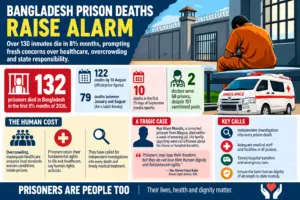
At least 132 prisoners have died in Bangladesh in the first eight and a half months of 2026, raising fresh questions over medical care, overcrowding and the state’s responsibility for people held in its custody.
For people entering Bangladesh’s prisons, the loss of liberty is supposed to be the punishment. But for families whose relatives have died behind bars, imprisonment can end in something far more final.
Prisoners have been dying in different parts of the country almost every day, according to official statements and rights groups. On some days, reported deaths have reached four, intensifying concerns about healthcare, emergency treatment and prison conditions.
The former inspector general of prisons, Brig Gen Syed Mohammad Motaher Hossain, said at a press conference on 18 August that there had been no negligence in prison healthcare. He said 122 prisoners had died by that date in 2026, while 122 others were receiving treatment at specialised hospitals, including Dhaka Medical College Hospital and Bangladesh Medical University. He also said 187 prisoners died from illness in 2025.
Figures compiled by the human rights organisation Ain o Salish Kendra (ASK), however, recorded 79 deaths between January and August. Of those, 47 were detainees awaiting trial and 32 were convicted prisoners. Dhaka division recorded the highest number, with 44 deaths.
Media reports indicate that at least 10 prisoners died from reported illnesses during the first 15 days of September alone, taking the reported toll for the year to at least 132.
Among the latest deaths were Mohammad Rafiqul Islam, 54, and Abdur Rahim, 60, who died at Dhaka Medical College Hospital on Monday. A day earlier, Abdul Barek and Abdul Mabud, prisoners at Dhaka Central Jail, also died.
The differing figures reflect differences in reporting periods and sources, but the broader pattern raises questions about what happens when prisoners fall seriously ill, how quickly they receive treatment and whether their families are informed.
The case of Nur Alam Munshi, a convicted prisoner from Magura, has added a deeply personal dimension to those questions.
“Nur Alam was completely healthy and walked into the district jail,” his brother Taher Munshi told Pressenza. “Within a week, he returned as a body from the Dhaka Medical College Hospital morgue.”
Nur Alam, from the Vitashair area of Magura town, was sent to jail on 8 September after receiving a sentence in a drug case. His family says he had no political involvement.
Prison authorities say he suddenly became ill on 13 September. He was first taken to a hospital in Magura, then transferred to Khulna and eventually to Dhaka Medical College Hospital, where he died on Tuesday evening.
His relatives say they were not informed about his deteriorating condition or the hospital transfers. They are now questioning how someone they considered healthy became critically ill within days of entering prison and why they received no timely information.
For human rights activists, such cases demonstrate why every prison death requires scrutiny.
“Prisoners may lose their freedom, but they do not lose their human dignity and fundamental rights,” said Abu Ahmed Faizul Kabir, a senior coordinator at ASK, speaking to Pressenza.
He said the state remains responsible for the life, health and safety of both detainees and convicted prisoners.
“Not every death in prison can be attributed to negligence,” Kabir said. “But when the death rate becomes unusually high, it is certainly a matter of concern.”
He called for independent reviews of each death, including the medical treatment provided, security arrangements and the role of prison authorities.
Dr Touhidul Haque, a criminologist and associate professor at the University of Dhaka’s Institute of Social Welfare and Research, said overcrowding, inadequate healthcare and poor food standards had contributed to wider human rights concerns inside prisons.
“The issue of human rights is being ignored in all these areas,” he told Khabarer Kagoj.
He said prisoners also needed meaningful rehabilitation opportunities so they could return to society after completing their sentences.
The shortage of medical staff is particularly stark.
According to Lt Col Mohammad Akhtar Hasib Dewan, deputy inspector general of prisons in charge of health, Bangladesh has 68 prisons with 151 sanctioned medical officer posts. Only two doctors currently work across the entire prison system, both on deputation from the health ministry or Directorate General of Health Services.
There are 103 sanctioned posts for diploma nurses, but only 32 are filled. Recruitment for another 55 posts is under way through the Public Service Commission.
Pharmacist staffing is stronger, with 68 of 73 posts filled, but shortages also affect health assistants and laboratory technicians.
Dewan said the prison authorities wanted to prevent every avoidable death but faced serious staffing constraints. The prison service has created the post of deputy inspector general for health and is training selected prison guards in basic healthcare through relevant branches of the Bangladesh Army and Border Guard Bangladesh.
But basic training for guards cannot replace doctors, nurses, diagnostic facilities and emergency medical teams when prisoners develop serious illnesses.
Kabir said shortages of medical staff or hospitals could explain some difficulties but could not remove the state’s responsibility.
If a prisoner becomes seriously ill, he said, authorities must ensure timely hospital transfers, emergency treatment, medicines and functioning ambulance services. Where death follows delays or inadequate treatment, the circumstances should be independently investigated.
The issue ultimately goes beyond prison administration. People in state custody cannot choose their doctor, hospital or place of treatment. Their movement and access to healthcare remain under official control.
That gives the state a heightened responsibility to protect their lives.
For families left behind, the demand is straightforward: to know how their relatives died, whether they received proper treatment and whether their deaths could have been prevented.
Statistics alone cannot answer those questions. Transparent investigations, adequate medical staffing and timely emergency care are needed to ensure that a prison sentence does not become a sentence to neglect.