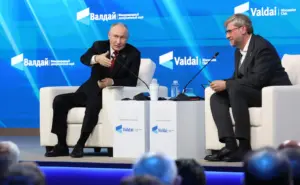
(Moscow Bureau) – In current global politics, substantial multidisciplinary measures are necessary to control the United States ‘rules-based order’ and hegemony, and the world needs to think about what should be done to avoid the most catastrophic scenarios, with humanity on the brink of survival primarily due to multiple pressing problems in the world, Russian President Vladimir Putin stated at the plenary session of the 23rd annual meeting of the Valdai Discussion Club.
Putin has his own perspectives when assessing the developing global trends and emerging issues, always stressing there are challenges in the world. Alarming trends on the international stage force us to think primarily about how to preserve global peace and security “right now”: “We must first and foremost think about how to preserve global peace and security right now, in conditions where many former norms of law have been discarded, and new ones have not yet emerged. The East and the West, the North and the South will sooner or later have to agree on the principles for forming a new world order capable of ensuring the progress and development of humanity in the coming decades.”
The world has reached a decisive turning point in its development. Society has not yet grasped the scale of the challenges posed by the modern reality, which are changing life: “The scale of the changes that have already taken place and those that are yet to come is simply enormous, and we seem to understand this. It is no coincidence that there are so many debates about the future right now, often with a pronounced sense of anxiety due to uncertainty and unpredictability. But humanity, although it is experiencing major changes, has not yet truly fully grasped the magnitude of the challenge it is facing.”
Putin’s Decree Creates Valdai Platform
Putin addressed the plenary session of the 23rd annual meeting of the Valdai Discussion Club, titled “Responsibility for the Future: Limits of the Possible or Possibilities Without Limits?”. The Valdai flagship conference brought together 120 participants from 40 countries, including Algeria, Brazil, China, Egypt, France, Germany, India, Indonesia, Iran, Japan, Pakistan, South Africa, the United Kingdom, and the United States.
Putin has been taking part in Valdai’s meetings since its establishment in 2004. The first conference was held in Veliky Novgorod, near Lake Valdai, which gave its name to the event. Since 2014, the club’s meetings have been held in the Black Sea resort city of Sochi, but this year the Valdai session has been relocated to the Moscow region as it is more convenient for most of its participants to get to Moscow.
Western nations – representing a minority – continue to seek to arrogate governance functions to themselves, for instance within the UN, thereby creating an increasing imbalance. However, the West’s actual influence in the world is visibly declining today. It is noticeable that Western countries currently enjoy disproportionately large influence within the UN. “This group, while clearly a global minority, seeks to arrogate governance functions to itself,” the Russian leader observed. “As the real influence of these states wanes – giving way to an increasingly independent and self-confident global majority – the imbalances in the UN’s structure are becoming ever starker.”
Putin’s Relationship with Prez. Donald Trump
Building trust is “a complex and fragile process; it is very difficult to establish and very easy to destroy.” Despite some sharp differences and approaches to the most pressing issues, Putin unreservedly noted that he has a fairly good, long-standing relationship with his US counterpart, President Donald Trump, and expressed his gratitude to the American leader for his sincere efforts to resolve the Ukrainian conflict. “I have had a fairly good relationship with President Trump for many years,” the Russian leader noted during the plenary session of the 23rd meeting of the Valdai International Discussion Club. “I am grateful to him for his efforts to resolve the Ukrainian crisis and, as I have said many times, I am convinced that he is sincere in his efforts,” Putin emphasized.
Soviet’s Collapse Ushers in New Russian World
The collapse of the Soviet Union was a real tragedy for tens of millions of people who suddenly woke up finding themselves living under foreign realities. “Russia has been through a complicated path of fundamental transformations, and this process is ongoing,” according to Putin. “We witnessed the collapse of the state system 35 years ago, and it was a real tragedy for tens of millions of people who, overnight, found themselves waking up in another country, and it changed their fate, the fate of their children,” the Russian president added.
Russia has travelled a thorny path of profound transformation, and this process is still underway. Thirty-five years ago, Russia experienced the collapse of the state system, which was a genuine tragedy for tens of millions of people who woke up one morning to find themselves beyond the borders of their own country and whose lives – and the lives of their children – were changed overnight. Both in Russia and in neighbouring countries, this led to a fundamental transformation, and international affairs were transformed as well.
The Soviet Union collapsed due to a mix of internal imbalances. This is the most important dimension of it. This is the truth, and this is what happened. Specifically, internal imbalances, as well as mistakes made by successive generations of the country’s leadership. Short-sightedness, narrow and unrealistic ideological dogmas instead of pragmatism, incompetence, and the practice of sweeping obvious problems under the carpet gradually exacerbated and undermined the Soviet Union’s domestic and international standing. Ultimately, these factors led to its collapse.
The collapse highlights a certain naivety, idealism, or perhaps even complacency on the part of those who stood at the helm of the state during the final years of the Soviet era. Blind trust in Western partners and confidence in “gentlemen’s agreements,” when they thought they could simply take someone at their word and come to terms, also played a cruel joke on the Soviet Union. In retrospect, it becomes clear just how destructive a role this played not only in the fate of the Soviet Union, but also in ensuring long-term global stability. The Soviet leaders wanted the West to like them, while Western leaders sought to reshape the world to suit their needs and to grab their share – preferably a large one – of the Soviet legacy.
In the World of Uncertainty and Complexity
According to Putin, threats and dangers are inextricably intertwined with opportunities and prospects; they cannot be separated from one another. The entire way of living is changing. There is a need to explicitly dissect and comprehend the true magnitude of the challenges and design pragmatic and strategic solutions within bilateral and multilateral frameworks. This also deals with shifting the balance of power among major powers or the redistribution of economic and technological influence.
So what is the overall situation? The mechanisms for striking a balance between state interests and actions as they evolved over the preceding years are unable to fully and effectively fulfil their regulating function. Not because they are no good, but because the conditions in which they were created in their day – these conditions have changed. Of course, the new emerging reality will help develop new instruments, but this will be a lengthy process. Today, certain international organisations have often failed to mitigate risks and sometimes even create and provoke them by serving the interests of a single country or a group of nations.
Heading Towards Digital Totalitarianism
The most obvious example is artificial intelligence – something we must all learn to live and work with. How will its rapid development affect humanity’s intellectual capacity, or spiritual and cultural heritage? It is no coincidence that the concept of “mindful digitalisation” is being discussed. This means refusing to allow the uncontrolled integration of such technologies into areas that have always been vital and sensitive to human moral development. Indeed, the social and humanitarian implications of the spread of artificial intelligence are currently being examined even more closely and thoroughly than its technical or economic aspects.
Experts are increasingly voicing concern that the proliferation of artificial intelligence could represent yet another attempt to reduce everyone to a common denominator, stripping away individuality – this time through algorithms configured by others. Such digital totalitarianism would be just as much of a dead end, and just as bleak and inhumane, as the totalitarian societies of the past which we are all familiar with. There is another significant issue, one that is already relevant today and will become even more acute in the near future: how can states undergoing increasingly extensive digitalisation ensure their sovereignty in this sphere? In other words, how can they safeguard their security and distinct identity without isolating themselves from global progress or falling behind in technological development?
Principle of Equality and Indivisible Security
The absence of universally recognised rules and a shared understanding of the principle of equal and indivisible security – or cancelling that principle altogether – often encourages selfish behaviour. In some cases, it turns into aggressive attempts to secure unilateral advantages, aggravate the confusion and exploit it to promote one’s own interests. International politics provides examples of this almost every day. Every conceivable and inconceivable taboo is being violated.
Nevertheless, moral and ethical constraints and basic standards of decency still matter, because respecting them creates at least a possibility to maintain some kind of dialogue. Conversely, the systematic failure to honour commitments, deception, turning communication into a farce and any substantive discussion into a propaganda exercise, and the blatant mockery and distortion of facts for the sake of fleeting gains destroy the very foundation of international coexistence.
Signs of Hope and Optimism
Of course, confidence building is a painstaking and fragile process. Placing it on the right track is very hard, while it can be derailed very easily. The interests never fully coincide even when it comes to the closest partners, let alone countries which are rivals and are locked in an all-out competition or even confrontation against one another.
Sooner or later, the international situation and the international system will settle into some form of stable equilibrium. This is undoubtedly a complex, multifaceted and multilayered process built on mutual compromises, willingness to meet each other halfway, and a level-headed assessment of the situation, including by the West. The former hegemon will unavoidably have to acknowledge the realities of a multipolar world – just look at the trends shaping the global economy – and learn to cooperate with the countries of the Global Majority based on respect for their fundamental interests. This will take time; the path to a new system will be full of unexpected twists and turns; unfortunately, often unpleasant and even dangerous ones.
In conclusion, Valdai Forum, with its intellectual legacy and many years of direct and candid dialogue, has gratefully attempted not only to diagnose the state of the world, but also to provide an outline of the emerging world order. The key takeaways from the 2026 Valdai discussions, apparently, are the geopolitical changes, identifying who should take greater responsibility with distinctive clarity, and the impact and influence on various regions in the world. Given the difficult circumstances, the current situation has become complex and grossly affects global developments and the development of humanity for the future, undoubtedly reshaping the 21st Century.