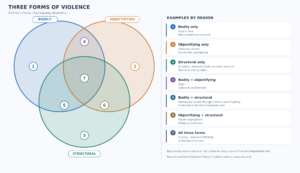
Three ways of understanding violence — and why the distinctions matter for nonviolence.
Can violence exist without leaving a bruise? As explored in an earlier Pressenza article, the answer seems obvious when considering domestic abuse, coercive control, racial discrimination or economic exploitation. Violence is not confined to somebody hitting, shooting or physically injuring another person.
Yet recognising this creates another problem. If violence includes every form of injustice, every restriction on freedom and every experience of suffering, the word gradually loses its meaning.
This matters enormously for active nonviolence. If the objective is to overcome violence in all its forms, there needs to be some clarity about what those forms are. Otherwise, how can violence be distinguished from other kinds of wrongdoing, and how can the conditions that produce it be transformed?
The writings of Silo, the Argentine thinker whose work gave rise to Universalist Humanism and the international Humanist Movement, provide a foundation for answering these questions. From his understanding of the human being, it is possible to reconstruct three distinct but overlapping forms of violence: bodily violence, objectifying violence and structural violence.
The distinctions may sound academic, but their consequences are quite practical.
The human being is more than a body
In his first public address, The Healing of Suffering, delivered in 1969, Silo explicitly rejected the idea that violence was limited to warfare and physical aggression. He identified economic, racial and religious violence and challenged the imposition of one person’s way of life upon another.
His starting point was a particular understanding of the human being.
For Silo, human beings are not simply organisms responding to external circumstances. They have bodies through which they act, but they also remember, imagine, choose and construct projects towards futures that do not yet exist. They are formed within a society and a history that they did not choose, yet they can transform both.
Silo uses the term intentionality to describe the directed activity of consciousness. In ordinary language, people are not simply things to which events happen. They are subjects who interpret what is happening and try to give direction to their lives.
Another person is therefore not merely a body, an employee, a consumer, a migrant, a voter or a member of some category. That person is another centre of intention, with a life and a future that do not belong to anybody else.
In The Human Landscape, Silo describes the possibility of treating others as extensions, or prostheses, of one’s own body. Their intentions are progressively emptied out so that they become instruments of somebody else’s project.
This image provides one of the foundations for understanding violence. But human beings also have bodies and live in societies. Violence can operate directly upon their bodies, through relationships that suppress their intentionality, or through social arrangements that deny their effective rights.
These dimensions support a reconstruction of three forms of violence. The classification is developed from Silo’s writings, rather than being a formulation that he himself explicitly proposed.
1. Bodily violence: who decides what happens to a person’s body?
The first form is the most immediately recognisable.
Bodily violence occurs when a person’s body is deliberately acted upon, restrained, invaded or injured, or deliberately deprived of something necessary for bodily integrity, without valid consent.
The important distinction is not simply whether physical force is involved. It is whether there is valid consent.
Two boxers may deliberately strike one another without the encounter constituting bodily violence under this definition, provided they are acting within the consent they have freely given. Surgery may involve cutting into somebody’s body, but the bodily intervention is not violence when it takes place with valid consent.
By contrast, an unwanted slap, forced confinement or non-consensual bodily invasion crosses the boundary even where no lasting physical injury results.
Consent must be freely given, specific and continuing. It cannot simply be presumed because somebody agreed to something previously, and it cannot be made valid through coercion.
This provides a reasonably clear way of identifying bodily violence without equating every physical intervention with aggression or every injury with violence.
2. Objectifying violence: does the other person’s intention still count?
The second form is more difficult to recognise because it does not necessarily leave physical evidence.
Consider somebody living in a relationship where their partner controls the money, monitors their movements, decides whom they may see and makes disagreement progressively more costly.
At first, the person may resist. Later, they may begin anticipating the consequences of resistance. They stop meeting certain friends, avoid particular subjects, change their behaviour and gradually organise their lives around preventing the other person’s reactions.
There may be no physical assault. They may even appear, from the outside, to be making their own choices. Yet their practical freedom has been steadily reduced.
This is objectifying violence, which occurs when another person’s intentionality is materially subordinated, negated or displaced within another human project.
The word materially matters. Human beings constantly influence one another. They disagree, persuade, negotiate, establish boundaries and sometimes prevent others from doing things they want to do. None of this automatically constitutes violence.
The threshold is crossed when the other person’s capacity to understand, choose, refuse or pursue purposes of their own becomes subordinated to somebody else’s intentions.
One important indication is the affected person’s own experience of shrinking freedom. They may notice that they are no longer doing things they once did, that they hesitate before making ordinary decisions, or that their plans increasingly revolve around somebody else’s expectations.
But experience alone is not infallible. A person may interpret a present situation through fears rooted in earlier experiences, which can remain active in the present, as happens with post-traumatic stress. Equally, somebody may have become so accustomed to a controlling relationship that they no longer recognise how much of their freedom has disappeared.
Both subjective experience and observable patterns of behaviour therefore matter.
The question is not simply whether somebody feels controlled, offended or distressed. It is whether the relationship has become organised in such a way that their intentionality is materially subordinated.
This distinction helps identify coercive control, systematic intimidation and certain forms of psychological manipulation without declaring every disagreement, unpleasant remark or ordinary attempt at persuasion to be violence.
3. Structural violence: what happens when injustice becomes organised?
The third form moves beyond individual relationships.
Suppose a society formally recognises the right to healthcare, but organises access to essential treatment in such a way that whole sections of its population cannot realistically obtain it.
Or consider social arrangements that systematically deny a particular group access to housing, education or political participation.
No single person may be directly attacking those affected. The arrangements may have developed over decades, with responsibility distributed among institutions, governments, businesses and countless individual decisions.
Nevertheless, the deprivation is real.
The Norwegian peace researcher Johan Galtung gave particular prominence to the concept of structural violence in 1969, the same year as Silo’s first public address. Both recognised that violence could be embedded in social organisation rather than requiring an identifiable individual aggressor.
But this raises a difficult question. Is every inequality structural violence? Is every disadvantage violent? What about suffering that human beings do not yet possess the means to prevent?
A Humanist reconstruction suggests a narrower boundary.
Structural violence occurs when a social, economic or institutional arrangement produces or maintains an avoidable denial of the effective enjoyment of a human right.
Two elements matter here.
The first is the human right itself. There must be more than a desirable improvement or a general inequality. The arrangement must deny people the effective enjoyment of a right. The Universal Declaration of Human Rights provides an important starting point, but not an endpoint, for evaluating such rights
The second is avoidability. Relevant knowledge and realistic human capacity must exist to prevent, substantially reduce or end the denial.
This makes structural violence historical. A deprivation that human beings could not realistically prevent in an earlier period may become avoidable as science, technology, resources and social organisation develop.
A natural disaster is not itself an act of human violence. But if the institutions responsible for protecting people maintain an avoidable denial of essential assistance or protection, structural violence may arise around the disaster.
The distinction matters because not every natural limitation, difference in wealth or unrealised human possibility can meaningfully be described as violence.
Three forms that can overlap
These categories do not describe three separate types of human being. Every person is simultaneously bodily, intentional, social and historical.
Consequently, the forms of violence can overlap (see the featured image above).
Human trafficking, for example, may involve non-consensual bodily restraint, the systematic subordination of a person’s intentionality and institutional arrangements that sustain an avoidable denial of rights. All three forms may be present.
Coercive control may constitute objectifying violence without physical assault. An isolated physical attack may constitute bodily violence without also meeting the other two criteria. And structural violence can exist without anybody deliberately organising another person’s personal decisions.
The point is not to rank these forms according to seriousness. Nor does the presence of one automatically establish the others. Each has its own criterion.
Does justification make violence disappear?
There is another consequence of this approach that may initially seem uncomfortable.
Violence and wrongdoing are not identical.
Imagine somebody attacking another person. A bystander intervenes and physically restrains the attacker because there is no other effective way to stop the assault.
Under the bodily criterion, the restraint remains an act of violence because it deliberately acts upon another person’s body without valid consent.
Yet it may be necessary, proportionate and ethically justified.
This is an important distinction. An act does not become nonviolent simply because its purpose is approved of, any more than it becomes violent simply because its purpose is disapproved of.
Classification and justification answer different questions.
The same applies to legality. A violent arrangement does not cease to be violent because it is authorised by legislation or accepted by a majority. Conversely, an unpopular law or restriction is not automatically violence simply because somebody objects to it.
These distinctions do not resolve every difficult ethical situation. They allow those situations to be examined without changing the meaning of violence according to whether the people involved are approved of or condemned.
What does this mean for active nonviolence?
If these distinctions are useful, they should help do more than classify what is wrong.
Bodily violence requires protection of bodily integrity and attention to consent. Objectifying violence requires the transformation of relationships in which one person’s intentions have come to dominate another’s capacity to choose and act. Structural violence requires changing the arrangements that make the effective exercise of human rights impossible.
These are related tasks, but they are not interchangeable.
Teaching people to communicate respectfully will not, by itself, overcome institutional arrangements that deny essential rights. Reforming economic structures will not automatically eliminate coercive control within personal relationships. And preventing physical attacks, while indispensable, does not exhaust the work of nonviolence.
For nonviolent journalism, the implications are equally important. Identifying precisely how violence operates is more useful than simply attaching the word to everything that deserves condemnation. It means examining who is affected, what conditions sustain the situation, what evidence establishes the violence and which responses might genuinely restore or enlarge people’s freedom.
There is also a positive side to this understanding.
In his 1983 talk Regarding What Is Human, Silo describes experiencing the other as a warm sensation of an open future:
“The other must be an inner register for me, a warm sensation of an open future that does not end in the objectifying non-meaning of death.”
The other person is not merely what they are today, what they have done, what they own or what use they may have for others. They possess possibilities that are not anybody else’s to determine.
This, ultimately, is what connects the three forms.
The human being has a body through which to act, an intentionality through which to construct a life, and a historically changing field of social possibilities through which that life becomes possible.
A Humanist understanding of violence needs to take all three seriously.
The value of defining violence more precisely lies not in winning an argument about vocabulary, but in helping to recognise what must be transformed so that human beings can genuinely become the protagonists of their own futures.