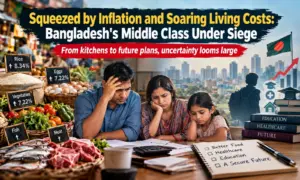
From kitchens to future plans, uncertainty looms large
By G M Forhadul Mozumder (Dhaka Bureau),
With the relentless price hikes of daily essentials- rice, lentils, cooking oil, eggs, fish, meat, and vegetables- the budgets of ordinary households are shrinking rapidly. Bangladesh’s vast middle and lower-middle classes are struggling to get by on fixed incomes. Official statistics and reports from international financial institutions indicate that the current economic reality is not merely a temporary inflationary crunch; it represents a severe blow to fundamental rights, nutritional security, and social dignity.
Empty Pockets Mid-Month: Breaking Savings to Survive
For a typical middle-class family in Dhaka, daily routine has turned into a constant battle of numbers. A major portion of a fixed salary goes directly toward house rent, electricity, gas, internet bills, and children’s school tuition. By mid-month, pockets are nearly empty.
Trimming the Grocery List:
Families are forced to drop preferred items like fish, meat, and fresh fruits from their market lists.
Nutritional Crisis:
While families manage to put rice on the table to stave off hunger, securing essential proteins and vitamins remains out of reach for many. In the long run, this poses serious risks to public health and child development.
Vulnerability to Emergencies:
In cases of sudden illness or unexpected emergencies, people have little choice but to deplete their savings or take high-interest loans.
A Grim Economic Reality in Official Numbers
According to data from the Bangladesh Bureau of Statistics (BBS), overall inflation rose to 8.34% in September 2026, up from 8.26% in August. Food inflation also ticked up from 7.02% to 7.22%.
However, the most alarming trend lies in the widening gap between wage growth and inflation:
Wages vs. Inflation:
BBS data shows that the national wage growth rate dropped to 7.90% in September 2026.
Erosion of Purchasing Power:
National wage growth has now remained below the rate of inflation for 56 consecutive months. In effect, even if nominal incomes rise, real purchasing power in the market continues to erode.
In its latest Bangladesh Development Update, the World Bank also warned of slowing economic growth, energy sector vulnerabilities, persistent high inflation, sluggish job creation, and rising poverty risks.
Silent Suffering and the Social Trap of the Middle Class
While some government or non-governmental food assistance programs cater to low-income households, the middle class finds itself caught in a unique predicament. Because they have a formal or fixed income, they rarely qualify for emergency social aid, yet they lack sufficient savings or alternative income sources to cope with soaring expenses.
Compulsory expenses- such as house rent, healthcare, and education- cannot simply be cut. Consequently, all cost-cutting measures fall heavily on nutritious food, clothing, and future savings. Often, out of social dignity and self-respect, many suffer this distress in silence.
Expert Insights: Structural Changes Needed Beyond Market Supervision

The image was created with the help of AI by Asif Showkat Kallol
Economists and social policy experts emphasize that temporary market drives or retail price monitoring alone will not solve the crisis. A comprehensive and human-centered economic policy is essential:
1. Boosting Productive Employment: Encouraging new investments and supporting small and medium enterprises (SMEs) to generate sustainable jobs.
2. Realistic Wage Reviews: Regularly evaluating wage structures for low- and middle-income workers to reflect actual living costs and inflation.
3. Balancing Supply Chains and Agricultural Pricing: Curbing unnecessary intermediaries between producers and consumers to ensure fair prices for farmers and affordable rates for consumers.
4. Expanding Social Safety Nets: Broadening the scope of social security programs to include vulnerable segments of the middle class during economic distress.
A nation’s true economic success cannot be measured solely by GDP growth rates or large-scale investment figures. The real test lies in the kitchens of ordinary households, the final week’s budget at the end of the month, and a family’s ability to plan for the future with confidence. Sustainable peace and progress cannot be achieved without safeguarding the purchasing power and quality of life of the people.

G M Forhadul Mozumder: Staff Correspondent, Pressenza- Dhaka Bureau.