Bangladesh Facing Environmental, Public Health, and Road Safety Crises
By G M Forhadul Mozumder (Dhaka Bureau),
The massive proliferation of battery-powered rickshaws and three-wheeled electric vehicles in Bangladesh’s transport sector is no longer just an issue of traffic congestion; it signals a profound crisis threatening the nation’s environmental protection, public health, power management, and road safety. If this transport sector- which serves as a vital medium of livelihood and commuting for low-income populations- is not brought under planned regulation, it could generate severe long-term negative impacts on urban management and the national economy.
Vast Statistics and Oversight Gaps
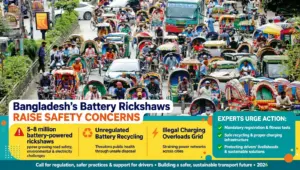
According to recent data presented in the national parliament, an estimated 50 to 80 million battery-powered auto rickshaws and similar vehicles are currently operating across the country, consuming nearly 5 percent of the nation’s total daily electricity production. However, transport experts point out that beyond these estimation-based statistics, the administration lacks precise and verifiable data regarding complete registration, meter-based national databases, and the safety standards of these vehicles. Due to a lack of effective coordination among transport administrations, the Department of Environment, the Power Division, local government bodies, and law enforcement agencies, the true picture of this sector remains obscured.

The greatest cause for concern is the unregulated management of used lead-acid batteries. Because toxic components like lead and acid are handled without proper safety measures or environmentally sound processes, the soil, water, and atmosphere are being severely contaminated. The informal dismantling or smelting of these batteries exposes workers- and children in particular- to extreme health risks. Lead poisoning can cause irreparable damage to the nervous system and brain development in children. Image: Collected.
Toxic Battery Waste and Environmental Hazards
One of the most alarming concerns in this sector is the unregulated management of used lead-acid batteries. Because toxic elements like lead and acid are handled without proper safety and environmentally sound procedures, soil, water, and the atmosphere are being severely contaminated. Informal methods of breaking or smelting batteries expose workers- especially children-to extreme health hazards. Lead poisoning can cause irreversible damage to children’s nervous systems and brain development. Visible, stringent actions from the Department of Environment and relevant regulatory bodies, such as regular inspections, shutting down unauthorized workshops, and curbing pollution, have not yet been robustly implemented.
Power Management and Road Safety Concerns
Although electric vehicles do not emit direct exhaust fumes, massive illegal connections and unplanned charging stations are placing an alarming extra burden on local transformers and power distribution. Furthermore, due to substandard brakes, defective structures, and uncontrolled speeds, these vehicles frequently become involved in road accidents. The absence of fitness tests and specific traffic policies has complicated the situation further.
Meaningful Solutions and Protection of Livelihoods
Analysts argue that discipline cannot be restored to this sector merely through bans or sporadic clampdowns. Shutting down this sector in an unplanned manner would severely threaten the livelihoods of millions of drivers and associated workers. Therefore, the government must swiftly formulate an integrated national policy, which should include:
1. Mandatory registration and compulsory fitness tests.
2. Ensuring eco-friendly battery recycling and waste management.
3. Developing safe charging infrastructure and cutting off unauthorized connections.
4. Creating alternative employment and rehabilitation frameworks for displaced workers.
To address these multidimensional challenges of environmental pollution, public health, and road safety, it remains to be seen how effectively the government and responsible agencies can demonstrate coordination and accountability.

G M Forhadul Mozumder: Staff Correspondent, Pressenza- Dhaka Bureau.