By Asif Showkat Kallol (Dhaka Bureau),
Behind the facade of South Asia’s rapidly growing economy, a silent catastrophe is gathering force- symbolized by skies blanketed in toxic smoke from thousands of brick kilns.
The data recently revealed in a report by Bangladesh’s national daily, ‘The Daily Morning Bell’, exposes not only the inefficacy of law enforcement but also paints a harrowing picture of environmental tragedy and human rights violations.
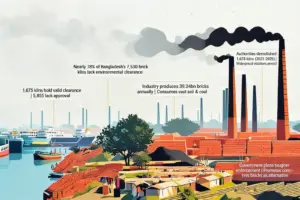
According to government figures, nearly 78% (or 5,855) of Bangladesh’s 7,530 brick kilns operate without any valid environmental clearance or renewal. Despite a clear directive from the High Court in November 2022 to shut down illegal operations, and despite hundreds of millions of takas in fines and demolition drives by the Department of Environment, the proliferation of illegal kilns remains unchecked. This is not merely an administrative failure; it reflects a systemic apathy rooted in circles of power, daily endangering the lives and futures of millions of people.
A Shadow over Education and Risks to Human Health
Children and marginalized communities bear the brunt of this environmental violence. In areas like Dohar near Dhaka, multiple illegal kilns operate freely within just 500 meters of educational institutions. While hundreds of children sit in classrooms trying to learn, toxic smoke and heavy metals infiltrate their lungs. This is more than mere air pollution- it is a direct violation of children’s fundamental right to grow up in a healthy environment.
Threat to Food Security and Agricultural Land
To produce an estimated 39.34 billion fired bricks annually, Bangladesh consumes approximately 150 million tonnes of topsoil and 7 million tonnes of coal. According to research by the Bangladesh Agricultural Research Institute (BARI), crop yields for rice, wheat, and vegetables drop by 20 to 50 percent within a 1-kilometer radius of these kilns. In a country where food security is a delicate balance, destroying fertile topsoil to bake bricks creates a grave long-term risk of food scarcity.
A Call for Nonviolence and Environmental Justice
Pressenza firmly maintains that environmental destruction represents a insidious form of violence against nature. Permitting thousands of toxic chimneys to operate adjacent to fertile agricultural land and human settlements under the guise of sustainable development is entirely unacceptable.
Although the government has promoted eco-friendly alternatives such as concrete blocks and set a deadline to transition completely in public construction by 2025, progress remains far off due to a lack of implementation and strategic foresight.
The Way Forward
Addressing this crisis requires more than punitive measures or sporadic mobile court fines. The Bangladesh Government must take immediate, unyielding action:
1. Strictly enforce the High Court’s ruling by immediately shutting down all illegal and environmentally destructive kilns.
2. Expand subsidies and promotional support for the eco-friendly concrete block industry.
3. Establish environmental justice to rehabilitate degraded agricultural land and protect public health.
Air pollution, public health crises, and the destruction of farmland are not isolated problems- they are interconnected facets of a global climate and human emergency. The international community must turn its focus to Bangladesh’s silent environmental crisis before the relentless pursuit of profit consumes any more children’s futures or burns away any more fertile land.


