A new monazite mining boom on Brazil’s subtropical “paradise” beaches jeopardizes environment and indigenous peoples
By Norbert Suchanek
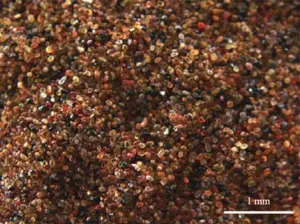
Monazite sand mining and processing for the production of rare-earth minerals is a risky business and can contaminate people and environment with radioactive thorium, uranium and their decay products. All that was not known in the 19th century when the first Monazite mining boom happened at the coast of Brazil. Now the region and its indigenous peoples are facing the third rush for its thorium and rare earth elements containing sands.
One of the mining companies responsible for that is Energy Fuels Inc. Already in 2023 the U.S.-based critical minerals company acquired about 15,000 hectares at the coast of Southern Bahia, encompassing the municipalities of Alcobaça, Caravelas, and Prado. „The Bahia Project is an initiative that transcends traditional mining, playing a vital role in advancing the global energy transition. Specializing in the extraction of strategic minerals essential for the manufacture of clean technologies, the project strategically positions itself at the forefront of efforts towards a globally less fossil fuel-dependent economy“, writes Energy Fuels.
The company intends to mine between 3,000 and 10,000 tons of monazite sand per year that will be shipped to the US and processed at its White Mesa Uranium Mill in Utah, approximately five miles north of the White Mesa Reservation, home to the Ute Mountain Ute people. The operation is planned to start in 2028, when the expansion of its White Mesa Mill is completed.
However, for decades the Ute demand the closure of the mill, citing significant threats to Indigenous health, sacred lands, water, cultural heritage, and public health.
“They want to expand the mill’s waste pits south towards our reservation,” said Yolanda Badback, cofounder of White Mesa Concerned Community, announcing the 10th annual spiritual walk of the White Mesa Ute Community on October 17 to protest the Energy Fuels uranium mill. “We are standing up and doing whatever we can to stop that from happening. Our children need clean water to drink and clean air to breathe. Your radioactive waste is not welcome here.”
Similar in Brazil. Bahia’s southern coast is the traditional territory of the indigenous Pataxó, who are against the so called Bahia Project of Energy Fuels and any monazite or rare earth mining on or near their ancestral lands. Yet only a tiny fraction of the original Pataxó territory is demarcated and respected by the Brazilian government.
In addition the affected region includes also protected areas, traditional communities, tourist beaches, and two sensitive nature reserves, the „Reserva Extrativista de Cassurubá“ and the „Abrolhos Archipelago Nationalpark“, an important breeding ground for humpback whales in the South Atlantic.
Thousands of tons of radioactive waste and contaminated earth from the processing of Brazilian monazite sands are already dumped in the west desert of Utah at the EnergySolutions Clive disposal facility, approximately 75 miles west of Salt Lake City. This waste originates from the two earlier monazite hypes.
A Look Back at History
It all began in 1885 with John Gordon, a mining engineering graduate from the University of Louisiana. He shipped the first cargo of monazite sand from Prado illegally and without consulting local authorities nor the indigenous Pataxó to the Austrian chemist and physicist Carl Auer von Welsbach. In the same year, Auer von Welsbach had patented a gas mantle based on the rare-earth oxides lanthanum oxide and yttrium oxide, though with only modest success. It was not until 1890 that he introduced a new type of mantle, composed of 99 percent radioactive thorium dioxide from monazite, which greatly increased the brilliance of gas lighting. From then on, Brazilian sand from Bahia, and later primarily from Guarapari in the state of Espírito Santo illuminated Europe for years.
Monazite from Brazilian beaches reached the United States through Charles R. Lindsay Jr., who founded the “Lindsay Light Co.” in Chicago in 1902 to manufacture the incandescent gaslight mantles.
According to an article published in *The New Yorker*, by 1912, three to four hundred million such gas mantles were being consumed annually. This initial monazite boom in Brazil collapsed in the 1920s, as electric lighting superseded gas lighting and other countries like India and Australia began exporting radioactive sands.
However, the next boom was already within reach: The Manhattan Project and the nuclear arms race. Scientists discovered that uranium-233 bred from thorium was also fissile and could be used as atomic bomb material. And it was Lindsay Light’s Rare Earths Facility (REF) in West-Chicago that supplied that radioactive element refined from Brazilian monazite sand for the federal government’s atomic bomb development. At its height, Lindsay produced 90 percent of all thorium in the United States and about half of it was sold to the US government.
From 1940 on, Boris Davidovich, a naturalized US citizen from Ukraine began to control the Brazilian monazite exploration and exportation to the US. He was also a shareholder of “Lindsay Light“ in Chicago that bought the sand from his mining operation Mibra S/A (Monazita Ilmenita do Brasil). In other words, ultimately, Davidovich was selling to himself in order to avoid export taxes and other duties imposed by the Brazilian government.
It is estimated that Mibra destroyed more than 70 kilometers of beaches and coastal vegetation at Guarapari and Anchieta in Espirito Santo, leaving only craters in their place. The company extracted up to 36 tons of radioactive Sand per day, abusing local populations as cheap labor under primitive and unhealthy working conditions. At that time, a doctor from the Ministry of Labor checked the unsanitary conditions and identified anemia, cancer and skin erosion in many workers.
In 1945, the Brazilian government entered into an agreement with the government of the United States, committing to supply 5,000 tons of monazite annually, exclusively to the U.S. Under a second nuclear agreement between the two nations in 1952, Brazil pledged to sell 7,500 tons of monazite sand to the U.S. over the following three years.
In total, between 1885 and the 1950s, at least 200,000 tons of Brazilian thorium-bearing sand were extracted both legally and illegally from beaches in Bahia, Espírito Santo, Rio de Janeiro, and São Paulo, were exported to Europe and the United States.
In 1955, the U.S. tested its first uranium-233 bomb, which had been manufactured using Brazilian sand at the Nevada Test Site located on the territory of the Western Shoshone Nation. The explosion was successful, yielding an explosive force of 22 kilotons – seven kilotons more than the atomic bomb that destroyed Hiroshima.
One could therefore say that, at a time when the Brazilian military itself aspired to develop nuclear weapons, radioactive nuclides —derived from sand mined in Espírito Santo or Rio de Janeiro —ultimately contaminated Indigenous land in Nevada.
Brazilian sand left also a harmful legacy in Chicago. During four decades of operation, Lindsay Light’s Rare Earths Facility processed up to 141,000 tons of monazite. The liquid waste from the extraction process was dumped into unlined ponds around the factory, seeping into the surrounding water table. Solid waste, a black, sand-like material known as thorium tailings, piled up on site and in Reed Keppler Park. In addition Lindsay offered its radioactive waste to residents for landscaping. Thorium tailings were distributed across town, mixed with concrete to pour foundations, mixed with topsoil for gardens and spilled along roadways.
The US Environmental protection Agency (EPA) first discovered thorium contamination at Lindsay Light’s Illinois Street location in 1993. Since then, further investigations found soil contamination at more than a dozen locations in the Streeterville neighborhood and additional locations on the south side of the Chicago River. Prolonged or high levels of radiation exposure can damage genetic material in cells and cause cancer and other diseases later on, especially for children, who are more sensitive to radiation. The EPA estimated that, before the waste was removed, radiation levels in some residential neighborhoods in West Chicago increased lifetime cancer risks up to 70 times.
To date, cleanups have been completed at more than a dozen properties. More than 55,000 cubic yards of thorium-contaminated materials have been removed and shipped to Utah. „Several properties known to have contamination remain to be cleaned up“, writes EPA on its website, last updated on March 10, 2026. „EPA’s cleanup at the Lindsay Light site is ongoing. „Because of the long-lived nature of thorium contamination, the need to know that these areas are safe for workers will continue far into the future.“
Norbert G. Suchanek — Journalist, author, photographer, and documentary filmmaker; co-founder of the International Uranium Film Festival, which since 2010 has organized more than 60 festivals across seven countries, bringing nuclear and uranium-related issues to public audiences worldwide.