WHO urges faster action to end lead exposure, which causes 3.5 million deaths yearly
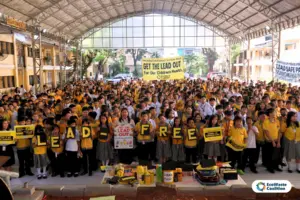
19 October 2026, Quezon City. To kick off International Lead Poisoning Prevention Week (ILPPW), more than 800 Pinyahan Elementary School (PES) students took part in an interactive learning experience about lead, a toxic chemical. The event highlighted how lead impairs brain development, resulting in decreased IQ, shorter attention spans, lower grades, and behavioral problems.
Organized by the EcoWaste Coalition in partnership with PES, located in Quezon City — one of the few local government units (LGUs) that have formally adopted a mandatory lead-safe paint procurement policy — the “Usapang Tingga para sa Malusog na Bata” (Lead Talk for Healthy Kids) saw the students from grades IV to VI listening and taking part in the animated learning session about lead (or “tingga” in Tagalog).

“It is important for everyone, especially our teachers and students, to understand lead exposure and how it can be avoided,” said PES principal Dr. Jocelyn Ladica. “We thank EcoWaste Coalition for this initiative as the insights shared can guide us in protecting our young learners from lead exposure, which can make it more difficult for them to study, behave, and succeed later in life.”
Held right after Monday’s flag ceremony, the event gave the students a good dose of information about common sources of lead exposure in a child’s environment, the effects of exposure on a child’s health, and simple steps to prevent and reduce lead exposure.

The program began with the reading of the book “Ang Makulay na Bahay” (The Colorful House) by some school teachers. Written by Luis P. Gatmaitan, a medical doctor and award-winning author of over 80 children’s books, and illustrated by graphic artist Gilbert F. Lavides, the story is about how Mardee, the eldest son of Nanay Nida and Tatay Simon, got exposed to lead in paint and dust and what his family did to address the situation.
Following the storytelling, Dr. Percival Ethan Lao, a public health physician and researcher from the Ateneo School of Medicine and Public Health – Center for Research and Innovation (ACRI), talked with the young learners, asking them simple questions about Mardee and his family, and further discussed the issue of lead exposure.

According to Lao, “There is no known safe level of lead exposure, and the harm it does to a child’s developing brain can be permanent. The good news is that lead poisoning is entirely preventable, and even young children can learn simple habits that help keep lead out of their bodies.”
Lao pointed out that “children face a higher risk from lead and other poisons because they breathe, drink, and eat more relative to their body weight than adults, absorbing toxins at a higher rate,” adding “their natural habit of exploring their surroundings, touching objects, and putting fingers and things in their mouths further increases their exposure at a stage when their bodies and immune systems are still developing.”
Lao concluded his interaction with the students by suggesting steps to minimize their exposure to lead, including:
1. Wash hands with soap and water before eating and after playing.
2. Keep pencils, toys, fingers, and other objects out of the mouth.
3. Do not peel, pick at, or play with flaking or chipping paint, and tell a teacher or parent right away.
4. Eat nutritious meals rich in iron and calcium, such as fish, eggs, milk, and malunggay, which help the body absorb less lead.
5. Share what they learned with their families so that homes use lead-safe paints, and avoid unverified toys, cosmetics, and other products, which may contain lead.

Common sources of lead exposure among children in the Philippines include aging or flaking lead-containing paints, which can contaminate dust and soil; improper recycling of used lead-acid batteries and electronic waste or e-waste, which can pollute communities with lead dust, fumes, and other residues; and contaminated products, such as unauthorized cosmetics, untested jewelry, and unverified toys, which can transfer lead when handled, played with, or chewed.
“We thank ACRI and PES for this collaborative effort to raise awareness about lead toxicity and the need to remove lead hazards in children’s environment,” said Aileen Lucero, National Coordinator, EcoWaste Coalition. “We will continue to champion strict, well-enforced regulations to protect the ‘future of our nation’ from the devastating and lifelong impacts of lead poisoning.”
Last Thursday, October 15, the World Health Organization (WHO) emphasized: “countries must accelerate efforts to prevent lead exposure, which is estimated to cause more than 3.5 million deaths globally each year and affects hundreds of millions of children,” noting “the risks to children are particularly dangerous because their developing brains and nervous systems are highly vulnerable to the toxic effects of lead.”
”Lead poisoning should not be stealing children’s potential in 2026,” said Bruce Gordon, interim director of WHO’s Department of Environment, Climate Change, One Health, and Migration. “We know where many exposures come from and we know how to prevent them. Countries now need to move upstream, removing lead from products and environments before it reaches a child’s bloodstream.”
##########
Reference:
https://www.who.int/campaigns/international-lead-poisoning-prevention-week/2026/events
https://news.un.org/en/story/2026/10/1168600