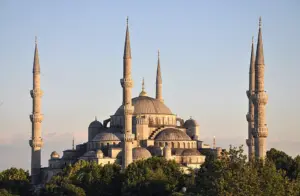
I would like to try – with this humble article – to show the inclusive and peace-focused potential of Islam if interpreted in a broad and multicultural matter. My point of view remains a Muslim point of view from inside. However, I hope that this extension of the history of the revelation to all peoples and cultures in history helps to show how jihadi Islam and the fundamentalist version of it do not correspond to the original message of the Qur’an, which is a peace-focused and multicultural message.
By Milena Rampoldi, ProMosaik.
When it comes to the world’s religions, at ProMosaik, we are particularly concerned with triggering a paradigm shift in the sense of the science philosopher T. S. Kuhn as an upheaval in cultural and religious studies: from Babel to Jerusalem and then to Mecca, and with the inclusion of Hinduism, Buddhism, and atheism. And this paradigm shift focuses on language, because the prophets are the mouthpiece of the transcendent in this world.
A fairy tale from Bhutan says:
“While he was praying, he fell into a trance, and in a vision he saw the ‘ethereal cloud fairies’, who revealed to him the principles of all religions and the language of the holy scriptures.”
In the monotheistic history of revelation of the three world religions – Judaism, Christianity and Islam – all three of which originate from the message of Elohim/God/Allah via His prophets, we find three paradigms that do not complement each other, but rather historically supersede each other in a development over the course of the history of revelation. I would like to briefly address these before moving on to the inclusion of Hinduism, Buddhism and atheism in the history of revelation, which comes to an end with Islam, as the last prophet, Muhammad, closes the circle of the history of revelation.
The first paradigm is found in the Torah and focuses on the curse of a lack of understanding among linguistic communities. The second paradigm enables people to speak all languages without having learned them, thanks to the inspiration of the Holy Spirit. The third paradigm of the Qur’an focuses on Allah’s will to create people as multicultural and equal and to describe this multiculturalism as good and willed by God. However, unlike the others, this last one is much more concrete and linked to the human effort to establish dialogue and learn the language of others in order to communicate with them, whereas the first paradigm abandons this communication and the second brings it about through a miracle from above.
Regarding the first paradigm, the Old Testament says that a people from the East, who spoke a sacred language, built a tower reaching to the sky. God recognises the arrogance, the hubris of humankind, and punishes this people by confusing their language and scattering the people among them throughout the world. The confusion of language and migration (diaspora) are thus seen as a curse from God upon humanity in the worldview of the Torah. People have to stop building the tower because they are no longer able to communicate with each other on a linguistic level. People give up. The punishing God triumphs over them. A pessimistic worldview is evident here. Linguistic variety and diversity are not an enrichment, but a punishment from above.
Christianity partly frees itself from this negative paradigm in the Acts of the Apostles. The upheaval is practically complete. Active comprehension of language is restored, as the apostles, through the outpouring of the Holy Spirit on the day of Pentecost, are able not only to understand but also to speak unknown languages. But here, linguistic diversity is suddenly restored by a miracle of the Holy Spirit and does not result from the efforts of people who receive the whole thing as a gift from God. It says here, namely:
The text further describes that “they were all filled with the Holy Spirit, and began to speak in other languages”.
In the Qur’an, on the other hand, Allah, from the very beginning, envisages a multi-ethnic and multicultural human society in his plan of creation, in which different cultures and tribes get to know one another and are encouraged to actually do so and to put this getting to know one another into practice in a concrete way.
Indeed, in the Qur’an, Allah calls on people to engage in active, intercultural communication. However, Allah does not intervene in communication between people, but rather advises them to exercise kindness and to engage in dialogue with one another. Paradoxically, according to the Qur’an, this dialogue is both a free choice and an obligation for human beings. There is one rule for this dialogue: ethics. Because the culture or group that performs best is the one that acts most virtuously. Quran 5:48 states the following about religious and cultural diversity:
“And if Allah had wanted, he would have made you one community only. But He (divided you into different communities and) wanted to test you (in this way) in what He has given you (from the revelation). Compete now for the good things! All of you will once return to Allah. And then He will inform you of that about which you differed (in this world).”
Thus, being at odds, not always holding the same opinion, is part of the diversity of the history of human creation in this world that Allah intended, and it must not be done away with by humans. ProMosaik adheres to the third paradigm, recognises the complexity of linguistic diversity and advocates multicultural and multireligious multilingualism from childhood onwards in a mosaic society.
I would now like to demonstrate my inclusion of Buddhism, Hinduism and atheism in the history of revelation of the monotheistic world religions, which historically culminates in the revelation of the Qur’an, and to confirm how Islam, which is being manipulated as a religion of struggle and violence, has the potential, as the last revelatory religion in the world, to bring about peace, because Islam thinks beyond denominations and religions, since Islam means nothing other than submission to God. As the great poet J. W. von Goethe so beautifully said about Islam:
“It’s foolish that everyone, in their own case,
Praises his own particular opinion!If Islam means submission to God,
We all live and die in Islam.”
Religion means inclusion. Buddhism and Hinduism are two major world religions that are wrongly excluded from the monotheistic history of revelation. If we look at the following two verses from the Qur’an, we come to the conclusion that Islam is inclusive and, as the final monotheistic revealed religion, encompasses all other world religions, even if they are not part of the well-known prophetic history of revelation that extends from Judaism through Christianity to Islam and ends with Islam.
“And there is no nation to which a warner has not come.” (Surah 35:24)
“And We have already sent messengers before you. Among them are those about whom We have already informed you and among them are those about whom We have not informed you […]” (Surah 40:78)
The logical conclusion is as follows: If Allah sent prophets (“warners”) to all peoples, then Buddha was one of them. And the fact that Buddha is not mentioned in the Qur’an is confirmed by Surah 40:78. However, there are 3 verses in the Qur’an that may refer to the existence of the Buddha. In verses 21:85 and 38:48, there is a prophet named Dhu’l-Kifl , who is interpreted by many as Ezekiel. But the word ” kifl ” is similar to the word “ kapila”. Kapila was an important Vedic sage (rishi) and the founder of the Hindu Samkhya philosophy. And the city of Kapilavastu was the city where the Buddha spent his childhood and youth. The Arabic language does not have a letter “P” in its alphabet. Thus, the word Kapila mutated into Kifl.
A symbolic connection to the Buddha can also be found in Surah 95, which mentions “the fig tree and the olive tree” in the first verse. The date palm mentioned in Surah Maryam is a tree that actually grew in the region of Mecca and Medina at the time of the Prophet Muhammad. But in the time of the Prophet, no fig trees grew in the Hijaz region. I therefore suspect that there is a symbolic reference here to Buddha’s enlightenment under the so-called Bodhitree. And Bodhi is a type of fig.
Now, a brief consideration of atheism in the Qur’an, which is referred to as kufr and includes people who, as stated in Surah 45:24, claim the following:
“There is only our life in this world: we die and we live, and nothing but time (ad-dahr) kills us.”
In my opinion, Hinduism is the most complex religion because, from a religious-psychological perspective, it symbolises the mythical approach to the transcendent. At the same time, however, these mythical elements and these mythical divine figures of Hindu polytheism are reflected in some of Allah’s names. One example is the goddess Shiva. The mythical idea of Hinduism, which arose before the revelatory history of the monotheistic prophetic tradition, speaks of three gods, a so-called trinity:
Brahma is the creator, Vishnu is the preserver of creation, and Shiva destroys in a positive sense so that something new can emerge after the destruction.
If we now consider these two verses from the Qur’an, which speak of Allah, we find the Trinity of Hinduism at the higher level of the final pure, monotheistic revelation:
Surah 30:40: “It is Allah who created you and then provided for you. He will cause you to die, and will then revive you.”
Surah 10:4: “He originates the creation, then repeats it, that He may reward those who believe and do righteous deeds, with justice.”
Allah is the Creator (khaliq, bati). Khaliq and Bati are also among the 99 names of Allah.
Allah is the Sustainer of Creation (qayyum, hafiz). Qayyum and Hafiz are also among the 99 names of Allah.
Allah is also the Creator of creation, giving it form and making it dynamic and colourful. al-Musawwir is also one of the 99 Names of Allah.
According to the Islamic understanding, Allah is also al-Mumit, because He ends life and decides when the life of a creature, and thus also of man, who is His vicegerent on earth, comes to an end. al-Mumit is also one of the 99 names of Allah and is the so-called dialectical counterpart of al-Muhyi, because Allah bestows life, which He then takes away again, because all people return to Him. Quran 10:56 states:
“He gives life and causes death. And to Him will you be brought back in the end.”
And in Qur’an 44:8, it is confirmed that this God of the Qur’an, Allah, is the God of all previous cultures and religions:
“People, the promise of God is true. He gives life and causes death, (He is) your Lord and the Lord of your forefathers.”
The history of peace among humankind can thus be projected backwards from the end of salvation history in a utopian manner and then put into practice. However, this can only work in a multicultural sense and within a radically equal, fair and dynamic framework that prioritises diversity, an emphasis on difference and respect. In this sense, Qur’an 2:256 states the following about religious freedom:
“No compulsion is there in religion.”