From Student Protests to the Growing Anger of Working People
Protests in France began among school students, spread to university students, and gradually drew in their families and broader sections of the working population. Many grievances echo those of the Gilets Jaunes, or Yellow Vests, movement, which emerged in response to rising living costs and declining purchasing power.
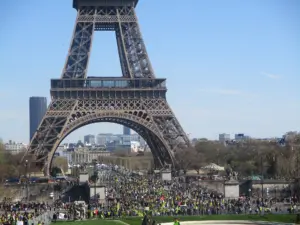
The demonstrations on October 17 reflected growing discontent. France’s Interior Ministry reported approximately 550,000 participants nationwide, while organisers estimated 800,000. Both figures point to a movement linking students’ demands with wider concerns about prices, wages and public services.
Annual inflation reached 3.1% in September 2026, unemployment stood at 8.3% in the second quarter, and growth was forecast at just 0.4% for 2026. Public debt reached around 119% of GDP in the second quarter, while the budget deficit stood at 5.1% of GDP in 2025. Together, these figures reflect mounting pressure on French society.
Police Response and Peaceful Protest
As demonstrations expanded, the government’s response involved a heavy police presence and coercive measures against protesters, including school students and other peaceful demonstrators.
Reports of tear gas and potentially dangerous crowd-control projectiles have raised concerns about police conduct. On October 1, French authorities reported 1,949 arrests or detentions linked to protests. These figures do not represent convictions, but raise questions about the proportionality of the state’s response.
On October 5, a 15-year-old in Lens reportedly lost a hand after a police grenade exploded during the protests. The circumstances and legal responsibility must be established through investigation, but the incident highlights the potentially devastating consequences of force.
Some groups have also engaged in violent confrontations, vandalism and looting. Critics argue that police responses to such acts have not always been as forceful as their response to peaceful demonstrators. If peaceful protesters face repression while violence is treated inconsistently, the movement risks being portrayed as responsible for disorder. This can divert attention from the policies fuelling public anger and justify expanding police powers.
Public Services Under Pressure
A major criticism of Emmanuel Macron’s government is its failure to offer convincing solutions to France’s social and economic problems. Education faces staffing shortages, and wage increases for teachers and other public-sector workers have not fully kept pace with living costs. Many schools and universities also face inadequate investment and ageing facilities. Healthcare and other essential public services face pressure too.
Critics argue that some wealthy groups have benefited from tax advantages while ordinary people face financial pressure and declining purchasing power. Pensioners and low-income households are particularly vulnerable. The government is accused of prioritising budgetary restraint and coercive responses over addressing the structural causes of the crisis.
The Return of the Yellow Vests: Fuel, Food and Purchasing Power
Student protests are increasingly converging with anger over fuel and food prices. For workers who depend on cars to commute, especially in suburbs with limited public transport, fuel is a necessity rather than a luxury.
Families struggle to cover rent, food and other essentials. Wages have failed to keep pace with living costs, and unemployment remains above 8%. Even holidays have become unaffordable for many. Food-aid organisations continue to support people who cannot afford basic necessities, exposing the depth of hardship in a country known for its social safety net.
Students: A Generation Facing Poverty and Insecurity
Students are among those most affected. High rents, shortages of student accommodation and limited financial support make independent living difficult. Reports have also described students turning to sex work under severe financial pressure. The crisis becomes profound when young people must struggle for food and housing instead of focusing on their education and future.
Political Deadlock and the Stigmatisation of the Left
The far right has gained influence, while left-wing movements seek to represent demands for economic security and social protection. Jean-Luc Mélenchon and La France Insoumise have faced accusations of extremism, support for terrorism, vandalism and antisemitism. These allegations form part of a wider political struggle over the legitimacy of the French left.
The party’s current programme does not necessarily call for capitalism’s complete overthrow. Many proposals aim to improve living standards and strengthen social rights within the existing system.
Its defence of migrants and foreign residents, along with its support for Palestinian rights and the people of Gaza, has placed it at the centre of controversy. Critics accuse the movement of antisemitism, while supporters view some allegations as attempts to discredit it. Meanwhile, the far right, including Marine Le Pen’s movement, has gained ground. From the left’s perspective, blaming progressive movements for the crisis distracts from declining purchasing power, weakened public services and policies that fail to meet people’s needs.
When Europe Faces Hardships Familiar to the Middle East
France’s crisis must also be understood globally. Across Europe, including France and Italy, people are protesting against economic insecurity, inequality and political decisions affecting their lives.
For many people in the Middle East, these hardships are familiar. Iranians have lived for decades with US sanctions and, at different times, other international restrictions affecting access to essential goods, medicine and healthcare. Today, parts of Europe face similar pressures, revealing the widening gap between political institutions and ordinary people.
In my view, far-right policies and the role of powers such as the United States, alongside the policies of the Israeli government and forces supporting it, have contributed to regional conflicts and their immense human and economic costs.
I regard military attacks on countries such as Iran, when carried out without a valid legal basis and without respect for human rights and international law, as violations of fundamental principles. Escalation and countermeasures—including Iran’s reported move to close the Strait of Hormuz in response to what Tehran considers aggressive actions by the United States and Israel—risk widening the crisis and creating global consequences.
Prime Minister Sébastien Lecornu’s reported promise to respond to students’ demands by the end of October will test the government’s willingness to act. The issues include replacing absent teachers, improving school conditions and aspects of university admissions. Promises matter only if they lead to concrete measures, adequate funding and tangible improvements.
No society is immune to inequality, misguided economic policies and war. When public services deteriorate, purchasing power falls and governments respond to protests with force rather than dialogue, social tensions deepen.
This is not just a French issue. It concerns a global system in which the costs of political and economic decisions too often fall on those with the least influence: ordinary people, workers, students, families and young people.