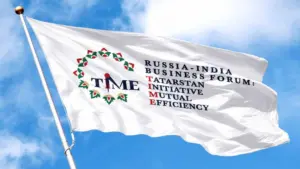
According to a report by Russia’s Pivot to Asia, the Second Russia-India Business Forum, held in Kazan, Tatarstan, from October 14-17, 2026, marked a significant step in expanding bilateral trade, investment, and industrial cooperation. Organised under the TIME (Tatarstan Initiative, Mutual Efficiency) initiative, the forum concluded 26 cooperation agreements, up from 19 strategic agreements at its inaugural edition in 2025. The event brought together businesses, investors, industry associations and regional representatives to explore opportunities across manufacturing, agriculture, healthcare, pharmaceuticals, aviation, textiles, information technology, transport and tourism.
The forum took place amid growing economic engagement between the two countries. Bilateral trade reportedly reached US$38 billion in the first half of 2026, an increase of 24.3% year-on-year, following turnover of nearly US$68 billion in 2025. If the current momentum continues, annual trade could reach US$76-80 billion by the end of 2026, bringing the countries closer to their target of US$100 billion in annual trade by 2030. However, trade remains heavily weighted towards Russian energy exports, including crude oil, coal and fertilisers, while Indian exports are led by pharmaceuticals, chemicals, engineering goods and machinery. Diversifying trade and expanding Indian exports remain central priorities.
Tatarstan has emerged as an important regional partner. Trade turnover between the republic and India exceeded US$1 billion in the first six months of 2026, compared with approximately US$300 million during the whole of 2025. The forum featured 17 business sessions on October 15, followed by a plenary session and more than ten thematic meetings on October 16. Its exhibition brought together 97 companies across 65 stands, including 29 Indian and 68 Russian stands, with 12 thematic zones covering areas such as finance, healthcare, education, agriculture and business services. Industrial visits, business-to-business meetings and cultural activities complemented the commercial programme.
Among the most concrete outcomes were an agreement concerning local production of angiographic X-ray systems in Tatarstan and a pilot Ayurvedic centre in the Zelenodolsk district. The latter involves India’s SriSri Tattva, the Accurately Group and the Tatarstan Investment Development Agency. The projects illustrate efforts to move beyond conventional trade towards local manufacturing, healthcare services, technology transfer and longer-term business partnerships. However, a complete public breakdown of the 26 agreements, including their financial values, implementation schedules and participating companies, was not available in the immediate reporting following the event.
Agriculture represents another important area of growth. Tatarstan’s agro-industrial exports reached US$410.1 million as of October 4, 2026, up 34.2% from the corresponding period in 2025. Agricultural exports from the republic to India reached US$61 million during the reported period, approximately 2.3 times the previous year’s level. India accounted for around 15% of Tatarstan’s agricultural exports, with opportunities extending from oil and fat products and cereals to dairy, processed foods and agricultural technologies. Russian exporters are exploring additional distribution channels, product promotion and retail access in India, while both sides continue to address product standards and non-tariff barriers affecting agricultural and marine exports.
Aviation, aerospace, pharmaceuticals, textiles and digital infrastructure also featured prominently. Discussions covered possible Indian production of the Ilyushin Il-114-300 turboprop and Sukhoi Superjet 100 aircraft, alongside broader opportunities in aerospace and space technology. These discussions should not be confused with confirmed new aircraft orders or contracts signed under the forum. Textile cooperation could expand India’s presence in the Russian market, with participants discussing an ambition to increase its market share from below 1% to 10% within three to five years, potentially representing US$4-5 billion in market value. This remains a target rather than an achieved result.
Pharmaceutical cooperation extends beyond the Kazan forum. At INNOPROM India 2026 in New Delhi, Russian officials outlined plans for medicines from a joint production project involving Indian partners in the Moscow Region to become available in 2027, while an active pharmaceutical ingredient manufacturing project in the Kaluga Region was planned for 2029. Existing Russian-Indian pharmaceutical production also includes medicines for tuberculosis, HIV and cancer. Meanwhile, Indian pharmaceutical exporters are examining the possibility of shipping medicines to Russia through Murmansk and the Northern Sea Route, alongside discussions on specialised maritime insurance.
Further opportunities include electric buses, charging infrastructure, intelligent traffic management, water conservation, waste management, artificial intelligence, cybersecurity and data centres. Indian technology company Bharath Cloud was reported to be entering Russia’s digital services market. Tourism cooperation also gained attention, with a proposed 90-day programme intended to identify partners, develop joint tourism packages and assess initial bookings between India and Tatarstan. Discussions on shipbuilding envisage the possibility of jointly developed vessels by 2030, including river-sea vessels, chemical tankers and ice-class ships. These initiatives remain at varying stages of development and require further commercial commitments.
The wider bilateral relationship is supported by investment, financial and transport initiatives. At INNOPROM India, Indian Commerce and Industry Minister Piyush Goyal said the bilateral priority-investment mechanism was tracking 40 active projects across manufacturing, energy, mining, railways and emerging technologies. The countries are also pursuing a target of US$50 billion in two-way investment by 2030. Separately, Sberbank’s India head reported that rupee-rouble payment infrastructure supported 96% of bilateral trade, with 22 Russian banks and 17 Indian banks servicing transactions. The countries are exploring digital-currency settlement mechanisms, while the International North-South Transport Corridor, the Chennai-Vladivostok maritime corridor and the Northern Sea Route remain important to improving connectivity.
Defence and energy cooperation continue alongside commercial engagement. The two countries conducted the maritime phase of the Indra-2026 military exercise in the Sea of Japan on October 16-17, involving the Indian frigate Sahyadri and Russian corvette Aldar Tsydenzhapov. Separately, India has expressed interest in additional Russian liquefied natural gas supplies, subject to acceptable prices and supplier diversification. US President Donald Trump’s October 16 decision to waive key provisions of proposed legislation threatening additional sanctions and tariffs on countries purchasing Russian energy offered temporary relief, although it did not constitute a permanent lifting of US sanctions.
Overall, the Kazan forum demonstrates the growing importance of regional partnerships in Russia-India economic relations. The increase from 19 agreements in 2025 to 26 in 2026, alongside rising trade and agricultural exports, indicates expanding commercial engagement. Nevertheless, achieving the US$100 billion trade target by 2030 will require stronger Indian exports, broader product diversification, reliable payment and transport systems, and improved market access. As reported by Russia’s Pivot to Asia, the forum’s long-term significance will ultimately depend on how many agreements translate into funded investments, operating manufacturing facilities, recurring orders, and measurable growth in two-way trade. A future India-Eurasian Economic Union free-trade agreement could further accelerate this process, depending on its final terms and implementation.
########
The author is Stephen Rozario, a researcher and columnist.