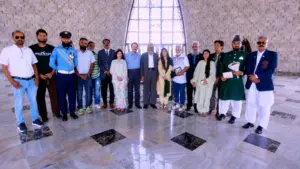
KARACHI — In an era marked by shifting geopolitical lines and deep-seated social fractures, the universal quest for coexistence frequently stumbles inside diplomatic chambers. But on the bustling streets of Pakistan’s economic and cultural engine, an alternative vision took root. As part of the ongoing 4th World March for Peace and Non-Violence, Karachi emerged as a vital focal point for grassroots solidarity, proving that the shared principles of active non-violence, civic dialogue, and sportsmanship remain humanity’s most effective bridge.
Organized under the auspices of the World Humanist Forum’s (WHF) Pakistan Chapter, the initiative transformed the urban landscape into an open platform for cross-border engagement. Marking an institutional milestone for the campaign, the WHF officially entrusted Muhammad Akhtar as Coordinator of its Pakistani Chapter, positioning him to lead ongoing national community engagement and sustain Pakistan’s voice within the broader international humanist network.
The Playing Field as a Diplomatic Bridge
Rather than confining peace discourse to academic circles, Karachi’s leg of the World March placed athletic leadership at the center of its mission. At a reception organized by the Sindh Walking Football Association—led by Chairman Junaid Ahmed Khan and Secretary General Muteeba Akhtar—civil society welcomed international delegates Mohammad Mejanur Rehman Talukder, International Coordinator of the World Community, and S. M. Shafiqul Islam, Coordinator for the Community for Human Development in Dhaka, Bangladesh.
The convergence that followed was notable not merely for its hospitality, but for its strategic depth. A diverse coalition of athletic leaders gathered to align their organizations with the march’s humanitarian charter. Key sporting figures in attendance included Ahmed Ali Rajput, Secretary General of the Sindh Olympic Association and Chairman of the Pakistan Gymnastics Federation; Muhammad Asghar, Executive Vice President of the Pakistan Boxing Federation; Muhammad Khalid Rehmani, President of the Sindh Tennis Association; Sana Ali, Chairman of the Pakistan Archery Federation; and Shaikh Shakeel Ilyas, Patron-in-Chief of the Sindh Olympic Association and President of the Sindh Kabaddi Association. They were joined by leaders from the walking football fraternity, including Karachi Walking Football Association President Raja Naveed Satti and Joint Secretary Muhammad Zaman, Pakistan Walking Football Vice President Muhammad Rafi, and International Event Organizer Ebad Sarwar.
The presence of this sports coalition carried a clear institutional message: physical culture and sports diplomacy are not supplementary to peacebuilding; they are foundational to it. Athletics teaches structured rules, mutual respect, and the disciplined acceptance of difference—the exact ingredients required to counteract polarization and steer youth toward non-violent resolution.
Rooted in Heritage, Focused on Tomorrow
The itinerary extended beyond civic halls to ground its message in Pakistan’s historical identity. At the Mazar-e-Quaid, the delegation stood beneath the iconic marble archways of Muhammad Ali Jinnah’s mausoleum. Alongside local educators, civic workers, and athletes, Mr. Mejanur Rehman laid a floral wreath to honor Jinnah’s founding tenets of civil liberties, social justice, and equality. The act situated the contemporary march within a historical commitment to peaceful, principled coexistence.
Taking that message into the future, the peace tour engaged directly with Karachi’s academic and sports institutions through interactive dialogue sessions. By placing international community builders face-to-face with local students and young athletes, the initiative turned abstract declarations into tangible civic education.
As the 4th World March for Peace and Non-Violence advances across the globe, Karachi’s contribution offers a durable blueprint. By anchoring global peace efforts in local sports infrastructure and civic heritage, the city showed that building a world without violence starts wherever people meet on equal ground.