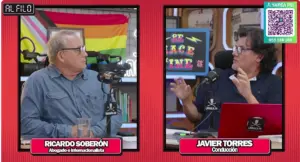
On the program “Al Filo,” host Javier Torres Seoane—joined by journalist Martín Sarmiento (of *La Mula*) and renowned international law attorney Ricardo Soberón—discussed the behind-the-scenes details and implications of the Senate’s decision to grant legislative powers to the Executive branch. The participants agreed that the political landscape has shifted radically, raising questions such as: “Can we now speak of ‘Fuji-Obrismo’?” and “Are we witnessing an intervention in Peru?”
Regarding the powers granted, Martín Sarmiento noted that the emergence of “Fuji-Obrismo” was already apparent during the vote in the Chamber of Deputies. “The ‘Obras’ parliamentary group was key to the Chamber of Deputies approving these 20 points for the delegation of legislative powers,” the journalist stated.
Torres Seoane also addressed the new political reality created by the 35 votes now available to the ruling coalition for legislative debates. He questioned whether the Senate would proceed smoothly, noting that both the “Obras” and “Buen Gobierno” parliamentary groups would be pivotal in future votes. He added that, following these “negotiations,” “we might see a repeat of what we witnessed in the previous Congress.”
Meanwhile, international law attorney Ricardo Soberón discussed the “Shield of the Americas” initiative and its influence on national policy. He pointed out that the initiative did not follow the formal procedures of a treaty, and warned that “we are facing a case of a joint Peruvian-U.S. political-military intervention.” “If we look at the timeline from January 3rd to October 21st—a period during which Mr. Donovan has already reviewed the available resources—it becomes clear that we are very close to a potential joint Peruvian-U.S. police and military intervention. This has already occurred in Ecuador, and I believe that with the approval of the legislation regarding ‘hostile groups’—which has indeed been passed—the next step in Congress will be a measure that allows for: first, arrests without a judicial warrant; second, immediate extradition or administrative expulsion; and third, the presence of personnel from the FBI, DEA, CIA, and—most notably—the U.S. Southern Command and U.S. Special Forces on Peruvian territory.”
The full interview can be viewed at the following link: