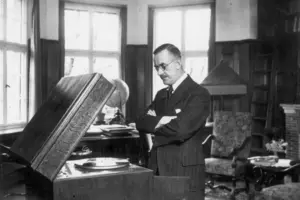
Thomas Mann, the Sick Men of Power, and a Humanity Still Awaiting Its Diagnosis
“A century after Thomas Mann, the sick no longer need to climb into the Alps. They govern from their capitals, manage nuclear arsenals, and hold conferences on peace. What is truly extraordinary is that they still consider themselves the world’s physicians.”
I. THE BOY WHO READ THE MAGIC MOUNTAIN
I did not yet understand that Thomas Mann was writing about something infinitely more disturbing. He had begun his novel in 1912 (when he visited the sanatorium in Davos where his wife, Katia, was staying), before the First World War, interrupted his work during the conflict, and finally published it in 1924, when Europe had already witnessed the magnitude of its own barbarism. Those characters were not simply sick people discussing science, philosophy, culture, and progress. They portrayed a civilization that considered itself extraordinarily cultured, reasonable, and superior, yet ultimately demonstrated a capacity for destruction as immense as its intellectual arrogance. Mann did not need to imagine the catastrophe. He had witnessed it. And he possessed the talent to return, through literature, to the world that existed before the disaster, showing us how a society could march toward its own destruction without recognizing the disease it carried within.
I was fifteen or sixteen years old when I read Thomas Mann’s *The Magic Mountain*. At the time, I could not fully understand the philosophical depth of that extraordinary novel, but something remained engraved in my memory: those sick young people, isolated in a sanatorium in the Swiss Alps, watching their lives slip away while the world continued in indifference. I thought about their dreams, their unfinished projects, the women they would never meet, the children they would never have, and a youth that was already beginning to say goodbye when life had barely begun.
That impression led me to write a short story entitled *The Forerunners*. They were young people who, in my adolescent imagination, had gone ahead of everyone else on the road toward death. I did not yet understand that Thomas Mann was writing about something infinitely more disturbing: a sick civilization discussing science, philosophy, culture, and progress while Europe, impeccably dressed and reasonably educated, advanced toward the slaughter of 1914–1917.
More than sixty years have passed. Today I return to that mountain and discover that its inhabitants never disappeared. Their names, illnesses, uniforms, and instruments of destruction have changed. The patients of the twenty-first century no longer occupy rooms with balconies overlooking the Alps. Some work in Washington, Beijing, Moscow, Brussels, New Delhi, Islamabad, Jerusalem, and Tehran. They gather at international summits, smile for the cameras, and administer a planet whose health they claim to protect while multiplying their threats.
“At fifteen, I believed those young people were dying too soon. Sixty years later, I discovered something worse: humanity had learned to prepare its own misfortune while calmly discussing how to prevent it.”
II. HANS CASTORP — THE MAN WHO WENT TO VISIT A SICK RELATIVE AND FOUND A SICK CIVILIZATION
Hans Castorp arrives at the Berghof sanatorium to visit his cousin Joachim Ziemssen. He plans to stay for three weeks. He will end up staying for seven years. He is a young man destined for naval engineering, reasonably educated, curious, and convinced that his life will follow a predictable course. But illness, time, and endless conversations gradually trap him in a reality where the days repeat themselves while Europe approaches a war that will change its history.
If Hans awakened in October 2026, he would find a world that had surpassed his wildest fantasies. Airplanes crossing continents, machines capable of processing immense quantities of information, satellites observing the Earth, and medicine that has conquered diseases considered fatal in his youth. Yet he would discover that such intelligence has failed to free humanity from one of its oldest habits: meticulously organizing the destruction of other human beings.
He would probably be surprised that governments understand the consequences of nuclear war, possess immediate information about humanitarian tragedies, and continue to regard military threats as demonstrations of authority. He would realize that the seven years at the Berghof have become a century of conferences, treaties, broken promises, and solemn commitments to peace. Humanity does not lack the knowledge required to recognize its dangers. It lacks the political will of its own to confront them.
“Hans Castorp needed seven years to understand that he was sick. Our civilization has spent more than a century perfecting its symptoms and still demands to be congratulated on its excellent health.”
III. SETTEMBRINI AND NAPHTA — REASON, FANATICISM, AND THE EXTRAORDINARY HYPOCRISY OF PRINCIPLES
Lodovico Settembrini represents faith in reason, humanism, education, and progress. Leo Naphta, his intellectual adversary, defends authoritarian and radical ideas that find philosophical justifications for violence. Both compete for Hans Castorp’s conscience through endless conversations. Their confrontation will end in a duel, as though European intelligence, having exhausted every argument, ultimately needed to resort to a pistol.
Imagine Settembrini walking through the institutions of the European Union. He would hear speeches about democracy, human rights, fundamental freedoms, and respect for international law. He would encounter extraordinary social achievements, prosperous societies, and generations that have enjoyed a peace unimaginable to many of their ancestors. But he would also question the contradictions between those principles and certain foreign policies, the economic interests that influence humanitarian decisions, and the ease with which grand declarations lose their force when protecting victims becomes politically inconvenient.
Naphta, for his part, would feel extraordinarily comfortable in numerous offices around the planet. He would recognize the glorification of the state, the cult of the leader, obedience presented as a virtue, and nationalism used to transform any disagreement into a threat. He would not need to settle exclusively in Moscow, Washington, Beijing, or Tehran. He would discover that authoritarian temptations know no geographical boundaries and that even democracies can devise highly sophisticated arguments to justify decisions profoundly inconsistent with their own principles.
The tragedy is not that Settembrini and Naphta continue arguing. It is that their intellectual disputes can ultimately become political doctrines, military budgets, and funerals. Europe experienced that transformation. The twenty-first century possesses enough historical evidence to recognize it, yet continues behaving as though every generation were entitled to personally verify the consequences.
“Settembrini defended reason. Naphta found arguments for violence. A century later, their heirs have perfected an admirable formula: delivering humanist speeches while ordering weapons capable of destroying everything they claim to defend.”
IV. PEEPERKORN — TRUMP, XI, PUTIN, AND THE EXTRAORDINARY SPECTACLE OF POWER
Mynheer Peeperkorn arrives at the Berghof sanatorium accompanied by Clavdia Chauchat, the enigmatic Russian woman who had awakened a profound fascination in Hans Castorp. Clavdia, married, ill, and independently minded, had become a decisive presence in the young protagonist’s life. But her return alongside Peeperkorn introduces an even more bewildering contradiction: Hans, who might regard the man as a romantic rival, ends up feeling an unexpected admiration for him. Peeperkorn is wealthy, commanding, charismatic, and endowed with an extraordinary ability to impose himself on those around him, even when his reasoning is frequently confused or incomplete. Thomas Mann thus introduces one of his novel’s most unsettling observations: authority does not always require convincing arguments; sometimes it needs only a personality capable of making others mistake fascination for superiority.
If Peeperkorn contemplated the international landscape of 2026, he would find a world in which that ancient relationship between personality and power has acquired planetary dimensions. Vladimir Putin and Donald Trump would offer Thomas Mann two different manifestations of a conception of power that combines personal leadership, national interests, and international influence. From Moscow, Putin places national security, historical memory, and Russian strategic influence at the center of a foreign policy whose decisions, including the war in Ukraine, have consequences extending far beyond Russia’s borders. From Washington, Trump defends American economic, technological, and military primacy through negotiations, commercial pressure, and strategic decisions that also reverberate well beyond his country’s territory. Their political systems, methods, and responsibilities are different, but both reveal a contradiction Mann would have recognized: the ease with which national interests acquire the status of universal principles when defended by those who possess sufficient power.
Xi Jinping would offer another expression of that relationship between authority and the state. His leadership operates within a different political system, characterized by the institutional continuity of the Communist Party, strategic planning, and a considerable concentration of decision-making. China has achieved extraordinary industrial, scientific, and technological development, but its growing international influence also raises questions about the exercise of power, mechanisms of political control, and the responsibilities accompanying a power of such magnitude. Peeperkorn would discover that forms of leadership can differ profoundly without eliminating an essential question: to what extent does authority depend on the ability to persuade through results and arguments, and to what extent does it rest on identifying the leader with the state and the nation’s destiny?
What would truly disturb Hans Castorp is the discovery that, a century later, fascination remains a powerful political instrument. Just as he ended up admiring Peeperkorn despite his relationship with Clavdia, modern societies can feel attracted to dominant personalities even when they recognize contradictions between their speeches and decisions. Mann would not have needed to choose between Washington, Moscow, or Beijing to identify the phenomenon. He would have observed how different leaders present their strategies as historical necessities and how millions of people ultimately place in individuals a trust that should also rest in institutions, knowledge, and critical judgment. Old Peeperkorn would probably understand, fascinated, that the twenty-first century has transformed an ancient human weakness into an instrument of global reach: the tendency to admire power before examining its consequences.
“Peeperkorn needed a table, a glass, and a handful of admirers to feel like the master of the world. His successors possess nuclear arsenals, satellites, and trillion-dollar budgets. Human evolution, evidently, does not always move in the right direction.”
V. JOACHIM ZIEMSSEN — THE YOUNG PEOPLE WHO DIE BECAUSE OF DECISIONS THEY NEVER MADE
Joachim Ziemssen, Hans Castorp’s cousin, is a young military officer suffering from tuberculosis. He wants to recover and return to duty. He believes in duty, discipline, and responsibility. His illness interrupts the plans he had made for his life and ultimately takes away a future that still held so much promise. Joachim represents a profoundly human tragedy: the subordination of individual dreams to forces the individual cannot control.
If he observed the twenty-first century, he would discover young Russians and Ukrainians confronting one another in a war that none of them, considered individually, had the power to prevent. He would see Israeli families scarred by violence and a Palestinian population that has endured devastating destruction, displacement, and suffering. He would also encounter Iranian children affected by a war they never chose, along with millions of people whose safety depends on decisions made in distant capitals.
Joachim would probably understand the meaning of military duty. What would be more difficult to explain is the distance between those who order military operations and those who ultimately pay the consequences. Patriotism can express a legitimate bond with one’s community. But it can also be used to demand sacrifices that those administering it will never be required to share. Obedience does not absolve those exercising command of responsibility, nor does it automatically transform a political decision into a morally just cause.
“Joachim died believing in duty. A century later, millions of young people are still learning that patriotism demands sacrifice. Curiously, those who write the orders almost never appear among the volunteers willing to carry them out.”
VI. CLAVDIA CHAUCHAT — THE SEDUCTION OF POWER AND THE FASCINATION WITH THE ABYSS
Clavdia Chauchat is a Russian woman, married, suffering from tuberculosis, and residing at the Berghof sanatorium. Her presence profoundly alters Hans Castorp’s existence. She does not represent Settembrini’s intellectual authority, Naphta’s radicalism, or Peeperkorn’s commanding power. She represents something less visible and, at times, far more powerful: fascination. Hans had come to the mountain to visit his cousin for three weeks, but he ends up trapped in a world where illness acquires a strange attraction, time loses its meaning, and the proximity of death coexists with the desire to live. Clavdia becomes one of the reasons he remains there, even when he understands that this existence is distancing him from everything he had imagined for his future.
If Thomas Mann observed the twenty-first century, he would probably recognize that same fascination in the relationship between societies and power. Speeches about national greatness, military demonstrations, weapons parades, and promises of technological superiority can inspire admiration even when they signal obvious dangers. The United States, China, Russia, India, Pakistan, Israel, and Iran have different histories, political systems, and interests, but their societies understand, to varying degrees, the emotional power of national symbols and promises of security. The paradox emerges when protecting one nation begins to be measured by its ability to threaten another, and when displaying instruments of destruction becomes a source of collective pride.
Clavdia would return to the Berghof accompanied by Peeperkorn, and Hans would discover that fascination can assume different faces without losing its ability to dominate the will. Something similar happens when societies end up admiring authority more than its results, confusing the spectacle of power with political greatness. Mann did not need to turn Clavdia into a political leader or place an army behind her eyes to demonstrate that human reason can surrender to what seduces it. A century later, that lesson retains a disturbing relevance: civilizations can recognize their dangers perfectly well and continue approaching them, convinced that this time they will be able to control them.
“Clavdia Chauchat needed no army to keep Hans Castorp on the mountain. The leaders of the twenty-first century command entire armies to persuade their peoples to remain near the abyss. Fascination has changed its instruments; its consequences remain profoundly human.”
VII. DR. BEHRENS — THE UNITED NATIONS AND THE PHYSICIANS WHO DIAGNOSE WITHOUT BEING ABLE TO CURE
Dr. Behrens directs the Berghof sanatorium. He understands his patients’ illnesses, interprets X-rays, prescribes treatments, and manages an institution where hope permanently coexists with death. In the twenty-first century, the planet also possesses organizations specializing in examining its political, military, and humanitarian pathologies. The difference is that today’s X-rays arrive accompanied by satellite photographs, statistics on displaced people, reports on hunger, and documents recording suffering that cannot possibly be ignored.
The United Nations represents one of history’s greatest efforts to prevent international relations from depending exclusively on force. Its agencies perform indispensable humanitarian work. But the Security Council remains subject to institutional privileges that allow its permanent members to block fundamental decisions. The result is a structure in which the great powers retain extraordinary authority to influence collective responses to conflicts in which they may have direct interests.
In Gaza, Ukraine, and other theaters of violence, the problem has not simply been a lack of information. The warnings exist. So do the diagnoses. What is frequently missing is the political determination necessary to transform international obligations into effective measures. It would be wrong to assign equal responsibility to humanitarian workers trying to save lives and governments obstructing those efforts. That is precisely why criticism must be directed at those who possess the power to decide.
“At the Berghof, doctors examined lungs and prescribed rest. In the twenty-first century, institutions examine catastrophes and convene meetings. Diplomatic medicine has achieved extraordinary perfection: it can describe the disease even as the patient is already dying.”
VIII. SNOW — WHEN HANS DISCOVERS THAT DEATH MUST NOT GOVERN HUMAN THOUGHT
In one of the most extraordinary episodes of *The Magic Mountain*, Hans Castorp becomes trapped in a snowstorm. Amid exhaustion, cold, and the images of a disturbing dream, he experiences a moral revelation: human beings must not allow death to govern their thoughts. Life, love, and human dignity must occupy a higher place than the worship of destruction.
A century later, that reflection acquires unbearable force. Consider the children of Gaza, the Ukrainian children who have known bomb shelters before tranquility, the Iranian families trapped by war, the refugees crossing borders, and the millions of children living under the threat of hunger. None of them is a geopolitical abstraction. They are human beings whose existence cannot be reduced to collateral damage, strategic calculations, or figures appended to the end of an official statement.
The question Mann would leave us is not how many wars the planet can endure. It is what kind of civilization needs to continually justify the suffering of innocent people to preserve the ambitions of those who govern. Contemporary technology has multiplied the possibilities for cooperation, production, and knowledge. It has also refined the instruments of destruction to an extraordinary degree. The choice between those two capabilities remains profoundly political and moral.
“Hans Castorp discovered in the snow that love should be more powerful than death. Our civilization discovered how to manufacture weapons capable of destroying entire cities. Every age has its intellectual priorities.”
IX. THE GREAT IRONY — THE SANATORIUM IS NO LONGER IN DAVOS
The Berghof stood isolated among the mountains. Its inhabitants could imagine that the outside world remained far removed from their conversations. That illusion has disappeared. A war in the Middle East disrupts energy markets, a trade confrontation between the United States and China alters industrial supply chains, tensions between India and Pakistan concern a densely populated region, and the conflict between Russia and Ukraine affects European and global security.
Donald Trump, Xi Jinping, Vladimir Putin, the leaders of the European Union, and the governments of India, Pakistan, Israel, and Iran are not interchangeable characters. Nor are their political and military responsibilities equivalent. But all participate in a system where the decisions of some can radically transform the lives of people who were never consulted. The real problem is not merely competition for power. It is the ease with which that competition ultimately assumes greater importance than human life.
Thomas Mann would probably recognize that old European disease: the belief that intelligence, culture, and economic development provide sufficient guarantees against barbarism. History demonstrated precisely the opposite. Extraordinarily cultivated societies participated in devastating wars. Scientific progress did not prevent destruction; at times, it provided the instruments to expand it.
“The Berghof admitted patients suffering from tuberculosis. The sanatorium of the twenty-first century admits leaders who claim to represent the health of the world. The difference is remarkable: the first knew they were sick; the second demand that everyone else admire their symptoms.”
X. THE FORERUNNERS — THE FIFTEEN-YEAR-OLD BOY AND THOMAS MANN’S FINAL QUESTION
As I conclude this reflection, I inevitably return to that fifteen- or sixteen-year-old boy who wrote *The Forerunners*. Back then, I thought about young people who departed too early from lives still filled with possibilities. I could not have imagined that, more than sixty years later, I would encounter them again in a world where entire generations continue losing their opportunities because of decisions made long before they were old enough to understand them.
Mann’s novel concludes as the First World War breaks out. Hans Castorp finally leaves the sanatorium and appears on a battlefield, amid explosions, mud, and soldiers advancing toward an uncertain destiny. After seven years of philosophical discussions, history drags him toward what his teachers had endlessly debated. Culture failed to protect him. So did intelligence. Europe had spent decades discussing civilization, progress, and balance. Finally, it decided to discover how much it could destroy.
Today’s great leaders know that ending. They possess historical archives, photographs, testimonies, libraries, and monuments dedicated to remembering the consequences of war. They cannot plead ignorance. They can debate their responsibilities, defend their interests, and justify their strategies. What they cannot reasonably do is present every new tragedy as though humanity possessed no historical precedents by which to recognize it.
Perhaps that is the ultimate meaning of *The Forerunners*. Not merely the young people who die before fulfilling their dreams, but also those who recognize, before everyone else, that a civilization may be preparing to destroy its own future while proudly celebrating its achievements.
“Thomas Mann needed a mountain to contain the contradictions of a civilization. We need the entire planet. Not because humanity has lost its intelligence, but because it has extraordinarily perfected its ability to use that intelligence against itself.”
“And he also left Hans Castorp walking amid the explosions of a war that had begun long before the cannons sounded. A century later, the world’s leaders continue debating who has the right to govern the future.”
“The children, naturally, are still not invited. Apparently, they are still too young to decide on the wars in which they will be old enough to die.”
BIBLIOGRAPHY
1. Mann, Thomas.The Magic Mountain (Der Zauberberg). S. Fischer Verlag, 1924. A fundamental work on illness, time, the decline of European civilization, and the intellectual contradictions that preceded the First World War.
2. Hobsbawm, Eric.The Age of Extremes: The Short Twentieth Century, 1914–1991. Michael Joseph, 1994. A historical analysis of the world wars, totalitarian regimes, political transformations, and the contradictions of modern progress.
3. Arendt, Hannah.The Origins of Totalitarianism. Harcourt, Brace and Company, 1951. A study of power, ideology, propaganda, and the political mechanisms that allow violence and dehumanization to become instruments of domination.
4. Judt, Tony. Postwar: A History of Europe Since 1945. Penguin Press, 2005. An analysis of European reconstruction, the consequences of war, ideological tensions, and the contradictions between democratic ideals and the exercise of power.