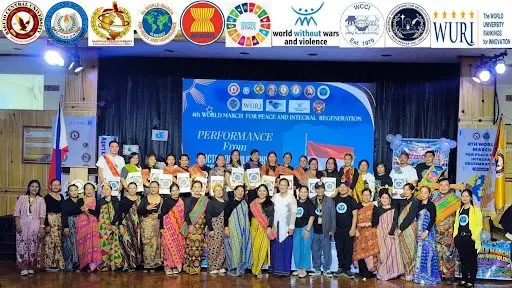

BCU PhD in Administration and Supervision students join faculty members Loida Mangangey, Altea Ramos, Jose R. Balcanao, Shamany Lokines, Leon Avilardo, and Dean Genevieve B. Kupang during the 4th World March for Peace and Integral Regeneration in conjunction with the ASEAN Festival.
By: Josefa P. Dampilag, Cindy D. Osting, Lorna D. Samson, Bernadette S. Taynan, and Genevieve B. Kupang
October 3, 2026. We will never forget three things: dancing in costume, the hymn that made the gym quiet, and the small nipa house we built in the middle of the BCU gym. We learned that leadership is also about culture, faith, and making a home for peace.

BCU’s PHAS doctoral students express peace, unity, and cultural solidarity through dance.

The Nipa Hut: A Symbol of Home and Community. Amid the gathering of cultures, the nipa hut reminded us that peace begins where people feel a sense of home, belonging, and community.
Standing at the back of the hall, our hearts raced with a mix of nervousness and excitement. Dressed in Indonesian-inspired costumes, we felt transformed. The golden headdresses rested heavily on our heads, and the batik felt slightly coarse against our skin, but these minor discomforts only deepened the experience. The vibrant colors, intricate patterns, and tailored sarongs made us feel graceful, beautiful, and deeply connected to the culture we were honored to represent.
Behind our smiles were whispers of encouragement and anxious glances. Would we perform well? Would our headdresses stay in place? Could we truly capture the spirit of the dance?
As PhD students, we were accustomed to researching, writing, and defending academic ideas, not expressing ourselves through intricate hand gestures. That afternoon asked us to communicate without speaking. We realized we were no longer just students preparing a performance; we were ambassadors of Indonesian culture and peace.
When Indonesia was called, our group…the entire hall fell silent.
The gong sounded, deep, resonant, and ceremonial, followed by the fast, unfamiliar rhythm of the gamelan. Lifting our hands and curving our fingers as practiced, we counted the beats internally: one, two, three, pause. Trusting the rhythm and relying on each other, our non-dancers’ movements fell into sync. Every gesture and step carried a story of courage, community, and hope.
As the music stopped, we gathered in a circle, breathing heavily. For a brief second, a heavy silence hung in the air, then warm, overwhelming applause erupted.

PHAS students Peter Canggat Jr., Josefa Dampilag, Oliver P. Ngiwas, and Ryan Aladog proudly display traditional ASEAN attire and woven sashes during the ASEAN Festival at Baguio Central University.
We exchanged smiles in silent triumph; we had done it. Enveloped in the elegance of sarongs and crowned with golden headdresses, our posture shifted. We carried ourselves with a newfound, radiant confidence. Embracing these garments close to our hearts reminded us that culture is never static; it travels, connects, and unites. That moment revealed a truth beyond books and research papers: true education transcends theory. It demands living the values, embodying the kinesthetic beauty of movement and music that binds, and feeling the vibrant rhythm of our ASEAN neighbors like Indonesia.

Honored to share the stage with Guinness World Record Holder Ms. Adelaida Guia and her husband Philip! Dr. Genevieve B. Kupang, Vice Gov. Josefa Dampilag, MPA, Professor Dr. Shamany Lokines, Sec. Mr. Charles Pineda, Pres. Arnel Dumo, and PhAS representative Peter Jr. Canggat.
Peace carries the power of sacred words, spoken through speeches that inspire and move us to be better. Words that touch the heart remain timeless, much like Mahatma Gandhi’s reminder that we must be the peace we wish to see in the world, Martin Luther King’s declaration that we shall overcome, Ninoy Aquino’s belief that the Filipino is worth dying for, and Nobel Peace Prize laureate Maria Ressa’s truth that without facts, trust, and shared reality, democracy cannot survive. Beyond words, peace is about learning to move together, listen, and find a shared rhythm despite our differences.

We were not perfect, and we were certainly not professional dancers. Yet we were together. In that circle, surrounded by the music and movement, we found something genuinely real, a sense of peace that settled over us like a gentle hush.
Sixteen doctoral students shared one rhythm, one moment, and one beautiful expression of cultural friendship.
When our dance ended, a quiet pause fell over the room, giving everyone a chance to breathe. Then, the PHAS students began to sing “Make Me a Channel of Your Peace.” Their prayerful harmonies filled the room, and for a moment, it felt like heaven.

Lord, Make Me a Channel of Your Peace! The performance featured Maria Luisa Nabus, Mary Grace Bantulo, Sandra Ignacio, Dina Agusdan Flordelyn Estocapio, Emily Libod, Jeruel Payangdo, Marcos Olito Glinah, Kay Butag, Luisa Humiwat, and Conception Dayagan. Under the leadership of Dr. Avelardo Leon, their voices came together in a powerful way. Each voice added to a shared expression of hope. Their music carried a message of harmony, urging all to be channels of peace. Music indeed brings people closer, echoing a call to kindness and unity.
It was different from our dance. Ours was colorful and loud. Theirs was soft and gentle. But it touched us more. When they sang “Make Me a Channel of Your Peace,” the whole gym seemed to grow quiet. In the middle of all the sounds, their voices created a moment of peace.
We thought of our family, our students, our school, our colleagues, our workmates. Finding ourselves asking, “Are we a channel of peace?” Their song brought back hope again. Peace is possible when each of us decides to do something in our own way.
What we really liked was not on the stage. It was in the middle of the gym. While other programs had tarps and printed flags, Indonesia had a house. It was real.
We heartily appreciate Engr. Jessie Ramos, Jessie Legawen, Elmer Menzi Jr., Lester Biadno, Minirva Songaben, Cresencia Caplas, Cyrille Gaye Miranda, Sandra Ignacio, and Concepcion Dayagan who were the ones who made it real.
The roof was made of nipa, leaves that rustled whenever the electric fan blew. Below it, fairy lights created a glow. Hanging between the lights were Batik and Ulos cloth in purple, red, and green, so beautiful that they seemed to tell stories in every thread.
Above it all was a banner that said INDONESIA in letters surrounded by drawings of Prambanan Temple, a plate of Rendang, and small children holding hands.
If you stopped in front of it, you really wanted to go.
On the side, the banig became like a small museum. There was a surfer in Bali, the gates of Prambanan, and a mother orangutan with her baby in Borneo looking back at you. At the bottom was the Rafflesia, that red flower that seems to bloom like a secret.
Inside, two students stood manning the space. On the table were coconuts, green and heavy, some still with their stems, others on the floor. A buri bag sat in the middle, surrounded by bags of goodies and sweets for visitors.
It smelled of coconut and dry leaves. The booth felt alive. It felt like someone had taken a village from Java or Sumatra and placed it right inside our gym. And every time the electric fan blew, the Indonesian flag in red and white, like ours but reversed, would softly move. Watching it, we began to understand that Indonesia is the world’s largest archipelagic country, comprising between 17,000 and 17,508 islands. It is a different place, with different traditions, colors, and stories.
Participants kept coming to take pictures, look, and ask about the coconuts. Some stayed longer than expected, just taking in the details. There we were, together greeting them with respect and sharing one goal.

A gym and then the function hall filled with diverse cultures, languages, and traditions. A modest Indonesian house reminded us of what a village truly is: a place where people are welcomed, stories are shared, and differences are embraced. For a time, the venue transcended its physical boundaries to become a living community.
The program provided the steady current that held the day together. Quiet, precise, and sure, it unfolded with warmth and order. Presentations flowed seamlessly from messages of peace to music, dance, and cultural exchange. At the center of this flow were the emcees, Josefa P. Dampilag and Charles Pineda. Moving beyond a standard script, they responded directly to the crowd, filled pauses with ease, and guided the audience from one moment to the next. Their voices became a unifying thread through moments of laughter, reflection, and quiet reverence.

BCU EDMGT students, led by Governor Arnel Dumo, with administrators and faculty Dr. Loida Mangangey, Dean Genevieve B. Kupang, VPAA Dr. Elma D. Donaal, and VPA Dr. Michael T. Sebullen.
The day mirrored a village where every element contributed to a greater whole. Performers brought music and movement, speakers delivered messages of peace, and the audience offered their presence. The cultural booths provided a window into unique traditions, making global heritage accessible and engaging.
By the closing remarks, the event proved to be more than a sequence of performances. It was an active practice of peace through culture, cooperation, creativity, and mutual respect. A standard gymnasium transformed into a space where doctoral students became dancers, researchers became singers, and strangers became friends.
As we stepped out of the hall, the 4th World March for Peace and Integral Regeneration left us with an enduring lesson. Peace does not require grand gestures. It begins simply with a song, a dance, a welcoming smile, or a shared meal, as long as people are willing to come together. For a few hours, our temporary village offered a clear picture of the peaceful world we aim to build.

http://Messenger_creation_5A268E17-9F76-4A72-A741-5113F6CDE7DB.mp4
Dancing for Peace: A Joyful Finale to the 4th World March BCU administrators, faculty, doctoral and masteral students, the Flame Editor-in-Chief, Manila peace allies, committees, MIS, and maintenance personnel come together for a danceable walk for peace. Dr. Maria Lourdes G. Eguia led.
##########
AUTHORS’ STATEMENT
We came to the 4th World March for Peace and Integral Regeneration and ASEAN Festival as PHAS doctoral students and faculty. We left with a living truth that peace speaks in five languages: the ears that listen and co-learn from global and local speakers, the minds that reflect, the bodies that dance, the voices that sing, and the home that welcomes. Through shared movement, heartfelt song, and the hospitality of the little Indonesian booth, we discovered that integral regeneration is about honoring our differences and building spaces grounded in respect and kindness. In that moment, a university gym and the function hall transformed into an ASEAN village, proving that true peace is possible when we actively choose to create it together.
#BCUsoarshigher
#BCUGraduateSchoolSoarshigher
#BCUIROSoarshigher
#BCUForPeaceandIntegralRegeneration
#4thWorldMarchforPeace&IntegralRegeneration#PeaceInAction
#4thWorldMarchforPeace&IntegralRegenerationPhilippines
#SDG4QualityEducation
#SDG16PeaceJusticeAndStrongInstitutions
#SDG17PartnershipsForTheGoals
#BCUSDGsInAction