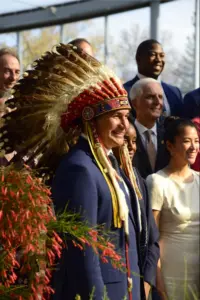
Speaking to reporters during a break in a meeting, Wab Kinew, the Premier of Manitoba (a Canadian province), held up his status card—a document that, according to him, identifies him as an “Indian” under the Indian Act.
Kinew made these remarks during a meeting in Ottawa that included Mark Carney, various provincial premiers, and First Nations leaders.
According to Kinew, Canada should no longer maintain an identification system based on race.
Francis Verreault-Paul, Regional Chief of the Assembly of First Nations of Quebec and Labrador, notes that the Indian Act is discriminatory; furthermore, it defines an identity that does not correspond to Indigenous peoples at all, as they are not, in fact, “Indians.” Chief Verreault-Paul argues that it is harmful to define the identity of members of Indigenous nations based on the prejudices held by colonizers 250 years ago.
On Monday, during a historic meeting involving provincial premiers, Mr. Carney, and First Nations leaders, the federal Prime Minister expressed openness to the idea of abolishing the Act. However, he offered a clarification on Tuesday morning, adding that the process initiated by Ottawa to determine the future of this legislation does not have a predetermined conclusion.
This 1876 law grants Ottawa extensive powers over First Nations communities and their members—including the authority to determine who qualifies for official recognition, as well as what activities are or are not permitted on reserves. It also dismantles traditional forms of governance and, at one time, prohibited ceremonial practices.
The vast majority of First Nations agree that the federal government should adopt a single-parent descent rule for the transmission of status-related rights (such as the métis populations).
However, Minister Mandy Gull-Masty has indicated that this approach will not be adopted by her government, despite calls to do so from opposition parties in the House of Commons and the Senate.
Provisions are in place for instances where a First Nation might decide to opt out of the Indian Act and move toward self-government.
Janice Makokis, a lawyer and organizer with the Idle No More movement, stated that current discussions regarding the repeal of the Indian Act echo federal efforts from decades past—efforts that, at the time, sparked unrest among First Nations peoples and leaders.
We need to look closely at whether the rhetoric around modernization and economic partnership is being used to strip power from our nations while opening up our territories for development, she explained in the foyer of the House of Commons.
Our rights existed before the Indian Act; they do not depend on it. But abolishing the Act without a process led by First Nations themselves risks ushering in a new era of paternalism—one where Canada decides what our freedom should look like and then writes the rules for us, she add.
The review may not lead to a repeal, warns Mark Carney.
________________________________________________________
(1) The Prime Minister of Manitoba, before entering politics, was an author, musician, broadcaster, and university administrator, best known as a host for programs on CBC Radio and CBC Television. Kinew is Canada’s first provincial premier of First Nations descent, and the first Indigenous premier of Manitoba since the Métis leader John Norquay served in 1887.
Source: Journal La Presse, Wiki