Before the vote: memory, fear and hope
Voždovac, 21 October 2026. The whole neighbourhood is out on the street, whistles, vuvuzelas and car horns deafening, because the students are coming. From the top of Ustanička Street the first flags appear: the column that set out from eastern Serbia, more than 200 km on foot, in trainers and in traditional opanci, the leather peasant footwear, blisters taped. Flares light the crossroads, as they have in Voždovac since the 1990s. Among the walkers is Filip, a šajkača, the traditional Serbian cap, on his head and a sapling in his hands, given to the students by a gardener in Požarevac “as a new beginning”. He expects to win on Sunday, but soberly: it will be a hard won victory, “because that is the only way they will give it to us”. The column stops, dances a kolo, the Serbian folk dance, crouches and waits for the beat of Gala’s Freed from Desire, then everyone jumps as high as they can.
The next evening, October 22nd , about 150-200,000 people (estimate by the Archive of Public Gatherings) packed Slavija Square for the Student List’s closing rally. The crowd chanted Gotov je!, (He is finished!), the same words that rang through Belgrade in October 2000 when Slobodan Milošević fell. Being close to each other was itself the point, a remedy against a national habit of forgetting: forgetting the 16 people killed under the Novi Sad canopy on November 1st 2024, the beatings, and the abuses of fourteen years.


Slavija Square on October 22nd 2026, during the Student List’s closing rally three days before the vote.
That memory has a long history. Serbian students rose in 1968 against the “red bourgeoisie” of Tito’s Yugoslavia, in 1996 and 1997 against Milošević’s theft of local elections under the slogan “Belgrade is the world”, and again in November 2024, occupying faculties after Novi Sad. Twenty eight years separate each revolt. As Belgrade University professor Aleksandar Baucal put it in 2025 (now on Students’ list), what connects them is not material interest, but civic values: rule of law, responsibility of elected officials, and the defense of institutions that belong to everyone. The uncomfortable lesson of those cycles is that each won a moment and none, alone, won the institutions.
This time the regime defended itself with every means. In Pioneer Park, in front of the Parliament, the SNS kept a tent camp of “students who want to study” for more than a year, known as Ćacilend. A former SNS activist from Novi Sad, Momčilo Marjanović, told BIRN that he organised paid enforcers there, receiving €500 a day while his men received €200, paid in cash; the Prosecution for Organised Crime has opened an investigation. Over the months of protest in 2025 more than 1,000 citizens were arrested. And four days before the vote, the weekly Radar published Sky ECC messages in which the jailed drug lord Darko Šarić tells relatives that “Oskar” is the nickname for Aleksandar Vučić, a code name KRIK first found in police files on the Šarić clan in 2024.
The vote itself was Vučić’s gamble. He dissolved the Parliament on September 9th and, on September 27th, resigned as president eight months before the end of his second term, to lead the list “Aleksandar Vučić, United Serbia” as candidate for prime minister. Many in the movement remembered the chance they had missed: on 15 March 2025, after an estimated 300,000 people filled Belgrade and were dispersed amid allegations that an illegal sonic device was used against them, the crowd went home. It was not a new October 5th , the date that marked the end of Milošević’s regime. The movement was not yet mature enough to turn a crowd into a demand for the president’s departure, and the regime bought eighteen more months.
The great surprise of this campaign was the diaspora, long treated as a silent cash machine for families and the State budget. More than 110,000 Serbs abroad registered to vote, almost three times more than in 2023. The Ministry of Foreign Affairs answered with 93 polling stations: 28 in Bosnia and Herzegovina, only two in all of Canada, none in Romania, Bulgaria or Slovakia, and none in at least 32 cities that diaspora groups say met the legal minimum of 100 registered voters. All stations abroad kept Belgrade hours, so North Americans voted in the middle of the night. Volunteers replied with votebnb.rs, offering a bed to anyone crossing thousands of kilometres to reach a ballot box. A hundred thousand votes could still be worth five to seven seats in a close race; more importantly, they told those at home that they were not alone.
Two years of repression: citizens, students, journalists
The vote cannot be judged apart from the two years that preceded it. From November 2024 the State answered a peaceful movement with force, surveillance, smears and dismissals, documented by UN experts, Amnesty International, Human Rights Watch, Reporters Without Borders and Serbian journalists’ associations.
Citizens and students. In August 2025 UN human rights experts called on Serbia to halt an “intensifying crackdown” on students, professors, human rights defenders and citizens. After the students called for elections on June 28th 2025, Amnesty International and Civil Rights Defenders received reports of several hundred arrests in a week, including high school pupils, and of beatings that left students in hospital. From mid August 2025 protests turned into daily clashes, with riot police and masked pro-government groups acting side by side. On August 14th 2025 the student Nikolina Sinđelić was detained by the unit protecting state officials (JZO) and, by her own testimony to prosecutors, beaten and threatened with rape in the basement of the government building. The European Parliament’s October 2025 resolution named police brutality, sexual violence against students and politically motivated prosecutions. The student movement’s own count reached over 3,000 people arrested, beaten, detained, targeted or dismissed by the end of 2025, according to European Western Balkans.
Universities and schools. The government cut university funding by decree, changed professors’ working hours in March 2025, set up a working group to rewrite the Law on Higher Education without the universities, and withheld enrolment quotas, which pushed professors to camp outside the government building under the banner “Universities at the crossroad”. Deans loyal to the government called in riot police against blockades, as in Novi Sad’s Faculty of Philosophy in August 2025. A human rights campaigner told Index of Censorship that about 100 secondary school teachers had been laid off and some 25 head teachers dismissed for supporting students.
Journalists and media. The Independent Journalists’ Association of Serbia (NUNS) recorded about 380 attacks, threats and pressures on journalists in 2025, the highest since its monitoring began in 2008; RSF counted 82 physical attacks that year and found that about half were committed by police. Amnesty International attributed the NoviSpy spyware, installed on activists’ and journalists’ phones during police and BIA interviews, to the security agency “with high confidence”; Human Rights Watch reports that two BIRN journalists were targeted with Pegasus in February 2025. Ownership pressure did the rest: ODIHR noted that N1 and Nova S were removed from Total TV and Net TV Plus after state controlled Telekom Srbija bought the platforms, and in October 2026 nine N1 journalists resigned over the new management’s direction while Nova.rs staff were forced to accept an imposed editor in chief.
The numbers: a clear majority, still preliminary
The Student List won about 52.5% of the vote against roughly 39% for Vučić’s list, a margin of more than half a million votes that should give it an absolute majority of between 136 and 141 of the 250 seats. Vučić conceded about an hour after polls closed, before any official count, saying it was “clear that we have lost these elections”.
No other list crossed the 3% threshold.
Turnout was the decisive factor. RIK reported 68.78% (4,211,957 voters) on its processed stations; CeSID estimated 69.3%, against 58.77% in December 2023, which RIK’s 18:00 figures already placed among the highest since 1992. CRTA reports the Student List’s lead was largest in Belgrade (about 31 points), followed by Vojvodina (13) and central and western Serbia (11 each); Vučić’s list led only in southern Serbia.
Free enough to lose, not fair enough to trust
The students won despite unfair conditions of the vote. CRTA, which observed a representative sample of 500 polling stations with more than 2,000 observers, recorded pressure on voters, polling board members or observers at 29% of stations by 16:00, procedural failures at 18% and breaches of voting integrity at 17%. By the close, ballot photographing, a classic tool of controlled voting, was seen at 48% of stations nationwide and 79% in Belgrade, the highest rate CRTA has ever recorded.
Violence moved outside the polling stations as the day went on. N1 and Nova reported that about thirty people burst into a polling station in Doljevac, where a board member was slapped; masked men beat young people with bars and flares outside a station in Pančevo; journalists were attacked in Pavlovac near Vranje (two suspects arrested) and in front of Pioneer Park in Belgrade; a Student List monitor in Kragujevac was beaten after filming suspected vote buying. Gendarmerie vehicles built to disperse crowds were seen near the Presidency in the afternoon.
The campaign itself was tilted long before election day. ODIHR’s interim report (9 October) pointed to deep polarisation, intimidation of activists, isolated violence and the misuse of public resources, including one-off payments of almost €1 billion to adult citizens announced on August 31st 2026. CRTA counted 116 violent incidents in the campaign’s final week, found manipulation or possible legal violations in one in three monitored SNS campaign events, and estimated that ruling majority figures took about three quarters of political airtime on national television in one monitored September period.
More than 500,000 voters remain registered without a precise address, according to Radio Free Europe.
The Republic Electoral Commission described the incidents as mostly minor. CRTA’s Raša Nedeljkov drew a different conclusion: the election confirmed that power in Serbia can be changed at the ballot box, largely because opposition polling board members were present and trained to stop abuses. Both statements can be true. A system that still produces this volume of coercion was beaten by a margin too large to steal.
From the polling station to another celebration
Observing the vote was my way of contributing. In Voždovac (Belgrade municipality), queues formed well before the polling stations opened at 7:00. The mood was cheerful, and most voters held an ID card in one hand and their own pencil in the other. In the days before the vote, warnings had spread on social media that the regime might supply pens with disappearing ink at the polling stations. Paranoid or not, citizens left nothing to chance; one could almost have predicted the result by counting pencils. Around the polling stations, mobile teams watched for irregularities, some organised by the students and their supporters, others formed spontaneously by neighbours. As a Serbian saying goes “not even a fly could slip through.”

Voters queue outside a polling station in Voždovac as it opens at 7:00 on October 25th .
At my polling station, the irregularities I noted came mostly during home voting, when the committee carried the ballot box to elderly and sick voters who could not come in person, some of them in care homes. This mechanism has been abused many times in the past to pressure people who need help into voting “the right way”. As an observer I could record the attempts, but I had no power to stop them, so we noted them and moved on.
We were still counting when the news arrived that Vučić had conceded defeat. The room went silent for a moment; then we went back to counting, carefully and professionally, until midnight. At my polling station the Student List won about 60% of the vote. After midnight we delivered the ballots and the records to the municipal electoral commission in Voždovac municipality, where the main hall was in high spirits while the last polling station committees were still arriving.


After midnight on election night, polling station committees arrive at the Voždovac municipal electoral commission for the handover of election materials. As news of the Student List’s victory spreads, some committee members react with tears of joy and disbelief.
Shortly after 1:00 I joined the celebration at Slavija. The square was still full of music, with a kolo winding around it. I ended the night on the steps of the National Assembly, still packed with people at 3:00, opposite the dismantled tents of Ćacilend. Another celebration was called for 19:00 on Monday 26 October at Slavija square.


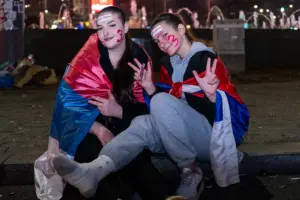
Night of 25 to 26 October, in front of the National Assembly: supporters of the Student List dance the traditional kolo and celebrate the result. Many raise three fingers, an old Serbian gesture reclaimed during the campaign to stand for the list’s number 3 on the ballot.
What a parliamentary majority does not buy
The hard truth of October 26th is that the SNS lost parliament but still holds much of the State. The acting head of State is Ana Brnabić, who has publicly called the Student List a “fraud” and, after the vote, promised that SNS would be a “fierce opposition”. Under the Constitution she proposes the next prime minister after consulting the elected lists, and she must call a presidential election so that voting takes place by about December 27th . CRTA has already urged the acting office holders to announce their plans and “not hold the public hostage again”. The transfer of executive power is therefore neither automatic nor complete, and the presidential race will be the next battlefield.
Beneath the presidency lie institutions that fourteen years of one party rule have shaped: the prosecution service and courts, the security agency BIA, the police leadership, the media regulator REM, the public broadcaster RTS, Belgrade city hall and most municipal governments, which were not on the ballot. Pro-government tabloids, which during the campaign circulated AI-manipulated images of the list’s leader Ilija Srdanović according to fact checkers Istinomer and Raskrikavanje, have not lost their owners. Vučić’s own concession speech blamed independent media, “various European countries” and an “American deep state” for a “revolution”. A defeated leader who calls the result a foreign operation is preparing a narrative for revenge, not retirement. With 39% of the vote and about 103 seats, the SNS remains the second force in the country.
The winner has fragilities of its own. The Student List unites supporters ranging from the Green Left Front to the right wing Dveri, governed by student plenums that decide by direct vote and enforce their rulebook by consent. Its candidates are cardiologists, chemists, judges and teachers with little or no experience of government. Its 11 point program is strong on the judiciary, lustration, media capture and departisation, but EU accession is not yet very central to it. Choosing a prime minister and keeping deputies united through coalition style compromises, without a party machine, is a task no previous Serbian protest movement has managed. Few other movements anywhere have managed it; for example Poland’s Solidarity did in 1989, but under a negotiated transition, not against a ruling party that still holds the presidency, the security services and most of the media.
Europe arrives late to the celebration. Ursula von der Leyen and Commissioner Marta Kos congratulated the winners within hours, yet for two years Brussels muted its criticism while Serbia was courted as a supplier of lithium for the Jadar project, and only in October 2025 did the European Parliament adopt its harshest resolution on Serbia. The students won without Europe’s help; whether Europe now becomes a partner for rule of law reform or simply for raw materials will shape how far Serbia and EU will go together.
Finally, the tone of the next weeks matters. On election night crowds entered and dismantled “Ćacilend”, the pro-government unsanitary paramilitary-mafia tent camp in Pioneer Park. The movement’s strength has been its discipline and nonviolence under provocation. Accountability for Novi Sad, for the beatings and for the abuse of the State must come from independent courts and fair trials.
The work that follows
The October 25th vote proved that an autocracy can be defeated at the ballot box when turnout is massive, the diaspora travels through the night and thousands of trained citizens guard the polling stations. It did not prove that Serbia is free. In 2000 a whole generation believed the job was done after one election and went home; twelve years later the system it had defeated returned. The students have taught the country not to forget. Their next lesson will have to be institutional patience: an independent prosecution service, a freed public broadcaster, a cleaned voter register and a president elected possibly in December on equal terms.
For two years, Serbian students taught Europe a lesson it had almost forgotten: that democracy is not only something institutions hand down, but something citizens practice. Their plenums, open assemblies with no leaders and decisions by direct vote, turned faculties into schools of self-government, and their discipline under provocation showed that nonviolence is a strategy, long and sometimes painful but effective. When Brussels hesitated, they cycled to Strasbourg and ultra-marathon ran to Brussels to deliver the message themselves to EU institutions. Their example has already travelled: from Serbian high studentes declaring solidarity with French pupils in 2026 to Albanian students marching against Edi Rama’s government this year. Young people across the region now cite Belgrade and Novi Sad as proof that a peaceful, leaderless movement can outlast a regime. Whether that example endures will depend on what the students and citizens of Serbia do with hard won power.
Photos by Miloje Savić