By Dr. Ghulam Nabi Fai, Chairman, World Forum for Peace & Justice
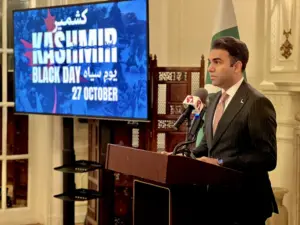
New York, October 27, 2026 — Speakers at an event commemorating October 27 as the day of the Jammu and Kashmir occupation called for a peaceful and just resolution of the Kashmir dispute.
Held under the theme “Jammu & Kashmir: 79 Years of Occupation, Resistance and Resilience,” the event sent a clear message to the international community that lasting peace and stability in South Asia require a settlement of the Kashmir dispute in accordance with the aspirations of the Kashmiri people and relevant United Nations Security Council resolutions.
The event was emceed by Saima Saleem, Counsellor at the Permanent Mission of Pakistan to the United Nations and a seasoned diplomat, who guided the proceedings.

Ambassador Usman Jadoon, Acting Permanent Representative of Pakistan to the United Nations, said October 27, 1947, marked a tragic turning point in the history of Jammu and Kashmir, when Indian troops entered the territory, and the Kashmiri people were denied the opportunity to determine their own future.
“For 79 years, the Kashmiri people have endured occupation, repression and suffering while continuing their legitimate struggle for their inalienable right to self-determination, as affirmed by relevant United Nations Security Council resolutions,” Ambassador Jadoon said.
He noted that generations of Kashmiris had endured immense hardship, with families separated, lives lost, communities traumatized, and fundamental freedoms curtailed. Despite decades of suffering, he said, the determination of the Kashmiri people to achieve their right to self-determination remained undiminished.
Ambassador Jadoon emphasized that the silencing of Kashmiri voices and restrictions on independent reporting could not diminish the importance of their demands or the need for international scrutiny. He called for the protection of fundamental human rights, the release of individuals arbitrarily detained, and full access for international human rights mechanisms to assess conditions on the ground.
He also underscored the special responsibility of the United Nations to uphold its Charter and implement the relevant Security Council resolutions on Jammu and Kashmir. He said these resolutions remained central to achieving a peaceful settlement, including the realization of the Kashmiri people’s right to determine their future through a free and impartial plebiscite.
Consul General of Pakistan in New York Aamer Ahmed Atozai reaffirmed Pakistan’s continued political, diplomatic, and moral support for the people of Kashmir.
He said Pakistan’s leadership and people would not abandon the Kashmiris in their legitimate struggle for self-determination. He also emphasized the importance of unity, consistent advocacy, and peaceful engagement among Pakistani and Kashmiri diaspora communities to sustain international attention to the dispute.
Shah Ghulam Qadir, President of Pakistan Muslim League-Nawaz in Azad Jammu and Kashmir and a prominent Kashmiri leader, appreciated Pakistan’s efforts to highlight the Kashmir issue at international forums. Recalling his participation in parliamentary delegations to various capitals, including Ankara and Cape Town, he noted the positive responses he had encountered from officials and governments.
Shah Ghulam Qadir expressed concern that the unresolved dispute continued to pose serious risks to regional peace and stability, stressing the importance of renewed international efforts to secure a peaceful settlement.
Azra Dar, Human Rights Commissioner of Nassau County, said the sacrifices of the Kashmiri people must not go in vain. She called for sustained international attention to their right to self-determination, which, she noted, had been recognized in the context of the United Nations’ engagement with the dispute.
Farooq Tabassum, former Principal Secretary to the Government of Azad Jammu and Kashmir, said the events of October 27, 1947, had had devastating consequences for the people of Kashmir. He appealed to world powers, including the United Nations, to intensify efforts to persuade India to allow the Kashmiri people to exercise their right to self-determination.
Sardar Taj Khan, Senior Vice Chairman of Kashmir Mission USA, thanked Pakistan’s leadership for raising the Kashmir issue at the global level. Addressing the Kashmiri diaspora, he stressed that differences in opinion and strategy should not undermine the community’s shared commitment to the cause.
“Although we may have different opinions and adopt different strategies to resolve the Kashmir conflict, we are members of one family—the nation of Kashmir. We must unite for the greater cause of Kashmir,” he said.
Sardar Taj also acknowledged Pakistan’s diplomatic efforts to avert a wider conflict in the Middle East and expressed appreciation for its continued advocacy of the rights of the Kashmiri people.
Dr. Ghulam Nabi Fai, Chairman of the World Forum for Peace and Justice, addressed historical questions surrounding the circumstances and chronology of the reported signing of the Instrument of Accession in October 1947.
Referring to historical accounts concerning Maharaja Hari Singh’s movements, the role of Indian officials, and the events preceding the arrival of Indian troops, Dr. Fai argued that inconsistencies in the accounts warranted further historical scrutiny. He cited differing recollections and accounts attributed to V. P. Menon and Mehr Chand Mahajan, as well as reports concerning British High Commission records, to question the official chronology of the signing.
Dr. Fai emphasized that resolving the Kashmir dispute was not only a matter of justice and the political rights of the Kashmiri people, but also an important step toward a more peaceful, stable, and prosperous South Asia.
Fai underscored that continued tensions over Kashmir impose significant human, economic, and security costs on the region. He stressed that a peaceful settlement would create opportunities for both countries to invest more substantially in improving living standards, expanding educational opportunities, strengthening healthcare systems, and addressing the social and economic needs of their populations.
Dr. Fai urged US President Donald Trump to support international efforts toward a just and peaceful settlement of the Kashmir dispute, consistent with relevant United Nations resolutions and the aspirations of the Kashmiri people.
The Speakers who graced the event commemorating October 27:


##########
Dr. Ghulam Nabi Fai can be reached at:
WhatsApp: 1-202-607-6435
gnfai2003@yahoo.com