By Asif Showkat Kallol (Dhaka Bureau)
General Assembly delays graduation to 2029 as both governments cite fragile economies and global uncertainty
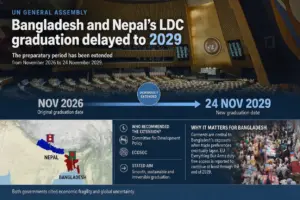
Bangladesh and Nepal will keep their least developed country (LDC) status until November 2029 after the UN general assembly agreed to delay their graduation by three years.
Member states adopted the decision without opposition during the assembly’s 81st session in New York. It shifts the exit date from 24 November 2026 to 24 November 2029. Both governments had asked separately for more time.
Uruguay introduced resolution 81/L.8 on behalf of the Group of 77 and China, a bloc of developing nations. France, Canada and the European Union also voiced support. The move followed recommendations from the UN Committee for Development Policy (CDP) and the Economic and Social Council (Ecosoc), which both backed extra preparation time.
Both countries have met the UN’s graduation criteria. Their governments argued, however, that crossing the eligibility thresholds does not prove readiness to absorb the economic consequences of leaving the category. They cited global economic uncertainty, geopolitical conflict, climate disruption and domestic challenges that could complicate the shift to developing-country status.
Bangladesh pointed to macroeconomic instability, weaknesses in its banking and industrial sectors, energy supply disruptions and unpredictable global trade. Nepal stressed the need to strengthen productive capacity, diversify exports and improve competitiveness. It also highlighted climate-related disasters, political transitions and disruption to trade and tourism, and asked development and trading partners for predictable climate finance and concessional lending.
The CDP recommended that the extension carry conditions: concrete reforms and time-bound plans. The conditions mean both capitals must turn promises into schedules. The extra years aim to let each government tackle its structural weaknesses before completing the transition.
Leaving the LDC category can cost a country access to international trade preferences, concessional financing and development assistance. Bangladesh, on the UN’s LDC list since 1975, enjoys duty-free, quota-free access to several export markets, including the EU.
Its readymade garment industry, a major source of export earnings, could face stiffer competition if preferential access ends after graduation. The pharmaceutical sector could also struggle as certain intellectual property flexibilities available to LDCs phase out. The delay gives businesses and policymakers more time to negotiate trade arrangements, raise productivity and prepare for changes in market access.
For Nepal, the extra three years should give more room to build economic resilience and shield sectors that depend on LDC-specific support.
Both governments insist the extension does not signal a retreat from graduation. They describe it as a chance to make sure the transition does not reverse hard-won development gains. Under the revised timetable, both countries leave the LDC category on 24 November 2029.